
Pip and Lot Size Mistakes New Forex Traders Make
Seven pip and lot size mistakes shown as wrong vs corrected calculations: $10 pip myth, one lot for all pairs, pipettes, yen decimals, margin sizing, rounding.
Pip and lot size mistakes lead to positions far larger or smaller than intended: assuming every pip is worth $10, using one lot size on every pair, confusing pips with pipettes, sizing by margin and forgetting the account currency. Each is easiest to see by putting the wrong calculation next to the corrected one.
How to read the corrections
Every section below shows a calculation as a new trader might do it, the corrected version and what the error does to the risk actually taken. All prices and account sizes are illustrative, and pip values assume standard lots of 100,000 units. The aim is not to memorize the numbers but to recognize the pattern of each mistake so it can be caught before an order is placed. See how to calculate pip value on any currency pair.
Mistake 1: «Every pip is worth $10 a lot»
| Calculation | Risk on a 50-pip stop | |
|---|---|---|
| Wrong, USD/JPY 0.5 lot | 50 × $5 per pip | $250 |
| Corrected | Pip = ¥500, about $3.33 at 150 yen per dollar | About $167 |
| Wrong, EUR/GBP 0.5 lot | 50 × $5 per pip | $250 |
| Corrected | Pip = £5, about $6.35 at GBP/USD 1.27 | About $318 |
What the error does: the $10 rule holds only when the quote currency is the account currency, such as EUR/USD for a dollar account. On USD/JPY it overstates risk by about half; on EUR/GBP it understates it by about a quarter. The second case is the dangerous one, because the trader takes more risk than planned without knowing it.
Mistake 2: One lot size for every pair
| Position | Stop | Risk | |
|---|---|---|---|
| EUR/USD | 0.5 lot | 30 pips at $5 a pip | $150 |
| GBP/JPY | 0.5 lot | 90 pips at about $3.33 a pip | About $300 |
What the error does: the same 0.5 lot carries twice the risk on GBP/JPY, because its wider typical moves need a wider stop. Using a fixed lot size across pairs quietly gives the most volatile pairs the biggest weight in the account. The correction is to size every trade from the risk amount: risk ÷ (stop in pips × pip value). See how to calculate forex position size.
Mistake 3: Reading pipettes as pips
A quote moves from 1.10000 to 1.10150. Read correctly, that is 15 pips, because the fifth decimal is a pipette, a tenth of a pip. Read as 150 pips, the move looks ten times larger than it is.
What the error does: the bigger problem comes when placing orders. A trader who intends a 20-pip stop but counts in pipettes places it at 1.10020 instead of 1.10200, just 2 pips from entry, and is stopped out by normal noise within seconds. Checking how many decimals the platform shows, and whether the last one is a pipette, prevents both mistakes. See what a pip is.
Mistake 4: The yen decimal
On yen pairs, a pip is 0.01, not 0.0001. A trader who wants a 40-pip stop on USD/JPY at 150.00 should place it at 149.60. Treating a yen pip like a dollar pip puts the stop at 149.996, effectively at the entry price.
What the error does: stops end up a hundred times too tight, or, in the reverse mistake, a hundred times too wide. Either way, the planned risk bears no relation to the real one.
Mistake 5: Sizing by available margin
| Calculation | Result | |
|---|---|---|
| Wrong | $5,000 account at 30:1 can open about 1.36 lots of EUR/USD | 40-pip stop risks about $545, nearly 11% of the account |
| Corrected | Risk 1% = $50; size = $50 ÷ (40 × $10) | 0.125 lots, about 0.12 after rounding down |
What the error does: margin shows the largest position the broker allows, not the loss the account can absorb. Sizing by margin turns an ordinary losing trade into a serious drawdown. See how lot size changes your risk per pip.
Mistake 6: Forgetting the account currency
A trader with a €10,000 account risks 1%, €100, on a EUR/USD trade with a 40-pip stop.
| Calculation | Size | |
|---|---|---|
| Wrong | €100 ÷ (40 × €10) | 0.25 lots |
| Corrected | Pip = $10, about €9.09 at 1.1000; €100 ÷ (40 × €9.09) | About 0.275 lots |
What the error does: here the mistake makes the position about 9% too small, which is harmless. On other pairs and exchange rates, the same mistake can make it too large. Converting the pip value into the account currency every time removes the guesswork.
Mistake 7: Rounding up
A calculation gives 0.37 lots; the trader rounds to 0.4 because it is a neater number. The risk rises by about 8% on that trade. Done once, it hardly matters; done on every trade, it adds up, and rounding up after a losing streak is often how position sizes creep higher. The correction is simple: always round down to the broker’s next allowed step.
The corrections in one table
| Mistake | Typical effect | Correction |
|---|---|---|
| Every pip is $10 | Risk off by 25% to 50% either way | Calculate pip value per pair |
| Same lot on every pair | Volatile pairs carry double risk | Size from the risk amount |
| Pipettes read as pips | Moves and stops misjudged tenfold | Check decimal places |
| Yen decimal | Stops a hundred times off | Use 0.01 for yen pairs |
| Sizing by margin | Ordinary loss becomes a drawdown | Start from the loss you accept |
| Account currency ignored | Size several percent off | Convert pip value |
| Rounding up | Risk creeps higher | Always round down |
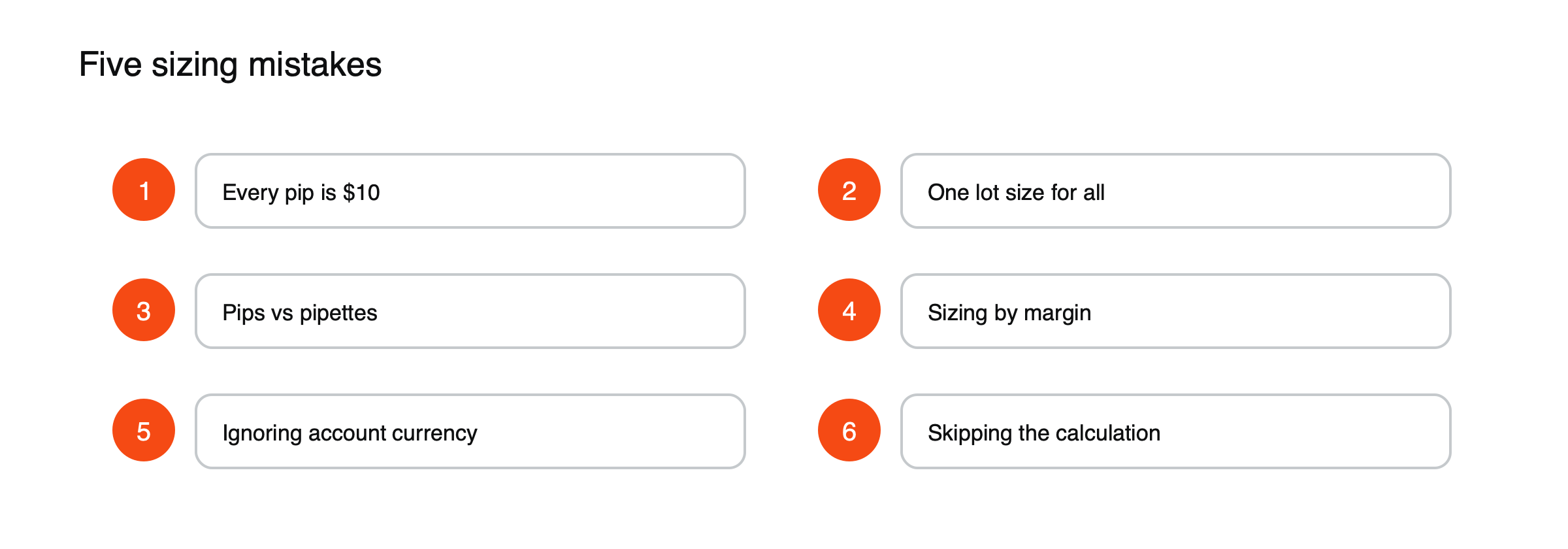
Figure: Five pip and lot size mistakes.
A two-minute check before every order
Write the stop distance in pips and check it against the price on the chart. Look up the pip value for the pair in your account currency. Divide the risk amount by stop times pip value, round down, and compare the result with the size you were about to enter. If the two differ, trust the calculation. See how the forex market works.
Why these mistakes survive
Trading platforms show position size in lots and margin in money, but rarely show the loss a stop would cause before an order is placed. That makes it easy to think in lots rather than in risk. Sizing habits formed on one pair, often EUR/USD, are then carried to others where the numbers no longer hold. Most of the mistakes above are not about arithmetic ability; they come from skipping the calculation because it feels familiar.
Using calculators safely
Position-size calculators remove most arithmetic errors, but only if the inputs are right. The common slips are entering the stop in pipettes instead of pips, choosing the wrong account currency and using an old exchange rate for the conversion. A quick check, multiplying the calculator’s suggested size by the stop and the pip value to see whether the result matches your risk amount, takes seconds and catches most input errors.
A practice drill
Work through five calculations on paper before your next session: EUR/USD, USD/JPY, EUR/GBP, a yen cross and a pair quoted in your own account currency, each with a different stop. Then check each answer with a calculator. Repeating the drill weekly for a month builds the habit of thinking in risk rather than in lots, which is the real fix behind every mistake in this article.
When the numbers look wrong
A quick sanity check catches most errors. If the money at risk on a trade is far from the amount you intended, such as $400 when you meant to risk $100, something in the calculation is off: the pip size, the pip value or the account currency. If a stop placed on the chart looks much closer or further than the pips you calculated, the decimal places are probably the problem. Stopping to recheck whenever a number surprises you is the single habit that matters most.
Leverage, margin and cost figures in this article are example values for illustration. Actual terms depend on the provider, the instrument and the rules in your country.
This article is educational content and does not constitute financial, investment, legal or tax advice. Digital assets are volatile and you may lose the amount you invest.