
Risk-On vs Risk-Off: How Currencies React
In risk-on markets, higher-yielding and commodity currencies tend to gain; in risk-off, the dollar, yen and franc tend to rise. How currencies sort into each.
Risk-on vs risk-off describes the market’s mood. In risk-on periods, investors buy stocks and higher-yielding assets, and currencies such as the Australian dollar, New Zealand dollar and many emerging-market currencies tend to gain. In risk-off periods, investors cut risk and the US dollar, yen and Swiss franc tend to strengthen. Yen crosses such as AUD/JPY often swing the most.
Side by side
| Risk-on | Risk-off | |
|---|---|---|
| Mood | Confidence, growth optimism | Fear, uncertainty |
| Stocks | Rising | Falling |
| Currencies that tend to gain | AUD, NZD, CAD, emerging markets | USD, JPY, CHF |
| Currencies that tend to fall | JPY, CHF, sometimes USD | AUD, NZD, emerging markets |
| Typical pair to watch | AUD/JPY rising | AUD/JPY falling |
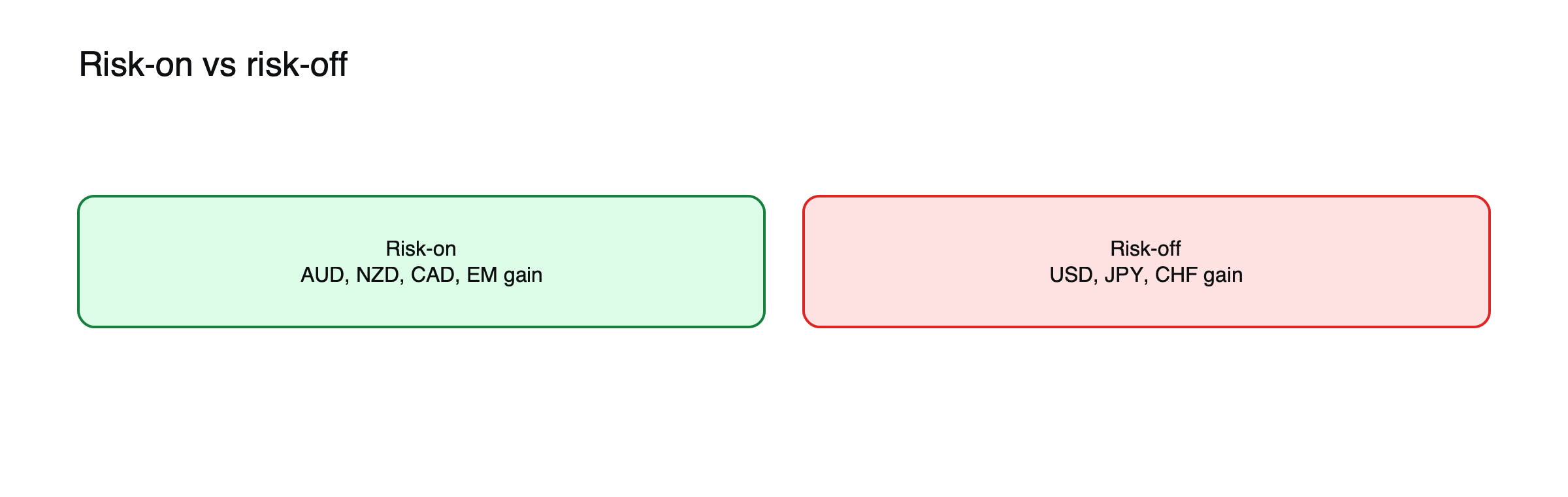
Figure: Which currencies tend to gain in each mood.
Why currencies sort this way
Risk currencies come from economies tied to global growth and commodities, or offer higher interest rates that attract money when investors feel safe.
Haven currencies come from countries with large foreign assets or deep, liquid markets. When risk falls, money flows back to them. See what a safe-haven currency is.
How to read the market’s mood
No single number defines risk-on or risk-off, so traders watch several signals together:
- Stock indices: broad rallies point to risk-on; sharp falls to risk-off.
- The VIX: a jump in this measure of expected US stock volatility signals fear.
- AUD/JPY and other risk crosses: falling when investors retreat.
- Credit spreads: the extra yield on riskier corporate bonds widens in risk-off periods.
- Government bond yields: often fall in risk-off as investors buy safe bonds.
- Gold: frequently rises when fear increases.
When most of these point the same way, the mood is clear; when they disagree, markets are usually in transition.
A risk-off day, illustrated
Suppose a surprise geopolitical event hits markets on a Monday. (Illustrative moves.) Global stocks fall about 2%, the VIX jumps several points, US Treasury yields drop as investors buy bonds, the yen and Swiss franc rise about 1%, AUD/USD falls about 1% and AUD/JPY close to 2%, and emerging market currencies slide. Currency moves of this size in a single session can wipe out weeks of gains on positions that were all quietly betting on calm, which is why the overall exposure of a portfolio to risk mood matters.
A clear example
On August 5, 2024, as a yen-funded carry trade unwound, the yen surged, Japan’s Nikkei fell 12.4% and risk assets worldwide dropped. See what happened in the August 2024 yen carry trade unwind.
What switches the mood
Risk-on periods are usually supported by steady growth, falling inflation, central banks expected to cut rates and calm politics. Risk-off episodes are often triggered by surprises: a weak data release that raises recession fears, a sharp rise in bond yields, a banking scare, a geopolitical shock or the unwinding of a crowded trade. The switch can be sudden, and the move in risk currencies is often larger on the way down than on the way up.
When correlations jump
In calm markets, currencies, stocks and commodities move for many different reasons. In a risk-off episode, those differences fade and many assets start moving together: risk currencies, stocks and commodities fall, havens rise. Positions that looked diversified, such as long AUD/USD, long an emerging market currency and long a stock index CFD, can turn out to be the same bet on market mood. See currency correlation.
When the labels do not hold
When the shock comes from the US itself, the dollar may fall in a risk-off move, as during the April 2025 tariff sell-off. Labels describe tendencies, not rules.
See how emerging market currencies behave when risk appetite falls and what moves currency prices.
Trading with the mood in mind
Traders use the risk backdrop in three ways. First, as context: a long position in a risk currency carries extra danger when the mood is fragile, so sizes may be smaller. Second, as a hedge: a small position in a haven can offset part of the losses on risk-sensitive trades. Third, as a signal: a sustained rise in AUD/JPY or in emerging market currencies alongside stocks can confirm that risk appetite is improving. None of these turns mood into a forecast, but they help avoid accidentally stacking many bets on calm.
Emerging market currencies
Emerging market currencies are among the most sensitive to shifts in mood. Higher interest rates attract money in risk-on periods, but when fear rises, foreign investors pull out quickly and liquidity can vanish. Countries with large current account deficits or heavy dollar debts tend to suffer most. See how emerging market currencies behave when risk appetite falls.
Risk-off episodes in brief
| Episode | What happened in currencies |
|---|---|
| 2008 financial crisis | The yen and dollar surged; high-yielding and emerging market currencies fell hard as carry trades unwound |
| March 2020 pandemic crash | A scramble for dollars lifted the US currency against almost everything |
| August 2024 carry unwind | The yen jumped as yen-funded positions were closed |
| April 2025 tariff sell-off | The dollar fell while the yen, Swiss franc and gold gained |
Each episode followed the broad risk-off pattern, but the details, especially the dollar’s behavior, depended on where the shock began.
Carry trades and mood
Risk-on periods and carry trades reinforce each other: calm markets encourage borrowing in low-yielding currencies to buy higher-yielding ones, which lifts risk currencies further. When the mood turns, those positions are closed together, magnifying the risk-off move. Knowing how crowded carry positions are helps judge how violent a shift in mood might be. See what the carry trade is.
Mood and your own positions
A useful exercise is to sort every open position by how it would react to a sudden risk-off move: gain, lose or roughly neutral. Many traders discover that most of their positions sit in the same column, typically long risk currencies, long stock indices and short havens. That concentration is invisible in calm markets and painful when the mood turns. Rebalancing toward a mix, or reducing size, makes the account less dependent on a single assumption about the market’s mood.
A quick mood checklist
- Are stocks rising or falling across regions?
- Is the VIX calm or jumping?
- Is AUD/JPY rising or falling?
- Are credit spreads widening?
- Are the yen, franc and gold in demand?
- Are emerging market currencies holding up or sliding?
- Are government bond yields falling as investors buy safety?
Three or more answers pointing toward fear usually mean that the market has clearly moved into a risk-off phase.
Common misreadings
- Treating one day of falling stocks as a lasting change in mood.
- Assuming every currency fits neatly into the risk or haven group.
- Forgetting that interest rate news can override mood for individual currencies.
Frequently asked questions
Is the US dollar always a risk-off currency?
Usually, because it is the world’s main funding and reserve currency. But when the shock comes from the United States itself, as in April 2025, the dollar can fall while other havens rise.
How quickly can the mood change?
Very quickly. A single surprising data release or headline can turn a calm week into a sharp risk-off move within hours, and the recovery can be just as abrupt.
This article is educational content and does not constitute financial, investment, legal or tax advice. Digital assets are volatile and you may lose the amount you invest.