
What Moves Currency Prices?
Interest rates, inflation, growth data, central bank policy, risk sentiment and capital flows drive currencies. How each works and how traders weigh them.
What moves currency prices most is the expected path of interest rates, because money flows toward higher or rising returns. Inflation, jobs and growth data move currencies by changing those expectations, alongside central bank decisions, risk sentiment and capital flows. In a panic, demand for the dollar, yen or franc can dominate.
A currency is the price of money
An exchange rate is the price of one currency in terms of another, and like any price it moves with supply and demand. Demand for a currency comes from investors who want to buy that country’s bonds, shares or property, from companies paying for its exports and from people and institutions seeking safety. Supply comes from those moving money out. Most of the forces below matter because they change how attractive it is to hold a currency, and therefore how many people want to buy or sell it at the current price.
Rates, inflation and data
Interest rate differentials. The gap between two countries’ rates, and where markets think it is heading. See how interest rate differentials drive currency pairs.
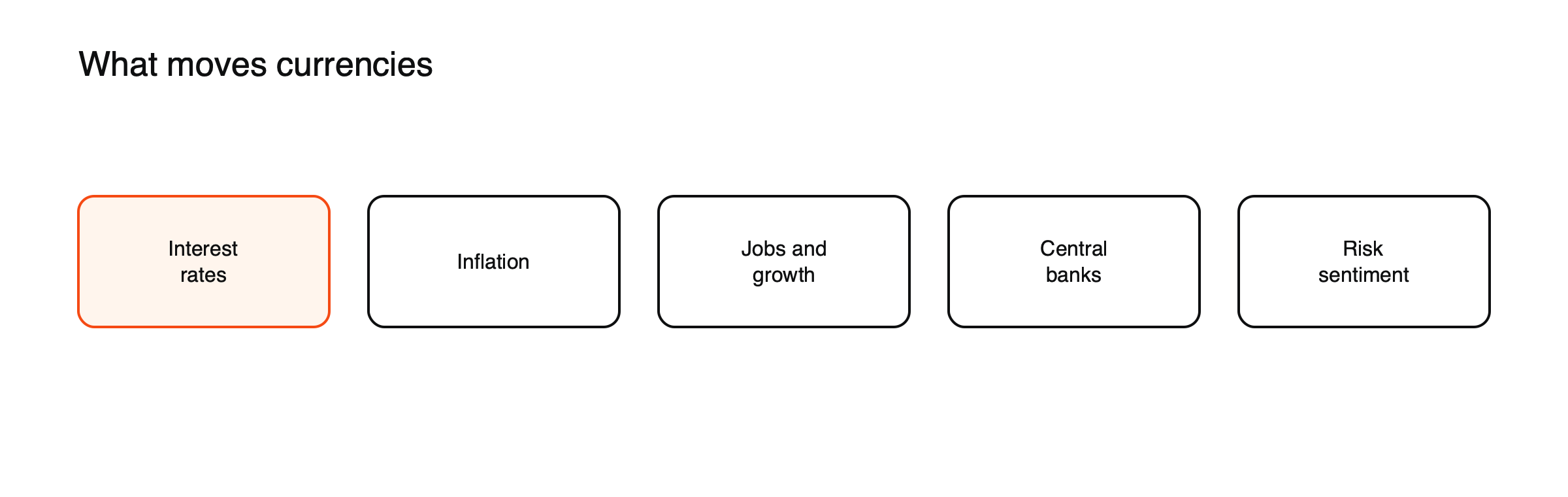
Figure: The main drivers, with rates at the center.
Inflation. Higher-than-expected inflation can raise expected rates and lift a currency, unless it signals lost control. See how inflation data moves currencies.
Employment and growth. Strong data supports higher rates. See how nonfarm payrolls moves the dollar.
Interest rates, in more depth
Suppose deposits and short-term bonds pay 5% in US dollars and close to 0% in Japanese yen. (Illustrative rates.) Investors are paid to hold dollars rather than yen, so demand for dollars tends to rise and the dollar tends to strengthen against the yen. What moves the price day to day, though, is not the current gap but changes in what markets expect it to be. If traders expect the Federal Reserve to cut rates by a quarter of a percentage point and it cuts by half a point instead, the expected return on dollars falls further than priced in, and the dollar usually weakens on the news. Markets read these expectations from interest rate futures and short-term bond yields, which move before and after every central bank meeting. See how interest rate differentials drive currency pairs.
A data surprise, worked through
Economists expect a US jobs report to show 180,000 new jobs, and markets have priced in rate expectations accordingly. The report shows 300,000. (Illustrative figures.) Traders conclude the economy is stronger than thought, so rate cuts look less likely; short-term Treasury yields rise within seconds, and the dollar climbs against most currencies. Had the report matched the forecast, the dollar might barely have moved, even though 180,000 jobs is a solid number. The surprise, not the number itself, moves the price.
Inflation: good news or bad?
Higher inflation can push a currency either way. If markets trust the central bank to respond with higher rates, an inflation surprise tends to lift the currency, because it raises expected returns. If markets doubt the central bank will act, or fear that inflation is getting out of control, the same surprise can weaken it, because inflation erodes what the currency will buy over time. The reaction to inflation data therefore says a lot about how credible markets think a central bank is. See how inflation data moves currencies.
Growth and relative performance
Currencies are always priced against each other, so what matters is how one economy is doing compared with another. Stronger growth tends to attract investment and supports expectations of higher rates, while weaker growth does the reverse. A country can have solid growth and still see its currency fall if its main trading partners are doing even better.
Policy, sentiment and flows
Central bank decisions and language. See how central bank decisions move currencies.
Risk sentiment. In stress, investors buy the dollar and often the yen and franc; in calm markets, higher-yielding currencies tend to gain. See why the yen rallies when global markets sell off.
Trade and capital flows. Commodity exports support currencies such as the Australian dollar; investment flows move currencies over longer periods.
Commodities and terms of trade
Countries that export a lot of one commodity often see their currencies move with its price. The Australian dollar tends to track iron ore and other metals, the Canadian dollar and Norwegian krone often follow oil, and the New Zealand dollar responds to dairy and agricultural prices. Rising export prices mean more foreign buyers need the currency to pay for those goods. See how oil prices affect USD/CAD and what moves AUD/USD.
Politics and government finances
Elections, referendums and budgets can move currencies sharply when they change the outlook for growth, inflation or government borrowing. Policies that markets see as unaffordable can push a currency down quickly, as investors demand more compensation for holding that country’s debt. Political uncertainty without a clear outcome tends to weigh on a currency until it is resolved.
Intervention and pegs
Some central banks act directly in the currency market, buying or selling their own currency to slow or reverse a move, and some maintain pegs or bands. Intervention can cause sharp short-term moves, but it rarely reverses a trend driven by rate differentials unless policy changes too. When a peg or floor is abandoned, the adjustment can be sudden, as the Swiss franc showed in 2015. See what currency intervention is and the Swiss franc floor removal.
Trade, investment and hedging flows
Persistent trade deficits mean a country is selling more of its currency to pay for imports, while surpluses mean foreign buyers need it. Large investment flows, such as pension funds buying foreign assets or companies paying for acquisitions, can move currencies for weeks. Hedging matters too: when foreign investors hedge their currency exposure more or less, they buy or sell currencies in large volumes regardless of the economic outlook.
Short term vs long term
In the short run, data surprises and rate expectations dominate. Over years, inflation differences and productivity matter more. See what purchasing power parity is.
What matters on which timeframe
| Timeframe | Main drivers |
|---|---|
| Minutes to hours | Data surprises, central bank announcements, headlines |
| Days to weeks | Shifts in interest rate expectations, risk sentiment, positioning |
| Months | Rate differentials, growth gaps, commodity prices, capital flows |
| Years | Inflation differences, productivity, trade balances, government finances |
Traders and long-term investors can look at the same currency and see different stories, because they are watching different rows of this table.
Why surprises matter more than levels
Markets price expected outcomes in advance; currencies move when results differ from forecasts.
Example
In 2022, the Fed’s rapid rate hikes and safe-haven demand pushed the dollar index to a 20-year high near 114 in September. See how a strong dollar hits commodities, emerging markets and crypto. For the basics, read how the forex market works.
The drivers working together: the dollar in 2022
The dollar’s rise in 2022 shows several drivers lining up. The Federal Reserve raised rates rapidly to fight high inflation, widening the gap with rates in Europe and Japan. Energy prices surged after Russia’s invasion of Ukraine, hurting energy-importing economies more than the United States. And as stock and bond markets fell, investors sought the safety of dollars. Together these pushed the dollar index to a 20-year high near 114 in September. As inflation and rate expectations later eased, the same drivers worked in reverse. See what the US dollar index is.
Positioning: when everyone is on one side
Currencies can also move because of how traders are already positioned. When many speculators hold the same bet, such as being long the dollar, there are fewer new buyers left and many potential sellers. A modest piece of contrary news can then trigger a sharp reversal as positions are closed. Traders watch published positioning data, such as weekly reports on futures positions, and signs like extreme funding in carry trades to judge when a move has become crowded.
Why currencies sometimes ignore the news
At times a currency barely reacts to data that would normally move it. The news may already have been expected, other drivers may dominate, or markets may be waiting for a larger event, such as a central bank meeting later in the week. A lack of reaction is itself information: it often shows which driver traders currently care about most.
Safe havens in a crisis
When markets panic, investors usually buy the US dollar, which is needed to settle debts and trades worldwide, and often the Japanese yen and Swiss franc. The yen’s role was visible in August 2024, when the unwinding of trades that had borrowed cheaply in yen pushed it sharply higher in a short period. See the 2024 yen carry trade unwind and what a safe-haven currency is.
Using these drivers as a trader
Knowing what moves a currency helps in three practical ways. It shows which events to watch on the calendar for each pair, so positions are not left open into a central bank decision by accident. It explains why a pair moved, which helps separate a lasting change from noise. And it warns when drivers conflict, for example when rates favor one currency while risk sentiment favors the other, which often leads to choppy, unpredictable trading. None of this predicts the next move with certainty, but it narrows down what to pay attention to. A practical habit is to write, for each pair you trade, the two or three drivers that matter most right now and the next dates when they will be tested, such as a central bank meeting or an inflation release. Reviewing that short note once each week keeps attention on what actually moves the pair, rather than on the loudest single headline of the day. See how to use an economic calendar.
Frequently asked questions
Which single factor matters most?
For major currencies, expectations about interest rates usually dominate in the short to medium term. In a crisis, safe-haven demand can override them.
Why does a currency sometimes fall after good data?
Because the data may have been less good than expected, or already priced in, or because other news, such as a change in risk sentiment, outweighed it.
Do long-term fundamentals ever matter?
Yes, but slowly. Inflation differences and productivity shape exchange rates over years, while daily and weekly moves are dominated by expectations and flows.
This article is educational content and does not constitute financial, investment, legal or tax advice. Digital assets are volatile and you may lose the amount you invest.
Sources
- The Dollar Index (DXY near 114 in September 2022; Fed rate path as the largest driver) — BIT Knowledge Hub
- Carry trade unwind (rate differentials and safe-haven flows; yen +14%) — Schwab via Advisor Perspectives
- Is Bitcoin showing greater sensitivity to US CPI releases again? (surprise vs expectation drives reactions) — Block Scholes