
What Usually Happens to Gold When the Fed Starts Cutting Rates?
Gold often benefits when Fed policy shifts toward easing, but timing varies. See how real yields, the dollar, recession risk and liquidity shape the move.
On gold and Fed rate cuts, the record is mixed: gold has often done well after the Fed turns toward easier policy, but the first cut is not a mechanical buy signal. The path depends on why the Fed is cutting, real yields, the dollar and whether the slowdown is soft or severe.
The biggest driver is the opportunity cost of holding gold
Gold does not pay interest. That makes the return available on cash and bonds an important competitor.
When expected policy rates fall, Treasury yields can fall with them. If inflation expectations do not fall by the same amount, real yields decline. That reduces the opportunity cost of holding an asset with no coupon, which can support gold.
The relationship is not one-for-one. Bond yields move on growth and inflation expectations as well as Federal Reserve policy. A rate cut can arrive while long-term yields are rising if markets fear persistent inflation or heavy government borrowing.
For traders, the useful variable is therefore not simply “Fed cut: yes or no.” Watch the direction of real yields and the yield curve around the policy shift.
The dollar can reinforce or offset the rate effect
Gold is commonly quoted in US dollars. A softer dollar tends to reduce the price of gold for buyers using other currencies, while a stronger dollar can act as a headwind.
A Fed easing cycle can weaken the dollar if US interest-rate advantages narrow relative to other economies. But a recession or financial crisis can create strong demand for dollars at the same time the Fed is cutting. That is one reason gold can behave strangely in the first phase of a crisis.
During the 2008 financial crisis, gold was sold during parts of the liquidity squeeze as investors raised cash. It later recovered as policy eased and the crisis changed expectations around rates, currencies and financial stability.
The reason for the cut matters more than the ceremony of the cut
There are two very different stories behind a lower policy rate.
Preventive easing happens when inflation is cooling and the Fed wants to keep a slowdown from becoming a recession. Financial conditions can improve without a deep collapse in earnings. In that setting, lower real yields and a softer dollar can help gold, but risk assets may also perform well.
Crisis easing happens because credit markets, employment or financial stability are deteriorating quickly. Gold can eventually benefit from safe-haven demand and aggressive policy easing, yet the first reaction can include forced selling and a rush into cash.
This distinction explains why historical averages around the first cut can look cleaner than the actual path an investor experiences.
Two past easing cycles show why timing varies
World Gold Council research on previous US policy transitions found no clean immediate response in every cycle. In the 1999–2001 episode, gold was lower one and three months after the transition from tightening, then positive over the following 12 months. In the 2004–2007 cycle, gold was already higher one month after the shift and gained further over the next year.
Those cycles were not identical. The 2001 period followed the bursting of the technology bubble. The 2007 turn moved into a banking and credit crisis. The common point is that the direction of policy was only one input. Dollar behavior, risk demand and the severity of the slowdown changed the route.
Ranked: the signals that matter most after the Fed starts cutting
1. Real yields
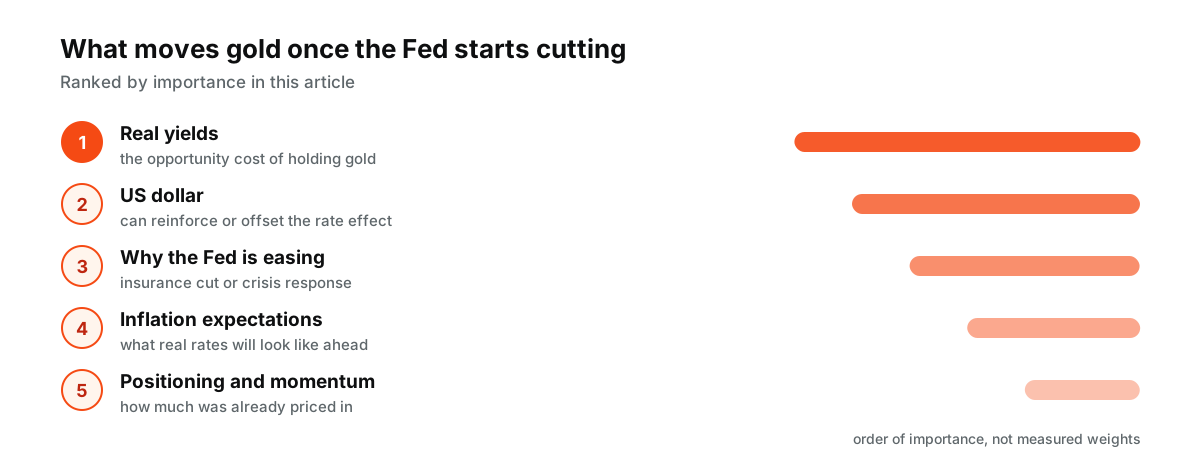
Figure: The article’s ranking of what matters for gold once cuts begin. Bars show order of importance, not measured weights.
Falling real yields are usually the cleanest macro support for gold because they reduce the return available on inflation-adjusted government bonds.
2. The US dollar
A weaker dollar can amplify the effect of lower yields. A crisis-driven dollar rally can delay it.
3. The reason the Fed is easing
A soft landing, recession and financial accident create very different demand for safe assets and liquidity.
4. Inflation expectations
Cuts accompanied by falling inflation may not push real yields down much. Cuts combined with persistent inflation can be more supportive for gold if nominal yields fall faster than inflation expectations.
5. Positioning and momentum
Gold can enter an easing cycle already heavily owned. In that case, good macro conditions may be partly reflected in the price before the first cut arrives.
What to watch instead of counting rate cuts
The Federal Funds Effective Rate tells you what policy has done. Markets trade what policy is expected to do next.
A practical watchlist is shorter:
- US real Treasury yields
- the broad direction of the US dollar
- inflation expectations
- credit spreads and financial stress
- whether incoming labor data point to cooling or contraction
- gold ETF flows and futures positioning when available
A first cut can matter because it confirms a regime change. It does not tell you the whole regime.
The useful takeaway
Historically, gold has often benefited as monetary policy moves from restraint toward easing, especially when real yields fall and the dollar weakens. The path can be delayed or interrupted when cuts arrive during a liquidity shock. Treat the first Fed cut as a change in the macro setup, not as a standalone forecast for the gold price.
Trading gold around Fed decisions
Gold often moves sharply around Federal Reserve announcements, especially when the decision or guidance surprises markets. Many gold CFD traders reduce size before the announcement and watch real yields and the dollar in the minutes afterwards, since those usually explain gold’s reaction. See what moves gold prices, how gold relates to real yields and how commodity CFDs work.
Gold in other currencies
For investors outside the United States, gold’s response to Fed cuts also depends on their own currency. If the dollar weakens as the Fed eases, gold priced in euros or yen may rise less than gold priced in dollars. Checking gold’s price in your own currency gives the more relevant picture.
Frequently asked questions
Does gold always rise when the Fed cuts rates?
No. Gold has often benefited from easing cycles, but its path depends on real yields, the dollar and why the Fed is cutting.
Why can gold fall in a crisis even as rates are cut?
Because investors sometimes sell gold to raise cash in the most acute phase of a crisis, before policy support takes effect.
This article is educational content and does not constitute financial, investment, legal or tax advice. Digital assets are volatile and you may lose the amount you invest.