
When Oil Prices Become a Problem for the Whole Economy
Oil shocks become macro problems when they hit inflation, household spending and business costs at once. The cause, speed and duration of the move matter most.
An oil price shock becomes a broad economic problem when the increase is large, fast and persistent enough to squeeze household spending, raise business costs and complicate central-bank policy at the same time. The cause matters too. A demand-driven rise can reflect a strong economy; a supply shock can raise inflation while weakening growth.
The first channel is simple: households have less money left over
A jump in crude oil prices feeds into gasoline, diesel, heating and transport costs with varying lags. Energy is difficult to avoid in the short run, so households often have to spend more on it before they can adjust how much they drive, heat or consume.
That leaves less disposable income for restaurants, travel, furniture, entertainment and other discretionary purchases.
The hit is not evenly distributed. Lower-income households tend to spend a larger share of income on energy and other necessities. Countries that import most of their energy also feel the terms-of-trade hit more directly than major oil exporters.
The second channel is business costs
Oil is not just a consumer product. It is an input into freight, aviation, chemicals, plastics, agriculture and industrial supply chains.
A trucking company sees fuel expense directly. A manufacturer may see it through transport and petrochemical inputs. An airline can face a sharp change in jet-fuel costs. Businesses then decide how much of the increase they can absorb in margins and how much they can pass to customers.
The more industries pass costs through, the more an oil shock broadens from energy inflation into the rest of the price system.
The third channel is the one central banks dislike most
A supply-driven oil shock can create a policy conflict: inflation rises while real economic activity weakens.
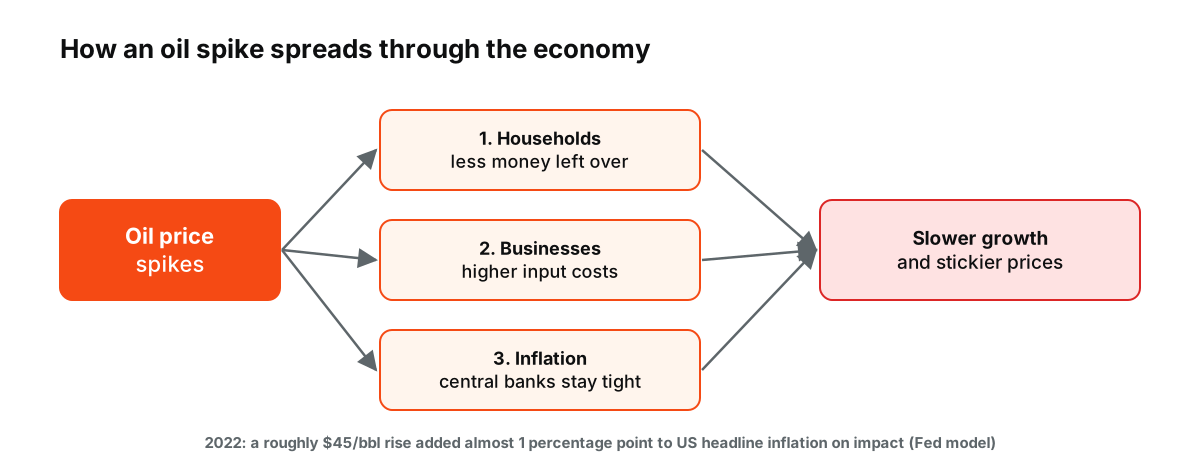
Figure: The three channels in this article. 2022 estimate from Federal Reserve modeling published in 2024.
The Federal Reserve’s 2024 modeling of the oil shock around Russia’s invasion of Ukraine estimated that oil supply shocks large enough to reproduce the roughly $45-per-barrel rise seen in the first half of 2022 added almost one percentage point to US headline inflation on impact. In that model, the effects on core inflation and output were much smaller.
That distinction matters. A central bank may be willing to “look through” a temporary energy spike if inflation expectations remain anchored. It becomes harder when higher energy costs spill into wages, services and broader pricing behavior.
Ranked: what turns an oil move into a macro shock
1. Supply disruption rather than strong demand
Oil rising because global activity is booming is different from oil rising because barrels have disappeared from the market. The second case is closer to a pure loss of real purchasing power.
2. Speed
A gradual increase gives households and businesses time to adapt. A sudden jump creates a larger immediate squeeze and can force rapid changes in spending and inventories.
3. Duration
A one-week geopolitical spike can reverse before it reaches the wider economy. Several quarters of high prices can change wage demands, contracts, investment plans and inflation expectations.
4. Starting inflation
An energy shock is more dangerous when underlying inflation is already high. Firms and workers may be more willing to pass costs through because price changes are already common.
5. Energy intensity and import dependence
Economies that use more oil per unit of output, or import a larger share of their energy, are more exposed.
The 1970s made oil shocks synonymous with stagflation
The oil shocks of the 1970s arrived in an economy where inflation expectations and wage-price dynamics were much less anchored than they are in many modern advanced economies. In a 2006 speech reviewing energy and the economy, Federal Reserve Chair Ben Bernanke noted that first- and second-round inflation effects were large during the 1970s and early 1980s, and that the policy response contributed to sharp slowdowns and higher unemployment.
That history still influences how markets react to oil spikes today. But copying the 1970s template onto every energy move is a mistake. Energy efficiency has changed, monetary frameworks have changed and the source of each shock differs.
The 2022 shock was large, but the transmission was narrower
Russia’s invasion of Ukraine in February 2022 intensified stress in global energy markets. Oil prices rose sharply, adding to headline inflation that was already elevated after the pandemic.
The Federal Reserve analysis cited above found a clear headline inflation effect from the oil shock but a much smaller effect on core inflation and output in its model. That does not make the shock harmless. It shows why economists separate the direct energy effect from the broader second-round process.
What to watch when oil starts moving quickly
Oil itself is only the first screen. The macro story becomes clearer if you also watch:
- gasoline and diesel prices;
- inflation expectations;
- core inflation measures;
- consumer spending, especially discretionary categories;
- corporate margins in transport and energy-intensive industries;
- wage growth;
- credit spreads;
- whether the move comes from demand, supply or both.
A rising oil price is not automatically recessionary. A fast supply-driven surge that persists while inflation is already high is the combination that deserves the most attention.
The 2026 shock
Military action in the Middle East on February 28, 2026, and the de facto closure of the Strait of Hormuz sent crude and fuel prices sharply higher in the first quarter of the year. Brent rose from about $72 to about $120 before falling back to around $72 by early July, as transit through the strait resumed and producers raised output. The episode showed how quickly a supply shock can lift prices, and how quickly they can reverse when supply returns, before the full economic effects have time to build. See what moves crude oil prices.
Oil shocks and stock markets
Rising oil prices help energy producers and hurt airlines, transport companies, chemicals makers and consumer businesses. Indices heavy in energy, such as the FTSE 100, can hold up better in an oil shock than technology-heavy indices, which suffer more if higher inflation pushes bond yields up. See how geopolitical risk moves commodities and how commodity CFDs work.
Oil and the dollar
Oil is priced in dollars, so the dollar’s moves change what other countries pay. A strong dollar can deepen an oil shock for importers such as Europe, Japan and many emerging economies, while a weak dollar can soften it. For those countries, the economic impact depends on the exchange rate as much as on the oil price itself. See how the dollar affects commodity prices. Exchange rates can therefore sometimes turn the same oil shock into very different economic outcomes.
Frequently asked questions
Does a rise in oil prices always cause a recession?
No. Rises driven by strong demand often accompany healthy growth. Sharp, persistent supply shocks, especially when inflation is already high, are the ones most associated with slowdowns.
Why do central banks worry about oil shocks?
Because they can raise inflation and weaken growth at the same time, making it harder to choose whether to tighten or ease policy.
This article is educational content and does not constitute financial, investment, legal or tax advice. Digital assets are volatile and you may lose the amount you invest.
Sources
- Oil Price Shocks and Inflation in a DSGE Model of the Global Economy — Federal Reserve Board, August 2024
- Energy and the Economy — Federal Reserve Board, June 2006
- Crude oil and petroleum product prices increased sharply in 1Q26 (after military action in the Middle East on February 28 and the de facto closure of the Strait of Hormuz) — US EIA, April 2026
- OPEC+ decides on additional output increase as transit through the Strait of Hormuz resumes (Brent about $72 on July 3, down from about $120 after the conflict began) — FN News, July 2026