
Small Caps vs Large Caps When Rates Start Falling
Rate cuts can help small caps through financing costs, but recession risk can reverse the trade. Compare balance sheets, earnings and market behavior.
Small caps vs large caps after rate cuts comes down to financing sensitivity. Small companies are more likely to depend on bank credit, floating-rate debt and external financing, so falling rates can relieve pressure faster. Large companies usually have stronger balance sheets. The catch is that rate cuts often arrive because growth is weakening, which can hurt smaller firms more.
The comparison starts with balance sheets, not index labels
| Factor | Small caps | Large caps |
|---|---|---|
| Financing access | Generally more dependent on banks and external credit | Broader access to bond markets and internal cash flow |
| Debt sensitivity | Often more exposed to floating rates and refinancing | More ability to lock in long-term funding |
| Economic sensitivity | Usually higher | Usually lower at the index level |
| Revenue base | More domestic on average | More international exposure on average |
| Profit margins | Often thinner and less stable | Often stronger and more diversified |
| Typical response to easier policy | Can benefit sharply if growth holds up | Benefits too, but financing relief is less dramatic |
These are tendencies, not rules for every company. A profitable small software firm with no debt can be less rate-sensitive than a heavily indebted large company.
Why lower rates can help small companies more
Research on monetary policy has long found that small firms can be more sensitive to credit conditions. Mark Gertler and Simon Gilchrist documented that after periods of monetary tightening, small manufacturing firms saw sales weaken faster than large firms and bank lending to small firms contracted while lending to large firms held up better.
That mechanism works in reverse when financial conditions ease, at least in principle. Lower short-term rates can reduce floating-rate interest expense. Cheaper credit can improve access to working capital. Refinancing becomes less punitive. Equity valuations can also benefit as discount rates decline.
FTSE Russell made the same point around the Federal Reserve’s 2024 easing cycle, noting that small-cap companies tend to have greater exposure to floating-rate debt than large-cap peers.
Large caps have an advantage when cuts signal trouble
Rate cuts are not always a gift. Sometimes they are an emergency response.
If the Fed is cutting because unemployment is rising and demand is deteriorating, the earnings side of the equation becomes more important. Smaller companies tend to have less diversified businesses, thinner margins and less financial flexibility. Lower rates may not compensate for a sharp drop in sales.
Large companies can also have stronger cash positions, longer debt maturities and better access to capital markets. That can make them more resilient when the reason for the cut is a recession rather than a successful disinflation.
This is the situation where the usual “small caps love rate cuts” answer can flip.
A soft landing is the cleaner setup for small-cap outperformance
The most favorable combination for small caps is not simply lower rates. It is lower rates without a collapse in nominal growth.
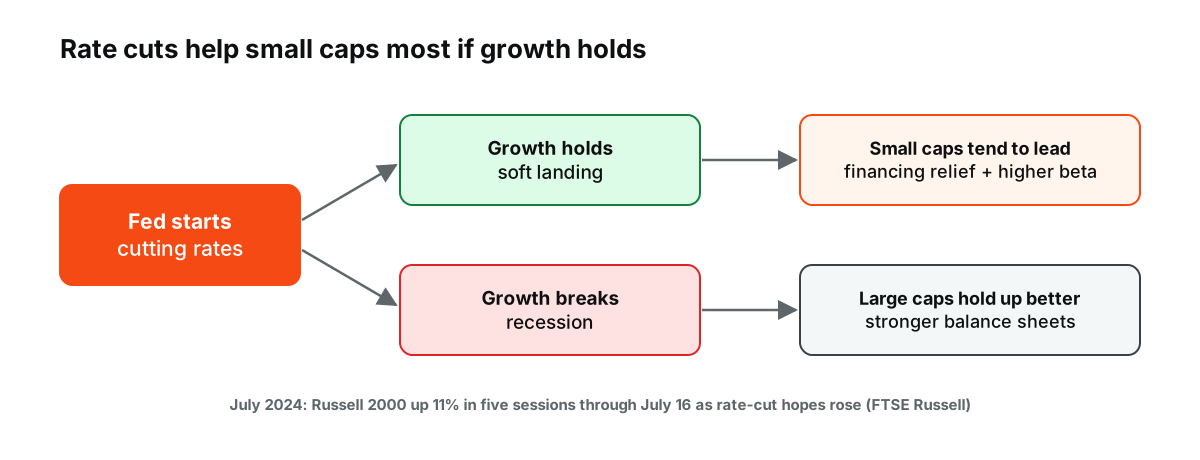
Figure: Why the Fed cuts decides which size of company benefits. July 2024 example from FTSE Russell.
In that setup:
- financing costs ease;
- credit remains available;
- domestic demand stays firm enough to support revenue;
- risk appetite broadens beyond the largest companies;
- investors may become more willing to pay for cyclical earnings recovery.
By contrast, a hard landing can create the opposite sequence: the Fed cuts, but credit spreads widen, banks tighten lending standards and earnings estimates fall faster than interest expense.
The 2024 easing cycle showed the market can move before the cut
In July 2024, the Russell 2000 rallied sharply as investors increased expectations for Federal Reserve easing. FTSE Russell reported an 11% rise over five trading sessions through July 16, while discussion around the move centered on small caps’ sensitivity to future rate cuts.
That episode is a useful reminder that markets price expectations before policy changes are delivered. By the time the first cut arrives, part of the financing story may already be reflected in prices.
The same principle applies in reverse. If investors expect a recession, small caps can underperform even while the market is pricing faster cuts.
What matters more than the number of cuts
A trader comparing small and large caps can track four questions.
Are credit spreads narrowing or widening?
Falling policy rates with wider corporate spreads are less helpful than they look. The all-in cost of capital can stay high even as the Fed cuts.
Are bank lending conditions improving?
Small firms depend more heavily on the banking system. Easier policy only helps if credit is actually available.
Are earnings revisions stabilizing?
A valuation boost from lower rates can be overwhelmed by falling profit forecasts.
Is market breadth improving?
A rally led by a handful of mega-cap companies tells a different story from one in which small and mid-sized stocks begin participating.
Small caps are the higher-beta version of the easing story
When rates fall because inflation is cooling and growth survives, small caps can have more to gain because financing conditions improve from a weaker starting point. When rates fall because the economy is breaking, that same sensitivity can become a liability.
The comparison is therefore less “small caps versus large caps after a cut” and more “which group is better positioned for the reason rates are falling?”
Interest costs, illustrated
Suppose a small company has $500 million of floating-rate debt and operating profit of $60 million. (Illustrative figures.) If short-term rates fall by 1.5 percentage points, its annual interest bill drops by about $7.5 million, more than 12% of its operating profit. A large company with mostly long-term fixed-rate bonds might see almost no immediate change. That difference is why small caps can react more strongly when markets start pricing rate cuts.
Valuations
After years in which the largest companies led US markets, small caps have often traded at lower valuations relative to their history than large caps. Lower valuations can mean more room for gains if easier policy and steady growth arrive together, but they can also reflect weaker profitability and higher debt.
Unprofitable members
Indices of small companies, such as the Russell 2000, include many companies that do not make a profit, because they have no profitability requirement for membership. These companies depend especially on access to financing, so they can benefit sharply from easier credit but are also most vulnerable if a slowdown cuts off funding. See Russell 2000 vs S&P 500.
Earlier easing cycles
Past easing cycles show both outcomes. When the Federal Reserve cut rates as insurance against a slowdown, with the economy still growing, smaller companies often did well. When cuts came in response to recessions, as in 2001 and 2007–2008, small caps often fell further before recovering, because earnings declines outweighed lower interest costs.
Trading the gap between them
Some traders express a view on the reason for rate cuts by buying a small-cap index and selling a large-cap index, or the reverse. Because the two indices often move in the same direction, the trade focuses on relative performance, but it still carries risk on both legs and costs on both positions. See how stock index CFDs work.
Credit spreads as a guide, illustrated
Suppose the Federal Reserve cuts its policy rate by half a percentage point while the extra yield investors demand on lower-rated corporate debt rises by a full percentage point. (Illustrative figures.) For a small company borrowing at those riskier rates, its cost of borrowing has risen despite the cut. That is why credit spreads often say more about the outlook for small caps than the policy rate itself.
Outside the United States
Similar patterns appear elsewhere. In the UK, the FTSE 250, made up of more domestically focused companies, tends to respond more to Bank of England rate expectations and the UK economy than the FTSE 100. Comparing the two after a change in rate expectations shows the same financing and growth sensitivity at work. See why the FTSE 100 often moves against the pound.
A small-cap checklist
- Why is the central bank cutting: insurance or emergency?
- Are credit spreads narrowing or widening?
- Are banks easing lending standards?
- Are small-cap earnings forecasts stabilizing?
- How is the equal-weighted index doing compared with the main one?
Clear answers point toward the soft-landing setup that has favored small caps; mixed answers suggest keeping exposure balanced between the two groups until the overall picture becomes much clearer.
Frequently asked questions
Do small caps always outperform after the first rate cut?
No. They have tended to do better when cuts accompany steady growth, and worse when cuts respond to a recession.
Why are small caps more sensitive to rates?
Because they rely more on floating-rate debt and bank credit, and their earnings are more tied to the domestic economy.
This article is educational content and does not constitute financial, investment, legal or tax advice. Digital assets are volatile and you may lose the amount you invest.
Sources
- Monetary Policy, Business Cycles and the Behavior of Small Manufacturing Firms — NBER, 1991
- Small-cap Stocks Poised to Benefit from Fed’s Easing Cycle — FTSE Russell, November 2024
- Zooming Out on the Russell 2000 Rebound — FTSE Russell, July 2024
- Federal Funds Effective Rate — Federal Reserve via FRED