
Stocks, Bonds and Commodities Across the Rate Cycle
How stocks, bonds, gold and commodities have tended to behave as interest rates rise, peak and fall, and why recessions change the picture after the first cut.
For asset classes across the rate cycle, the key question is whether a recession follows. When the Fed starts cutting without one, US stocks have averaged about 14% over the next year. When cuts come as a recession starts, stocks often fall while bonds and gold do better. Fast rate rises, as in 2022, hurt bonds most.
Side by side
| Phase | Stocks | Government bonds | Gold |
|---|---|---|---|
| Rates rising fast (2022) | S&P 500 about −18% | Worst year on record for the main US index | About flat |
| First cuts, no recession | Average 12-month gain about 14% | — | Average gain about 7.7% after 6–12 months (all cycles since 1995) |
| First cuts, recession follows | Often fall | Rally as yields drop | Average about +15.5% after 12 months |
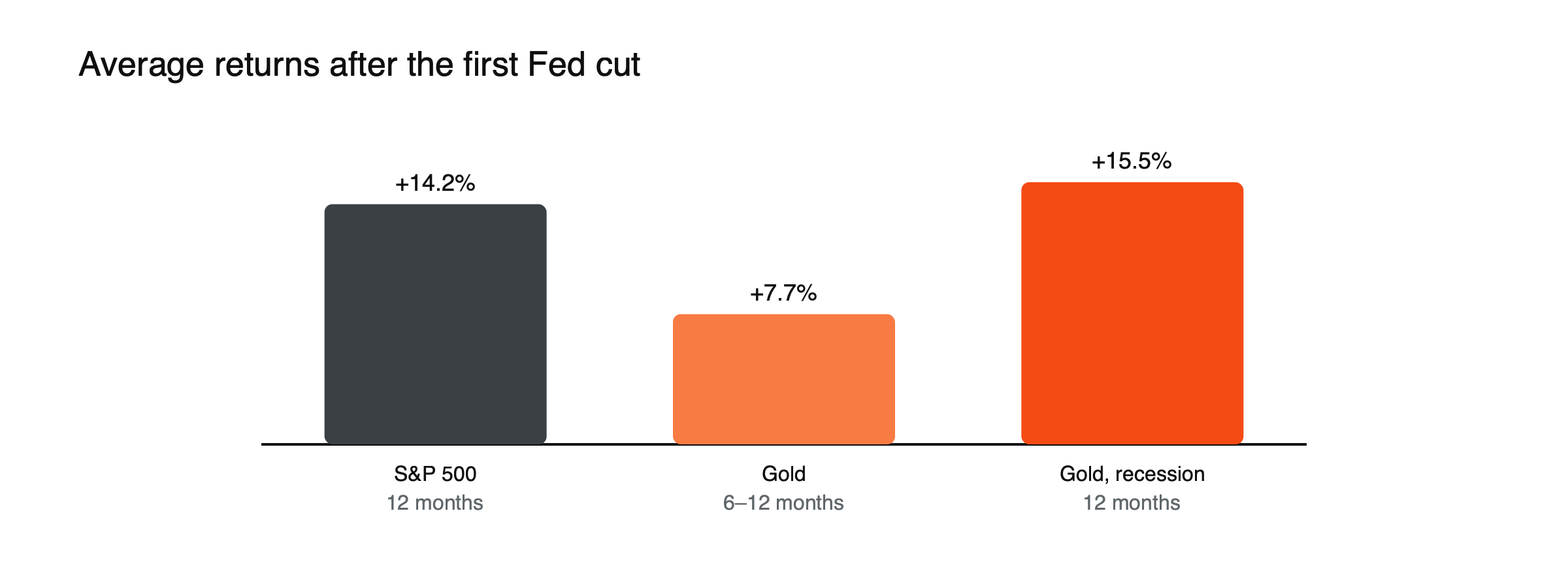
Figure: Average returns after the first cut. Sources: Julius Baer; Kitco.
The four phases of a rate cycle
Rate cycles usually move through four phases. Hiking: the central bank raises rates to cool inflation; bond yields rise and richly valued assets come under pressure. Peak: rates stop rising; bonds often begin to recover as markets anticipate cuts. Cutting: rates fall, either gradually as inflation eases or sharply in response to a downturn. Trough: rates sit low until growth and inflation pick up again. Each phase tends to favor different assets, but the reason behind each phase matters as much as the phase itself.
Bonds
Bond prices fall as yields rise, which made 2022 the worst year on record for the main US bond index. Once rates peak and cuts approach, bonds have usually gained.
Stocks
After the first cut since the 1980s, the S&P 500 averaged about 14.2% over the next 12 months, above its long-run average, mainly in cycles without a recession. Small caps have not reliably led: large caps outperformed in four of the six cycles before 2024. See small caps vs large caps when rates start falling.
First cuts, illustrated
Suppose the Fed makes its first cut after a long pause because inflation has fallen toward target, while unemployment remains low. (Illustrative scenario.) Shares may rally as lower rates support valuations and growth holds up, bonds gain modestly and gold rises as real yields edge down. Now suppose the first cut comes after weak jobs data and widening credit spreads. Shares may fall as earnings forecasts drop, while long bonds rally strongly and gold gains on safe-haven demand. The same policy move produces very different outcomes.
Gold
Since 1995, gold has averaged gains of about 7.7% six to 12 months after the first cut, and more when a recession followed. See what usually happens to gold when the Fed starts cutting.
The dollar and currencies
The dollar tends to strengthen when the Fed is raising rates faster than other central banks, as in 2022, and to weaken when the Fed cuts faster. Currencies of countries whose central banks are hiking relative to others usually rise. Rate cycles are therefore a major driver of currency trends. See how a strong dollar hits commodities, emerging markets and crypto.
Commodities
Commodities often do well late in the hiking phase, when growth is still strong and inflation high, and badly when cuts come because of recession, as demand falls. Energy and industrial metals are most sensitive to that growth swing. See commodities vs stocks during inflationary periods.
Where the usual answer flips
The phase alone does not decide outcomes. Inflation shocks can make stocks and bonds fall together even late in a cycle, as in 2022. See why the stock-bond correlation flipped after 2021.
Sectors within shares
Within share markets, rate cycles shift leadership. Banks often benefit early in hiking cycles as lending margins widen, while rate-sensitive sectors such as property and utilities suffer. When cuts begin without recession, cyclical and smaller companies can rally; when cuts come with recession, defensive sectors such as healthcare and consumer staples tend to hold up better. See what sector rotation is.
Reading where we are
Markets move ahead of central banks, pricing future rate changes months in advance. Futures markets, the 2-year Treasury yield and central bank projections show where investors think the cycle is heading. When expectations shift sharply, for example from cuts to hikes, asset prices adjust quickly, often before the central bank acts. See what markets listen for in a central bank meeting.
Cash across the cycle
Cash and short-term bills earn more as rates rise and less as they fall. Late in a hiking cycle, cash can pay attractive yields with almost no price risk, which tempts investors to wait. But once cuts begin, cash yields fall quickly, while bonds bought near the peak in yields lock in higher income and can gain in price. Staying in cash too long has often meant missing those gains.
Crypto across the cycle
Crypto has been among the most rate-sensitive assets. It fell sharply in the 2022 hiking cycle and has tended to rally when markets expected easier policy and more liquidity. Its reactions are amplified by leverage and speculative demand, so it often moves further than shares in both directions. See how real yields connect gold, growth stocks and crypto.
Property
Listed property is sensitive to interest rates because higher rates raise borrowing costs and reduce the value of rental income. It fell about 24% in 2022 and has often recovered when rate cuts approach, provided the economy avoids a deep recession.
Common misreadings
- Treating the first cut as a universal buy signal.
- Assuming each cycle repeats the last one.
A cycle checklist
- Is the central bank hiking, pausing or cutting?
- Why: inflation, a slowdown or a financial shock?
- What are markets already pricing?
- Are credit spreads and unemployment rising?
Recent cycles in brief
Recent US rate cycles show the range of outcomes. In the mid-1990s, the Fed cut modestly without a recession, and shares rallied strongly. In 2001 and 2007, cuts came as recessions began, and shares fell heavily while government bonds gained. In 2019, small precautionary cuts supported markets. In 2020, emergency cuts to near zero came with a sudden crash and a rapid recovery. From 2022, the fastest hikes in decades hit almost every asset, and cuts resumed in 2024. No two cycles produced the same pattern.
Bonds near the peak, illustrated
Suppose 10-year yields peak at 5% and fall to 4% over the following year as cuts approach. (Illustrative scenario.) A 10-year bond bought near the peak earns its 5% coupon plus a price gain of roughly 7% to 8%, a total return around 12% to 13%. A holder of cash earns only the falling short-term rate. Locking in yields near the peak has historically been one of the more rewarding moves of a rate cycle, though the peak is only clear in hindsight.
Cycles in other countries
Central banks do not always move together. In 2024 and 2025, the European Central Bank and several emerging market central banks cut rates before or faster than the Fed, while the Bank of Japan moved the other way and raised rates. Such divergence drives currency moves and shifts relative performance between markets, so investors watch global cycles, not just the US one. See ECB vs Fed.
Positioning ahead of a turn
Because markets move before central banks act, the biggest gains and losses often come before the first cut or hike. Investors who wait for confirmation may miss part of the move, while those who move early risk being wrong about timing. Many adjust gradually, adding bond duration as hikes slow and trimming it as cuts become fully priced.
The role of inflation
Inflation decides much of how a cycle plays out. When cuts come because inflation has fallen, most assets tend to do well; when they come while inflation is still high, central banks may have to stop early, limiting gains in bonds and rate-sensitive shares. Watching core inflation alongside the policy path therefore matters as much as watching the rate decisions themselves.
Frequently asked questions
Do stocks always rise after the first rate cut?
No. They have averaged gains in cycles without a recession but often fell when a recession followed.
Which asset does best when rates peak?
Bonds have often gained once markets expect cuts, especially longer maturities, though timing the peak is difficult.
This article is educational content and does not constitute financial, investment, legal or tax advice. Digital assets are volatile and you may lose the amount you invest.
Sources
- US Fed cuts rates: what does this mean for gold, equities and emerging markets? (S&P 500 average 14.2% in 12 months after the first cut; gold +15.5% on average when a recession followed) — Julius Baer
- Gold prices may drop following the first Fed rate cut, but will rally over 6–12 months (up more than 7.7% on average since 1995) — Kitco, August 2024
- S&P 500 hits all-time high on soft-landing hopes (large caps outperformed small caps in four of six prior instances) — ThinkAdvisor / Bloomberg, September 2024
- Long Live the 60/40 Portfolio (2022 worst year in the Bloomberg US Aggregate’s history) — Advisor Perspectives, May 2023
- Commodities are more than just an inflation hedge (2022: S&P 500 −18%; gold about flat) — WisdomTree
- Revisiting the Fall of 2008 (long-term Treasuries rallied as the crisis deepened) — A Wealth of Common Sense