
Why the Bank of Japan Ended Yield Curve Control
From 2016 to 2024 the Bank of Japan capped 10-year yields near zero. Why it introduced yield curve control, how it loosened it and why it ended in March 2024.
Yield curve control (YCC) was the Bank of Japan’s cap on 10-year government bond yields near 0%, introduced in September 2016 alongside negative short-term rates to lift inflation. As global inflation and Japanese wages rose, the BoJ loosened the cap repeatedly and ended YCC on March 19, 2024, with its first rate hike in 17 years.
Timeline
- January 2016: the BoJ sets a −0.1% rate on some bank reserves.
- September 2016: YCC begins, targeting a 10-year yield around 0%.
- December 20, 2022: the allowed band widens from ±0.25 to ±0.5 percentage points; the yen jumps.
- July 2023: further flexibility.
- 2023: wages grow 3.6%, the fastest in 30 years.
- March 19, 2024: negative rates and YCC end; the policy rate moves to 0–0.1%.
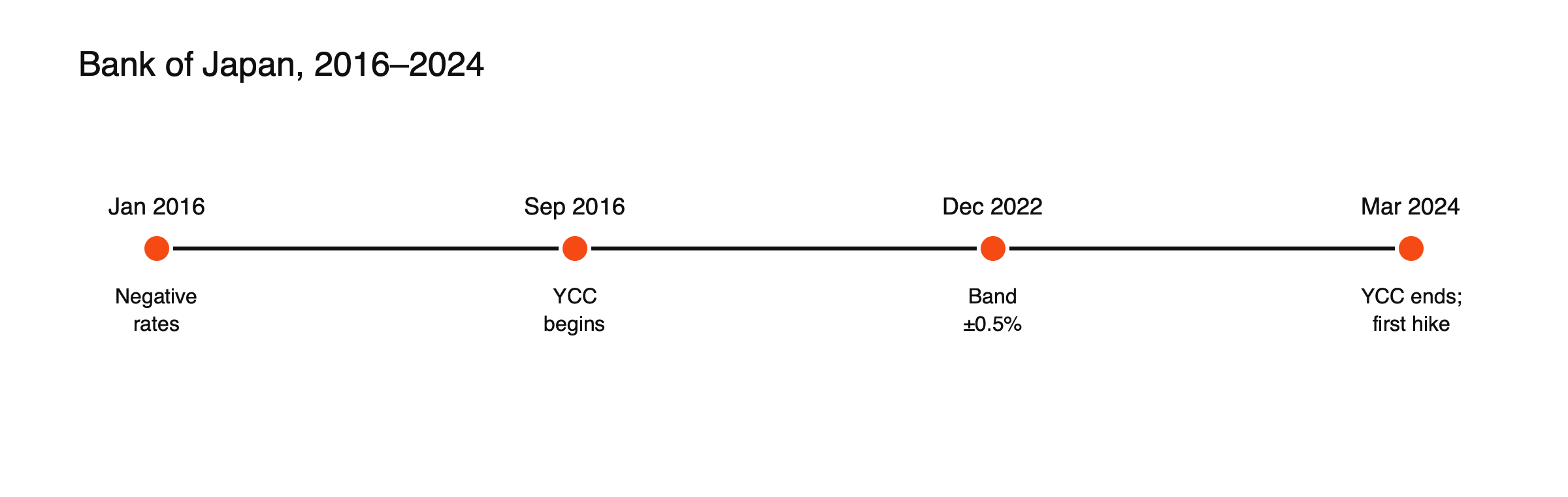
Figure: Eight years of yield curve control.
Before YCC: decades of fighting deflation
Japan spent much of the period after its asset bubble burst in the early 1990s fighting falling prices and weak growth. The Bank of Japan cut rates to near zero in the late 1990s, pioneered quantitative easing in the early 2000s and launched a much larger asset purchase program in 2013, aiming for 2% inflation. Inflation rose for a time but slipped back, and by 2016 the bank was looking for new tools. Negative rates and yield curve control were the result.
How YCC worked
Under YCC, the Bank of Japan announced a target for the 10-year government bond yield and promised to buy whatever amount of bonds was needed to keep the yield near it. If yields rose toward the top of the allowed band, the bank bought more; it could also offer to buy unlimited amounts at a fixed yield, a tool known as fixed-rate purchase operations. The promise itself often did much of the work: investors rarely tested the cap while they believed the bank would defend it.
Why it was introduced
Negative short-term rates had flattened the whole yield curve, hurting banks’ profits. YCC aimed to keep borrowing costs low while steepening the curve slightly.
Why it ended
Global inflation pushed yields up worldwide, making the cap expensive to defend: the BoJ had to buy large amounts of bonds. With inflation and wages finally rising, the original goal looked within reach, and the policy had largely been abandoned in practice before the formal end.
Defending the cap, illustrated
Suppose global inflation pushes US 10-year yields from 1.5% to 4%, while the Bank of Japan caps Japanese 10-year yields at 0.25%. (Illustrative scenario.) The gap between US and Japanese yields widens sharply, investors sell Japanese bonds and the yen weakens. To hold the cap, the Bank of Japan must buy every bond sold to it, swelling its balance sheet. Meanwhile, the weak yen pushes up import prices. The longer global yields stay high, the more expensive and distortive the cap becomes. That, broadly, was the Bank of Japan’s position in 2022.
The formal end
The formal end was well telegraphed, so the immediate reaction was muted.
After ending YCC, the Bank of Japan kept buying government bonds for a time, then announced plans to reduce its purchases gradually, letting market forces play a larger role in setting long-term yields.
The bigger market moves
The bigger market moves came at the surprise loosening in December 2022 and the July 2024 hike that helped trigger a carry trade unwind. See why global markets watch Japan’s bond market , what happens to currencies when a central bank pivots and what markets listen for in a central bank meeting.
The July 2024 hike and its aftermath
On July 31, 2024, the Bank of Japan raised its policy rate to 0.25% and signaled reduced bond buying. Combined with weaker US data, the move helped push the yen up about 14% against the dollar between July 10 and August 5, triggering a rapid unwind of yen-funded carry trades. On August 5, the Nikkei 225 fell 12.4%, its worst day since 1987. The episode showed how sensitive global markets had become to Japanese policy after years of near-zero rates. See why the yen rallies when global markets sell off.
The weak yen and intervention
Even after YCC ended, Japanese rates stayed far below US rates, and the yen weakened for long stretches. Japan’s finance ministry intervened to support it repeatedly: about ¥6.35 trillion in October 2022, about ¥9.79 trillion in April and May 2024, about ¥5.53 trillion in July 2024, about ¥11.7 trillion in April and May 2026 and a record ¥15.4 trillion between July 30 and August 26, 2026, including the first joint US–Japan yen purchase since 1998. The pattern showed how hard it is to unwind years of ultra-easy policy without currency stress.
Timeline at a glance
| Date | Event |
|---|---|
| January 2016 | Negative rate of −0.1% introduced |
| September 2016 | Yield curve control begins |
| December 20, 2022 | Band widened to ±0.5 points; yen surges |
| July 2023 | Further flexibility |
| March 19, 2024 | Negative rates and YCC end |
| July 31, 2024 | Policy rate raised to 0.25% |
Lessons for traders
YCC showed that a central bank can hold a bond yield almost anywhere for years, but that the exit can trigger large moves in currencies and global markets. Surprise changes, like December 2022, moved markets far more than the well-signaled formal end. Traders in yen pairs, Japanese shares and global bonds now treat Bank of Japan meetings as major events. See what markets listen for in a central bank meeting.
The side effects
YCC and negative rates had costs. Japanese banks earned thin margins on lending, the bond market became less liquid as the Bank of Japan owned an ever-larger share of government bonds, and the yen weakened sharply when global yields rose. Some days, very few Japanese government bonds traded at all, a sign of how distorted the market had become.
How markets tested the cap
In 2022, as global yields surged, some investors bet that the Bank of Japan would have to abandon its cap, selling Japanese bonds and futures. The bank responded with large purchases and unlimited fixed-rate operations, but the pressure contributed to the December 2022 decision to widen the band, which surprised markets and sent the yen up sharply.
The balance sheet
By the time YCC ended, the Bank of Japan held roughly half of all Japanese government bonds. Reducing those holdings gradually, without disrupting the market, became one of its main challenges after the exit. See how quantitative easing changed markets after 2008.
Common misreadings
- Believing the March 2024 exit caused the big market moves.
- Assuming the end of YCC meant rapid rate rises.
What YCC meant for the yen
By holding Japanese yields near zero while other central banks raised rates in 2022, YCC widened the interest rate gap between Japan and the rest of the world. Investors borrowed yen to buy higher-yielding assets, and the yen fell to multi-decade lows against the dollar. Each sign that the Bank of Japan might loosen YCC triggered sharp yen rallies, as in December 2022.
Lessons for other central banks
YCC showed that a central bank can control long-term yields if it is willing to buy without limit, but that the policy becomes harder and costlier to sustain as global conditions change.
The 2026 picture
By 2026, the Bank of Japan had raised rates further from 0.25%, but Japanese rates remained well below those in the United States, and the yen stayed under pressure, prompting record interventions. The exit from YCC had been completed, but normalizing Japanese policy was still a work in progress.
Watching the Bank of Japan now
Traders follow its policy rate path, the pace of its bond purchase reductions, comments on the yen and wage data from annual pay negotiations.
What it means for traders
Traders in USD/JPY, Japanese shares and global bonds still treat Bank of Japan decisions as major events. Surprises, rather than well-signaled moves, have produced the biggest reactions, from December 2022 to July 2024. Reducing leverage ahead of meetings, watching wage and inflation data and following Ministry of Finance comments on the yen help manage the risk of sudden moves. Spring wage negotiations have become a key input for its decisions and a market event in their own right.
Frequently asked questions
Did YCC achieve its goal?
Inflation eventually rose above 2%, though mostly because of global price shocks and a weak yen rather than YCC alone. Rising wages in 2023 suggested the change might last.
Could another central bank use YCC?
It is possible, but Japan’s exit showed the costs: a huge balance sheet, distorted bond markets and currency pressure.
This article is educational content and does not constitute financial, investment, legal or tax advice. Digital assets are volatile and you may lose the amount you invest.
Sources
- Bank of Japan raised rates for the first time in 17 years (YCC and negative rates since 2016; band widened to ±0.5% at end-2022; wages +3.6% in 2023; YCC largely abandoned before the announcement) — The Conference Board, March 2024
- Bank of Japan’s policy adjustment ripples through markets (NIR in January 2016; YCC to steepen the curve; changes in December 2022 and July 2023) — Wilmington Trust
- Japanese investors poised to back further away from US Treasuries (YCC from September 2016; relaxed December 20, 2022) — S&P Global Market Intelligence
- Japan, the largest foreign holder of US Treasuries (March 19, 2024 decision) — Bursa
- What is the yen carry trade? (BoJ raised rates to 0.25% and announced less bond buying; Nikkei −12.40%) — GKToday
- Bank of Japan: Yield curve surprise (yen biggest one-day surge since 1998; JGB yields highest since 2015) — Principal Asset Management, December 2022
- History of Japan’s intervention in currency markets (October 2022 ¥6.35 trillion; April–May 2024 ¥9.79 trillion; July 2024 ¥5.53 trillion; April–May 2026 ¥11.7 trillion) — Reuters via Investing.com, 2026
- Japan spent record $96 billion in yen interventions (¥15.4 trillion between July 30 and August 26, 2026; first joint US–Japan yen purchase since 1998) — Kuwait Times / AFP, August 2026
- Carry Trade Unwind: Is It Really Over? (yen +14% against the dollar July 10 to August 5, 2024; Japan’s $3.3 trillion net foreign investment position) — Schwab via Advisor Perspectives