
How a Strong Dollar Hits Commodities, Emerging Markets and Crypto
Why a rising US dollar weighs on commodities, emerging markets and crypto, what happened when the dollar index hit a 20-year high in 2022, and the limits.
A strong dollar tends to weigh on commodities, emerging markets and crypto at the same time. Most commodities are priced in dollars, many emerging-market borrowers owe dollars, and dollar strength usually signals tight global liquidity. In September 2022, the dollar index reached about 114, its highest since 2002, while bitcoin fell about 66% that year.
Why one currency moves so much
The dollar is the world’s main currency for trade, commodities and borrowing. Governments, companies and banks outside the United States owe trillions of dollars, and global investors hold dollar assets as their main safe store of value. When the dollar rises, the cost of servicing dollar debt rises everywhere, dollar funding becomes scarcer and global financial conditions tighten. That is why a strong dollar affects so many markets at once.
Commodities
When the dollar rises, commodities become more expensive in other currencies, which can reduce demand. Over time, commodities have tended to do better when the dollar is weak, though the 2021 commodity surge was an exception.
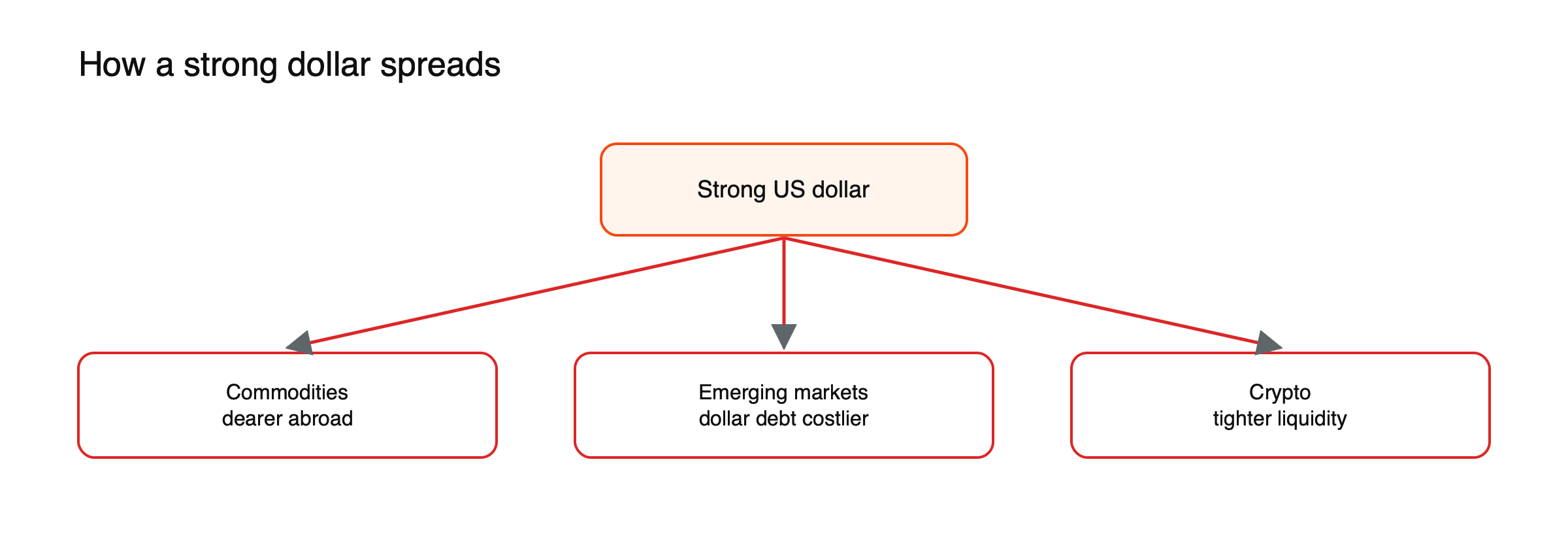
Figure: Three channels through which a strong dollar hits other assets.
A commodity price in two currencies, illustrated
Suppose oil is priced at $80 a barrel and the dollar rises 10% against the euro. (Illustrative figures.) For a European buyer, the same barrel now costs about 10% more in euros, even though its dollar price has not changed. Higher local prices reduce demand, which tends to push the dollar price down over time. When the dollar weakens, the reverse happens, supporting commodity demand and prices.
Emerging markets
Countries and companies that borrowed in dollars must pay more in local currency when the dollar rises. Imports cost more, and investors pull money out. MSCI emerging markets outperformed developed markets from 2000 to 2010, a period of dollar weakness, and lagged during the long stretch of dollar strength that followed. See emerging vs developed market stocks.
Dollar debt, illustrated
A company in an emerging market borrows $10 million when its currency trades at 10 per dollar, owing the equivalent of 100 million in local currency. If its currency falls to 12 per dollar, the same debt costs 120 million to repay, a 20% increase in local terms, while its revenues, earned locally, may not have grown at all. Multiply that across governments and companies, and a strong dollar can turn manageable debts into crises. (Illustrative figures.)
Crypto
Bitcoin is priced in dollars and bought with dollar liquidity. In 2022, as the Federal Reserve raised rates and the dollar index climbed, bitcoin fell from about $47,000 to under $16,000. As the dollar peaked in September 2022 and turned down, bitcoin stabilized and began recovering in 2023.
What drives the dollar
Higher US interest rates, demand for safe assets in a crisis and stronger US growth than elsewhere all lift the dollar. The Fed’s rate path is usually the biggest single factor.
Limits
The relationship is common, not mechanical. Commodities rose with the dollar in parts of 2021–2022 because of supply shocks, and bitcoin’s link to the dollar has weakened at times as ETF and long-term demand grew. For gold, see how real yields connect gold, growth stocks and crypto, and for the wider picture, stocks, bonds and commodities across the rate cycle.
The 2022 dollar surge
In 2022, as the Federal Reserve raised rates faster than most other central banks, the dollar index rose to about 114 in September, its highest level since 2002. Commodities other than energy came under pressure, emerging market currencies and shares fell, and bitcoin dropped from about $47,000 to under $16,000 over the year. The euro fell below parity with the dollar, and the yen and pound fell sharply. Once US inflation began to ease and markets expected fewer hikes, the dollar turned down, and many of these assets stabilized.
Who benefits from a strong dollar
A strong dollar is not bad for everyone. US consumers pay less for imports, and US tourists abroad find things cheaper. Exporters outside the United States, especially in Europe and Japan, earn more in local currency on their dollar sales, which can lift their shares. Foreign investors holding dollar assets gain when they convert back. See why the FTSE 100 often moves opposite to the pound.
US companies and the dollar
US companies that earn a large share of their revenue abroad see those earnings shrink when converted into a stronger dollar. Many large technology and industrial firms mention currency headwinds in their results during periods of dollar strength, which can weigh on the S&P 500’s earnings growth.
Watching the dollar
Traders follow the dollar index, which measures the dollar against a basket of major currencies, and broader trade-weighted measures that include emerging market currencies. A sustained rise in either, especially alongside rising US real yields, is a signal to check exposure to commodities, emerging markets and crypto. See how real yields connect gold, growth stocks and crypto.
Dollar cycles
The dollar moves in long cycles lasting years. It was strong in the early 1980s and late 1990s into 2002, weak through much of the 2000s and strong again in parts of the 2010s and in 2022. These cycles reflect differences in interest rates, growth and capital flows between the United States and the rest of the world. Assets sensitive to the dollar, such as emerging markets and commodities, have often moved in long cycles in the opposite direction.
The dollar smile
A popular framework, the dollar smile, suggests the dollar strengthens in two situations: when the US economy outperforms the rest of the world, attracting capital, and when global markets panic, driving demand for safety. It tends to weaken in between, when global growth is broad and investors are willing to take risks abroad. The idea is a simplification, but it captures why the dollar can rise in both booms and crises.
The dollar and gold
Gold is priced in dollars, so a stronger dollar usually makes it more expensive for other buyers and weighs on its price. The link has weakened at times, for example when central bank gold buying or geopolitical demand dominated, but traders still watch the dollar as one of gold’s main drivers.
Common misreadings
- Assuming a strong dollar is always bad for US markets.
- Ignoring the dollar when analyzing commodities or crypto.
A strong-dollar year, illustrated
Suppose the dollar index rises 15% over a year as the Fed tightens faster than other central banks. (Illustrative scenario.) An investor in a euro-area fund with US shares sees gains in euro terms even if those shares are flat, while a US investor in emerging market shares loses from currency moves on top of any local declines. Industrial metals weaken, and emerging market borrowers face higher debt costs. A single currency move reshapes returns across portfolios worldwide.
Emerging market central banks
When the dollar surges, many emerging market central banks raise interest rates or sell foreign reserves to defend their currencies and contain imported inflation. These defenses can slow their economies, adding to the pressure on their markets. Countries with large reserves and lower dollar debts usually cope better.
When the dollar weakens
The effects reverse when the dollar falls: commodities often rise, emerging markets attract capital and dollar debts become easier to service. A turn in the dollar after a long rise, as in late 2022, has often marked a change in leadership across global markets.
A dollar watchlist
- Fed policy relative to other central banks
- US real yields
- The dollar index and trade-weighted measures
- Emerging market currency indices
- Commodity prices in dollars and in other currencies
Hedging dollar exposure
Investors outside the United States can hold dollar assets with or without currency hedging. Hedging removes the effect of dollar moves on returns, which helps when the dollar falls, but gives up the gains when it rises. Many institutions hedge part of their exposure, accepting some currency risk as a potential cushion in crises, when the dollar often strengthens. The right balance depends on each investor’s own goals and hedging costs.
Frequently asked questions
Why does the dollar rise in crises?
Because global investors and borrowers need dollars for safety and to repay dollar debts, demand jumps when markets are stressed.
Does a strong dollar always hurt bitcoin?
Not always. The link has weakened at times as long-term and ETF demand grew, but in tightening cycles the two have often moved in opposite directions.
This article is educational content and does not constitute financial, investment, legal or tax advice. Digital assets are volatile and you may lose the amount you invest.
Sources
- The Dollar Index (DXY near 114–115 in September 2022, highest since 2002; bitcoin from about $47,000 to below $16,000; inverse with risk assets, not mechanical) — BIT Knowledge Hub
- Why the strong dollar could be a source of concern for investors (emerging markets and commodities; 2021 outlier) — AJ Bell, September 2022
- Emerging Markets: Why and Where (EM outperformed 2000–2010, underperformed since) — Dodge & Cox, May 2024