
How a Futures Roll Adjusts a Commodity CFD Price
At a futures roll, a commodity CFD's price jumps by the gap between contracts and providers offset it in cash. A worked example on 100 barrels of oil.
At a futures roll, a commodity CFD switches to the next contract and its price jumps by the gap. Providers usually offset the fake profit or loss: adjustment = (old price − new price) × size. Rolling 100 barrels from $80.00 to $81.20 means about a $120 debit for a long and a $120 credit for a short.
The mechanics
- Before expiry, the CFD tracks the front-month contract.
- On the roll date, it switches to the next contract.
- The quoted price changes by the price gap.
- The provider applies an offsetting cash adjustment, and may charge a spread for the roll.
Some providers instead close the position and reopen it in the new contract.
Worked example (contango)
- Long 100 barrels
- Expiring contract: $80.00; next contract: $81.20 (example values)
- Quoted price jumps +$1.20
- Without adjustment, the long would show +$120 of fake profit
- Adjustment: (80.00 − 81.20) × 100 = −$120 to the long; +$120 to a short
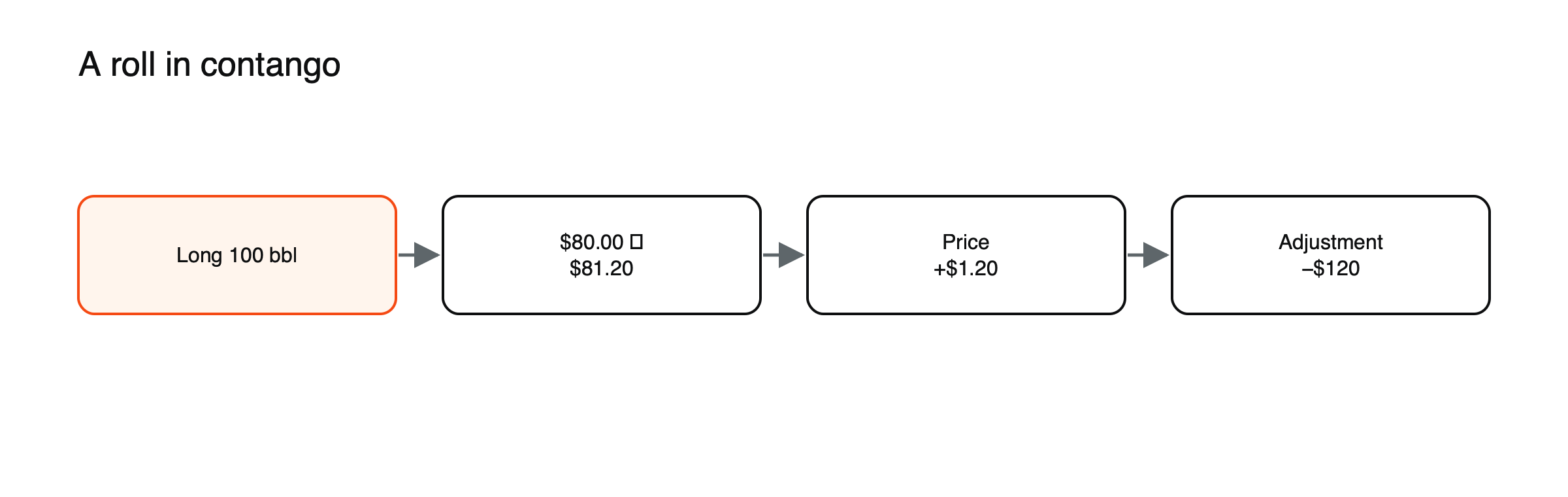
Figure: The roll adjustment keeps equity unchanged (example values).
Your equity is unchanged by the roll itself, apart from any roll charge.
In backwardation
If the next contract is cheaper, the price drops at the roll and longs receive a credit, shorts a debit.
Worked example: short in backwardation
A trader holds a short of 50 barrels. The expiring contract trades at $85.00 and the next at $83.50, so the curve is in backwardation. (Example values.) At the roll, the quoted price falls by $1.50. Without adjustment, the short would show a profit of $75 that it did not earn; the provider debits $75 so that equity is unchanged. If the market stays in backwardation, each roll works against a short and in favor of a long, the reverse of contango.
Worked example: a roll with a charge
Some providers charge for the roll, often as a spread on the switch. Suppose the charge is $0.03 a barrel. On a 100-barrel position, the roll costs about $3, in addition to the price adjustment that keeps equity neutral. Small on one roll, the charge adds up for positions held through many months, so it belongs in any estimate of holding costs.
How often rolls happen
Roll frequency depends on the underlying futures contract. Crude oil and natural gas have monthly contracts, so futures-based CFDs on them usually roll every month. Gold and some other metals have a set of active delivery months, so rolls happen less often, typically every couple of months. Providers publish roll calendars showing the exact dates, usually a few days before the futures contract stops trading.
Roll dates and expiry dates
The roll date is set by the CFD provider and normally comes before the futures contract’s last trading day, to avoid the thin and sometimes erratic trading near expiry. April 2020 showed why: as the May oil contract approached its final days, its price collapsed while the June contract stayed far higher. Positions rolled before those final days avoided the worst of the expiry move.
Stops and orders
Stops and limits may need to move by the same gap, or a stop could trigger on the roll jump alone. Check whether your provider adjusts open orders automatically.
What to check
Your provider’s roll dates and any roll fee. See what contango and backwardation are, commodity trading mistakes around contract rolls and how commodity CFDs work.
Cash CFDs avoid the roll
Cash or spot commodity CFDs do not switch contracts, so there is no roll jump. Instead, the carry implied by the curve is built into daily financing: long positions in contango usually pay more, and shorts may receive a credit. Over time the economic effect is similar to rolling, but it arrives in small daily amounts rather than in a single adjustment. See spot vs futures prices.
Rolls on your charts
Charts of futures-based CFDs can show a jump at each roll, because the price switches from one contract to the next. Some platforms show adjusted continuous charts that remove these jumps; others do not. A sudden gap on the chart at a roll date is not a market move, and technical levels drawn across it may be misleading.
A roll checklist
- When is the next roll date for this instrument?
- Is the curve in contango or backwardation, and by how much?
- Will open stops and limits be adjusted automatically?
- Is there a roll charge, and how is it applied?
- Would a cash CFD be cheaper for my holding period?
A year of rolls in contango
The roll adjustment keeps equity unchanged on the day, but contango still costs a long position over time. Suppose oil’s front-month price stays at $80 for a year, while each next contract trades $0.60 higher. (Illustrative prices.) A long position of 100 barrels enters each new contract at $80.60, and as that contract approaches expiry its price drifts down toward $80, losing about $60 a month. Over twelve rolls, that is about $720, roughly 9% of the position’s value, even though the headline price never moved. In backwardation, the same mechanism works in a long position’s favor.
Why statements can look confusing
Account statements may show the roll as two lines: a price change on the position and a cash adjustment of the opposite amount. Seen separately, one looks like a loss or gain that did not happen. Netting the two shows the true effect, which is zero apart from any roll charge.
Planning around roll dates
Traders often plan entries and exits with the roll calendar in mind. Opening a futures-based position just before a roll means paying the spread on the switch soon after entry, and stops set close to the price may need adjusting. Some prefer to open new positions just after a roll, when the CFD tracks the new front-month contract with weeks to go before the next switch.
Rolls differ by commodity
Crude oil and natural gas have contracts for every month, so futures-based CFDs on them usually roll monthly. Gold futures trade most actively in a set of alternating months, so gold CFDs that follow futures roll every two months or so. Grain contracts follow harvest-related months, with gaps of two or three months between them. Fewer rolls mean fewer switches and charges, but each roll may involve a larger price gap. Checking the roll calendar for each instrument you trade, rather than assuming monthly rolls everywhere, avoids surprises. Roll calendars are usually published several months ahead, so adding them to a trading calendar takes only a few minutes.
Frequently asked questions
Does the roll change my profit or loss?
Not by itself, if the provider applies the usual adjustment. Only a roll charge, if any, affects equity. The real cost of holding through contango comes from the curve’s shape over time.
Can I avoid the roll?
Yes, by closing the position before the roll date, or by trading a cash CFD that does not roll. Either choice has its own costs, such as spreads or daily financing.
Leverage, margin and cost figures in this article are example values for illustration. Actual terms depend on the provider, the instrument and the rules in your country.
This article is educational content and does not constitute financial, investment, legal or tax advice. Digital assets are volatile and you may lose the amount you invest.