
How Rights Issues, Mergers and Spin-Offs Affect Stock CFDs
Corporate actions change share prices and counts. How CFD providers typically adjust positions for rights issues, mergers, takeovers and spin-offs.
Corporate actions such as rights issues, mergers and spin-offs change a company’s share price or share count. Because CFD holders do not own shares, providers apply adjustments to keep positions economically equivalent: cash adjustments, new positions in a spun-off company, or closing positions when a takeover completes. Terms vary by provider, so the details matter.
Rights issues
The company offers existing shareholders new shares at a discount. The share price usually falls when it trades without the right. CFD providers typically make a cash or price adjustment to reflect the value of the right, and may not let CFD holders take up new shares directly.
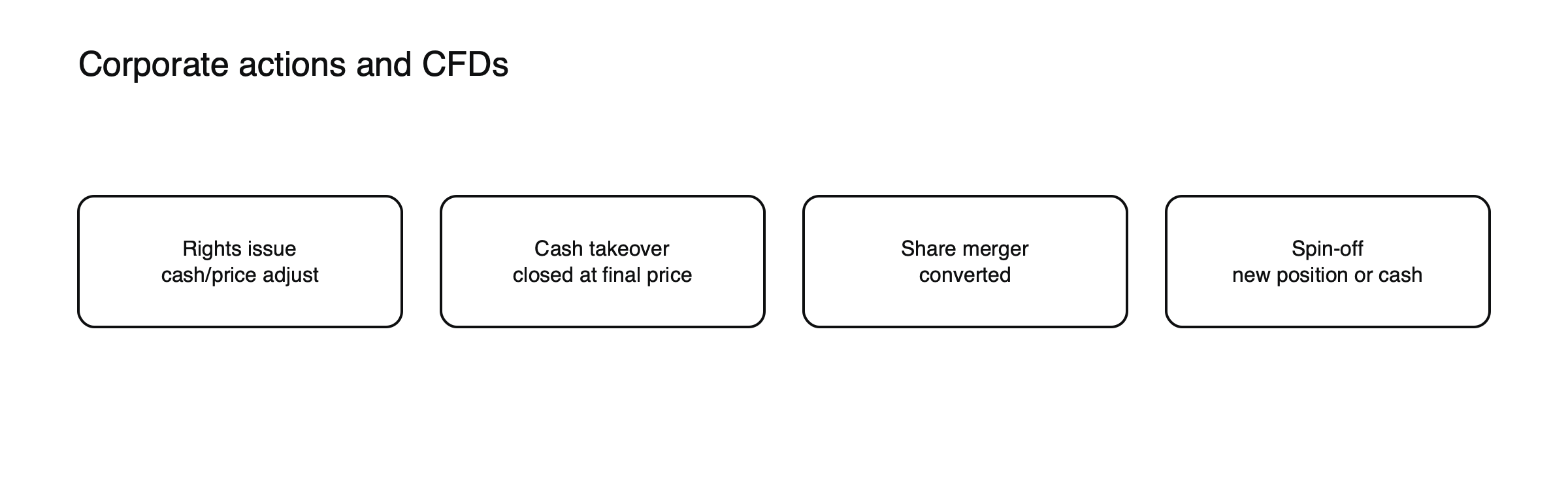
Figure: Typical treatment; terms vary by provider.
Worked example: a rights issue
A company whose shares trade at $12 offers existing holders one new share for every four held, at $8. After the rights issue, the theoretical price of each share, averaging four old shares and one new, is (4 × $12 + $8) ÷ 5 = $11.20. The share falls by about $0.80 when it starts trading without the right. A provider might credit long CFD holders roughly the value of the right, about $0.80 per CFD share, or adjust the position size, so that the drop does not create an artificial loss. Short positions receive the opposite adjustment. (Illustrative figures.)
Mergers and takeovers
- Cash takeovers: when the deal completes, the share stops trading and CFD positions are closed at the final price.
- Share-for-share mergers: positions may be converted into CFDs on the acquiring company at the exchange ratio.
- Before completion: the target’s price often trades near the offer price, with risk that the deal fails.
Worked examples: deals
Cash takeover. An acquirer offers $50 a share in cash; the target trades at $47 because the deal might fail or take time. The gap of about 6.4% is the reward for that risk. If the deal completes, long CFD positions close at about $50; if it collapses, the share may fall back well below $47. (Illustrative figures.)
Share-for-share merger. The target’s holders receive 0.5 acquirer shares for each target share. A long position of 200 target CFD shares would typically be converted into 100 CFD shares of the acquirer at the agreed ratio, preserving the position’s value at the conversion. (Illustrative figures.)
Spin-offs
When a company spins off a division, holders receive shares in the new company. CFD providers usually open a corresponding position in the new company or make a cash adjustment.
Worked example: a spin-off
A company spins off a division, giving holders one share in the new company for every five they own. A long position of 500 CFD shares would usually receive a new position of 100 CFD shares in the spun-off company, or a cash adjustment if the provider does not offer CFDs on it. The original share’s price typically falls by about the value of what was spun off. (Illustrative figures.)
Other actions. Special dividends, share consolidations and delistings can all lead to adjustments or forced closure. See how stock splits affect a CFD position.
What to check
- Your provider’s corporate actions policy and notices.
- Whether short positions face extra risks, such as forced closure before an event.
- How pending orders are treated.
See what happens to a stock CFD on ex-dividend day and how stock CFDs work.
Short positions and corporate actions
Short positions can face extra risks around corporate actions. Providers may close shorts before an event if borrowing becomes impossible, and shorts receive the opposite of every adjustment longs receive, such as debits for rights or special dividends. A takeover offer can lift a target’s shares by 30% or more overnight, one of the most painful gaps a short can face.
Trading halts and delistings
Exchanges may halt trading in a share pending major news, and CFD trading usually stops too, leaving positions frozen until trading resumes, often at a very different price. If a company is delisted, positions are typically closed at the last available price, or in some cases left open until a value can be determined. Providers’ policies differ, so it is worth knowing them before trading smaller or troubled companies.
Where to find notices
Companies announce corporate actions through stock exchange filings and press releases, and CFD providers publish notices explaining how they will treat open positions, usually in advance of the effective date. Reading these notices for any share you hold avoids surprises such as unexpected closures or adjustments.
Tender offers and buybacks
A company may offer to buy back some of its own shares at a set price, or an acquirer may make a tender offer directly to shareholders. CFD holders cannot tender shares they do not own, so providers usually leave positions open at the market price, which typically moves toward the offer. Ordinary buybacks on the open market need no adjustment, though they can support the share price over time. See how share buybacks affect stock prices.
Scrip dividends
Some companies let shareholders choose new shares instead of a cash dividend. CFD providers generally apply a cash adjustment based on the cash dividend, since CFD holders cannot make that choice. The share price behaves as on any ex-dividend date.
Name and ticker changes
When a company changes its name or ticker, providers update the instrument, usually without any change to open positions. Checking that positions appear under the new name avoids confusion.
Why adjustments aim at neutrality
The principle behind every adjustment is that a corporate action should neither create nor destroy value for a CFD holder, compared with someone who owns the shares. Providers aim to leave the economic position unchanged, apart from effects that genuinely change the share’s value, such as a takeover premium. Where an exact match is impossible, for example with rights that cannot be taken up, a cash adjustment approximates the value.
A corporate action checklist
- Is any action announced for shares you hold?
- How will your provider treat long and short positions?
- Will pending orders be adjusted or cancelled?
When a deal fails
Takeovers can collapse because of regulatory objections, financing problems, shareholder votes or a change of heart by the buyer. When that happens, the target’s shares often fall sharply, sometimes below where they traded before the offer. A long position held for the small gap between market price and offer can therefore lose far more than it stood to gain. Understanding what could block a deal, and how likely that is, matters more than the size of the gap. Deal arbitrage specialists spread their bets across many deals for this reason; a single position concentrates the risk of one failure. Always size for the downside, not the gap.
Frequently asked questions
Can I take part in a rights issue through a CFD?
Usually not directly. Providers typically make a cash or position adjustment to reflect the value of the rights instead.
What happens to my CFD if the company is taken over for cash?
When the deal completes and the shares stop trading, the CFD position is normally closed at the final price, close to the offer price.
This article is educational content and does not constitute financial, investment, legal or tax advice. Digital assets are volatile and you may lose the amount you invest.