
How Currency Correlations Work
Pairs that share a currency often move together or opposite. How currency correlation works, common examples like EUR/USD and USD/CHF, and why it matters.
Currency correlation measures how closely two pairs move together, on a scale from +1 (always together) to −1 (always opposite). Pairs that share a currency are often strongly correlated: EUR/USD and GBP/USD tend to move in the same direction because both are priced against the dollar, while EUR/USD and USD/CHF tend to move in opposite directions. Correlations change over time.
Why pairs correlate
- A shared currency: any pair with USD reacts to US news.
- Linked economies: the euro and Swiss franc, or the Australian and New Zealand dollars, respond to similar forces.
- Risk sentiment: risk currencies tend to move together against havens. See risk-on vs risk-off.
How a correlation is measured
A correlation is calculated from a series of price changes, usually daily percentage moves over a set period such as 20, 60 or 250 trading days. If two pairs rise and fall on the same days by similar proportions, the result is close to +1; if one rises when the other falls, close to −1; if there is no consistent pattern, close to zero. Charting platforms and spreadsheet functions can calculate it in seconds from closing prices. The period matters: a 20-day correlation reacts quickly to new conditions, while a 250-day correlation shows the longer-run relationship.
Common examples
| Pairs | Usual relationship | Why |
|---|---|---|
| EUR/USD and GBP/USD | Positive | Both are priced in dollars |
| EUR/USD and USD/CHF | Negative | Dollar on opposite sides; euro and franc often move together |
| AUD/USD and NZD/USD | Positive | Similar economies and drivers |
| AUD/JPY and stock indices | Positive | Both reflect risk appetite |
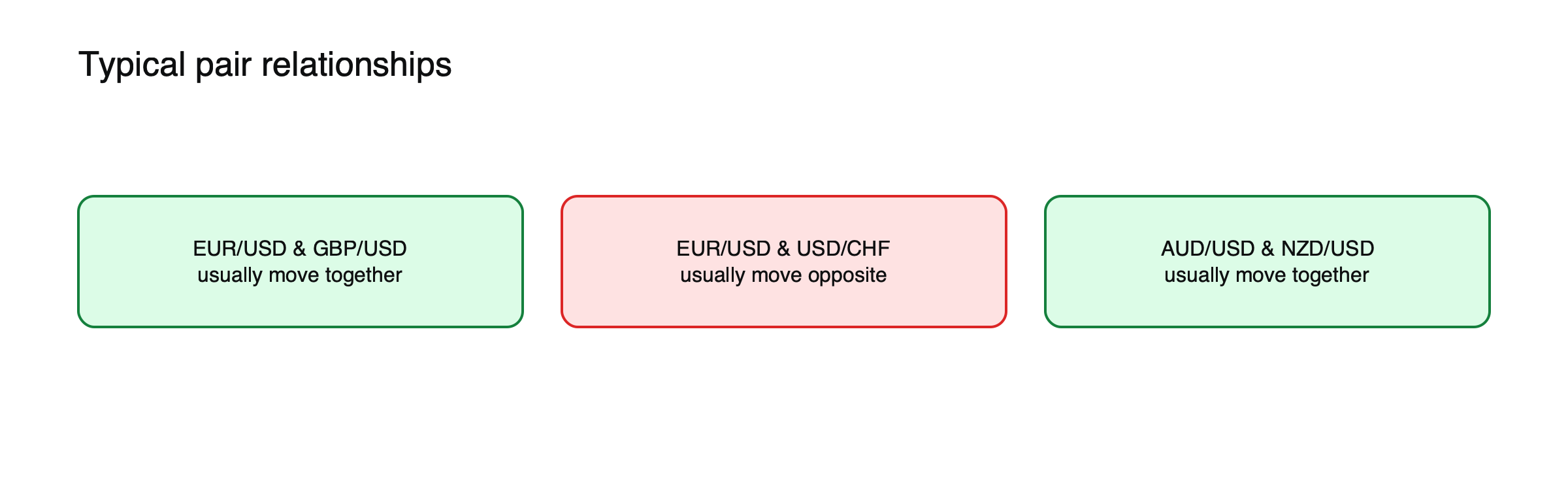
Figure: Typical relationships; actual correlations change over time.
These are tendencies; actual correlations rise and fall with market conditions.
Why it matters
Holding two strongly positively correlated positions, for example long EUR/USD and long GBP/USD, is close to doubling the same bet on the dollar falling. Holding long EUR/USD and long USD/CHF can largely cancel out. See correlation mistakes that quietly double your forex risk.
What correlation does to risk, in numbers
Suppose you hold one position in EUR/USD and one in GBP/USD, each of which typically moves by about $500 a day. (Illustrative figures.) If the two pairs were unrelated, the combined daily swing would be about $707. With a correlation of 0.8, it is about $949, close to the $1,000 of a single position twice the size. If instead the correlation were −0.8, the swings would largely offset, leaving about $316. The same two trades can carry very different risk depending on how the pairs move together.
How to use it
Check correlations over several periods before combining positions, and size the total exposure, not each trade alone. In a crisis, correlations can jump. See why correlations go to one in a crisis and what moves currency prices.
Correlations change
Correlations are not fixed. They shift when central banks diverge, when one economy faces a shock the other does not, or when markets switch between calm and fear. EUR/USD and GBP/USD, usually closely linked, can drift apart when UK politics or Bank of England policy dominates. In a crisis, many correlations jump toward +1 or −1 as everything trades on risk mood. Checking a short and a long measurement side by side shows whether a relationship is stable or changing.
Using correlation for hedging
Correlation can also be used deliberately. A trader long AUD/USD who worries about a general risk-off move might hold a small position that tends to move the other way, such as a long yen position, accepting the cost as insurance. The hedge only works as long as the correlation holds, so it needs checking regularly rather than being set once and forgotten.
Correlation is not causation
Two pairs can move together without one causing the other; usually both respond to a shared driver, such as the dollar or global risk appetite. Understanding the driver matters more than the number, because when the driver changes, the correlation usually changes with it.
A correlation calculated by hand
Take five days of percentage moves. EUR/USD: +0.4, −0.2, +0.3, −0.5, +0.6. GBP/USD: +0.3, −0.1, +0.2, −0.4, +0.5. (Illustrative data.) The two pairs rose and fell on the same days by similar amounts, so the correlation over this short window works out at about 0.99, almost perfectly positive. Five days is far too few to rely on, but the example shows what the number captures: not whether the pairs moved by the same amount, but whether they moved together consistently.
A rough correlation map
| Pair | EUR/USD | GBP/USD | USD/JPY | USD/CHF | AUD/USD |
|---|---|---|---|---|---|
| EUR/USD | 1 | Strong + | Moderate − | Strong − | Moderate + |
| GBP/USD | Strong + | 1 | Moderate − | Moderate − | Moderate + |
| USD/JPY | Moderate − | Moderate − | 1 | Moderate + | Variable |
| USD/CHF | Strong − | Moderate − | Moderate + | 1 | Moderate − |
| AUD/USD | Moderate + | Moderate + | Variable | Moderate − | 1 |
(Typical tendencies only; actual readings change over time and should be checked before trading.)
Correlations with other markets
Currencies also correlate with assets outside forex. The Australian dollar often moves with iron ore and copper, the Canadian dollar at times with oil, USD/JPY with US Treasury yields and the Swiss franc with the euro. AUD/JPY often tracks global stock indices. These links help explain moves, but like currency correlations they strengthen and weaken over time. See why USD/CAD moves with oil prices and why USD/JPY follows US Treasury yields.
Sizing correlated positions
A practical rule is to treat strongly correlated positions as parts of one trade. If two pairs have a correlation above about 0.7 and you would normally risk 1% on a trade, the combined risk across both positions should stay close to 1%, not 2%. Sizing this way prevents a single move in the shared driver, usually the dollar, from causing a loss twice as large as planned. See how to calculate forex position size.
When a correlation breaks
A sudden change in a long-standing correlation is itself useful information. If EUR/USD and GBP/USD, which usually move together, start moving in opposite directions, something specific to the UK or the euro area is probably driving one of them. If AUD/USD stops following commodity prices, interest rates may have taken over. Noticing these breaks early can explain confusing price action and prompt a review of positions built on the old relationship.
Matching the window to your holding period
A pair can be strongly correlated over a year but weakly over a week, or the reverse. Short-term traders should care most about short windows, and longer-term traders should look further back. Using a window that matches your holding period keeps it relevant.
Common traps
- Relying on a correlation measured over a calm period during a crisis.
- Assuming opposite positions in negatively correlated pairs remove all risk.
- Forgetting that spreads and rollover are paid on every position, even when they offset each other.
- Ignoring correlation with positions in other markets, such as stock index CFDs.
Frequently asked questions
What counts as a strong correlation?
Readings above about 0.7 or below about −0.7 are often described as strong, and readings near zero as weak. The exact thresholds are a convention, not a rule.
How often should I check correlations?
Whenever you add a position to related pairs, and periodically for open positions, especially after major news that might change how currencies relate to each other.
This article is educational content and does not constitute financial, investment, legal or tax advice. Digital assets are volatile and you may lose the amount you invest.