
What Is the EURO STOXX 50?
The EURO STOXX 50 tracks 50 of the largest euro area companies by market value. How it differs from the DAX and FTSE 100, what moves it and how it trades.
The EURO STOXX 50 tracks 50 of the largest companies in euro area countries, weighted by free-float market value. It is the main eurozone blue-chip benchmark, spanning France, Germany, the Netherlands, Italy, Spain and others, and is widely used for futures and ETFs. Unlike the DAX or FTSE 100, it spans many countries.
How it is built
- 50 large companies from euro area countries.
- Market-cap weighted, using free float, with caps on individual weights.
- Administered by STOXX.
How it differs from national indices
| EURO STOXX 50 | DAX 40 | FTSE 100 | |
|---|---|---|---|
| Coverage | Euro area | Germany | UK |
| Currency | Euro | Euro | Pound |
| Dividends in main version | No | Yes | No |
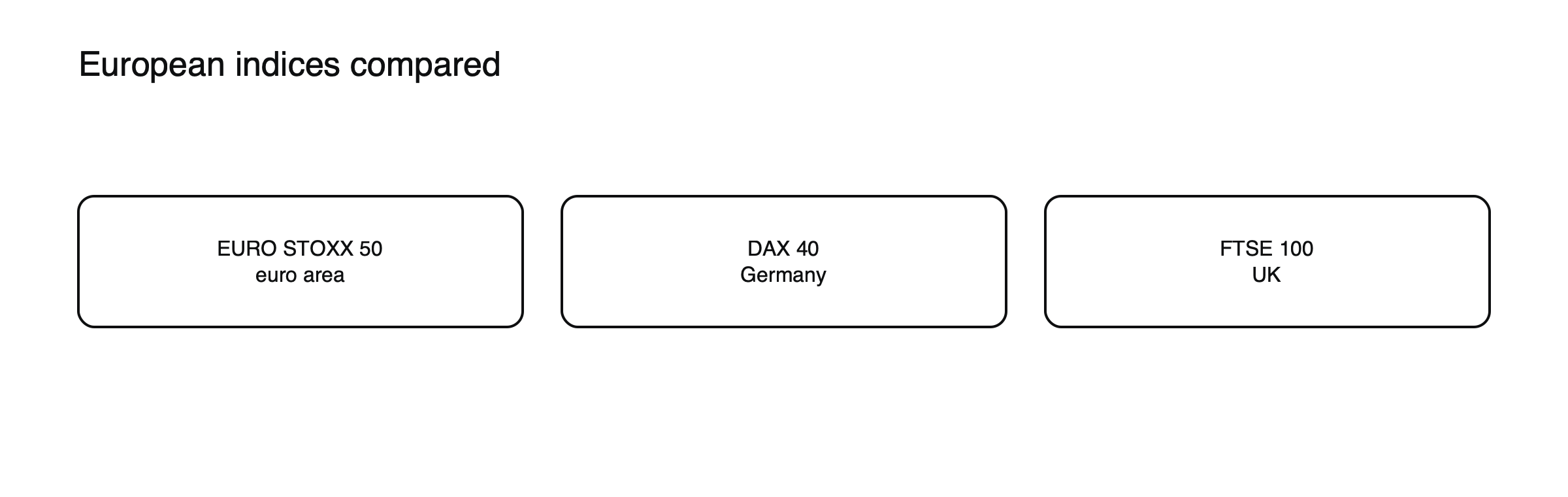
Figure: Coverage of three European indices.
Country and sector mix
French and German companies make up the largest share of the index, followed by the Netherlands, Italy and Spain. Its members include luxury goods makers, chipmaking equipment suppliers, software companies, banks, insurers, energy companies and industrial groups. Because it spans several countries, it is less exposed to any single national economy than the DAX or the French CAC 40, but more exposed to euro area-wide factors such as ECB policy and the euro.
Banks and bond spreads
Banks carry a significant weight, and their shares are sensitive to interest rates and to the health of government bond markets. When investors worry about the finances of a euro area government, for example Italy, the gap between its bond yields and Germany’s widens, weighing on banks that hold those bonds and on the index. Rising rates, by contrast, can support bank profits, making the index’s reaction to ECB decisions more mixed than that of technology-heavy indices.
What moves it
ECB policy, euro area growth and inflation, bank stocks, energy prices, global trade and the euro’s exchange rate. Bond spread worries, such as Italy’s, can weigh on it. See how the ECB and the Fed differ in moving markets.
How it is traded. Through futures, options, ETFs and CFDs, often labeled «EU Stocks 50.» See how stock index CFDs work.
See what the DAX 40 is and what moves stock market indices.
The euro’s effect
A weaker euro generally helps the index’s many exporters, because their foreign earnings are worth more in euros, while a stronger euro can weigh on them. For investors outside the euro area, returns depend on both the index and the euro’s exchange rate, which can amplify or offset each other.
Trading an EU Stocks 50 CFD, worked through
With the index at an illustrative 5,000, an EU Stocks 50 CFD at €5 per point is a position worth about €25,000, needing about €1,250 of margin at the 20:1 retail limit for major indices. A 60-point move, about 1.2%, gains or loses €300. (Illustrative trade.) Futures on the index are among the most actively traded equity index contracts in Europe, so CFD pricing is usually tight during European hours. See how to calculate the value of a point on an index CFD.
Dividends and the spring season
As a price index, the EURO STOXX 50 falls when its members go ex-dividend. Many European companies pay their main annual dividend in the spring, so the index sees large dividend drops in April and May, and cash CFDs receive correspondingly larger dividend adjustments during that period.
History
The index was launched in 1998, shortly before the euro’s introduction, to provide a benchmark for the new single-currency area. It has since become the main reference for eurozone large companies and the basis for many funds and derivatives.
Compared with the S&P 500
| EURO STOXX 50 | S&P 500 | |
|---|---|---|
| Members | 50 | About 500 |
| Technology weight | Lower | Close to 40% |
| Banks and insurers | Significant | Smaller share |
| Main currency | Euro | US dollar |
| Typical valuation | Lower | Higher |
(General characteristics.) Lower valuations in Europe partly reflect a heavier weight in banks, energy and industrial companies and slower growth, which is why the two indices respond differently to the same events.
An ECB day, illustrated
Suppose the ECB cuts rates by more than expected. (Illustrative scenario.) The euro falls, lifting exporters; bond yields drop, supporting real estate and some growth companies; but bank shares slip, because lower rates squeeze lending margins. The index might rise modestly overall, with large moves underneath. The same decision would have a more one-sided effect on a technology-heavy index, which is why European indices often react to central banks in more complex ways. See how central bank decisions move currencies.
Energy prices and Europe
Europe imports much of its energy, so sharp rises in gas and oil prices hit companies’ costs and consumers’ spending. In 2022, when European gas prices surged to about ten times normal levels, industrial companies faced higher costs and recession fears weighed on the index, even as energy companies benefited. Energy shocks therefore tend to hurt European indices more than US ones.
Luxury and China
Several large members are luxury goods companies that sell heavily to Chinese consumers, and chip equipment makers that sell to Asian chip factories. Their results, and news about Chinese demand, can move the index noticeably, linking it to China’s economy more than its European focus suggests.
Common misreadings
- Assuming the index reflects any single country.
- Treating lower valuations as a sign it must outperform.
The euro area debt crisis
Between 2010 and 2012, fears that some euro area governments, including Greece, Ireland, Portugal, Spain and Italy, could not repay their debts drove sharp falls in European shares, especially banks. The crisis eased after the president of the European Central Bank pledged in July 2012 to do «whatever it takes» to preserve the euro, followed by new tools to support government bond markets. The episode left a lasting sensitivity: whenever investors question a member government’s finances, bank shares and the EURO STOXX 50 tend to fall. See what the euro launch in 1999 changed.
Measuring European fear
Just as the VIX measures expected volatility in the S&P 500, the VSTOXX measures expected volatility in the EURO STOXX 50 from options prices. It tends to jump during sell-offs and crises, and traders watch it as a gauge of stress in European markets. See what the VIX is.
Sector rotation within Europe
Because the index combines banks, energy, industrials, luxury goods and technology, rotations between these groups can move it differently from other indices. A shift from growth to value, for example, usually helps European indices relative to technology-heavy US ones.
Trading hours
The index’s members trade on several exchanges that share similar hours, roughly 9:00 a.m. to 5:30 p.m. Central European Time, while EURO STOXX 50 futures trade for longer. CFD providers often quote EU Stocks 50 for extended hours, pricing from futures outside the cash session. The European open reacts to overnight Asian trading and US futures, and the afternoon session overlaps with the US open, when US data and Wall Street can move European shares. Spreads are usually tightest when both major European and US cash markets are open together.
Frequently asked questions
How is it different from the STOXX Europe 50?
The STOXX Europe 50 includes companies from across Europe, including the UK and Switzerland; the EURO STOXX 50 includes only companies from euro area countries.
Which country has the most influence?
France and Germany together usually account for most of the index’s weight.
This article is educational content and does not constitute financial, investment, legal or tax advice. Digital assets are volatile and you may lose the amount you invest.
Sources
- Share index SMI (launch years and weighting methods; EURO STOXX 50, Hang Seng and FTSE 100 cap-weighted; Nikkei 225 price-weighted) — SIX Group
- What is the DAX index (dividends reinvested; FTSE 100 quoted as price return; FTSE heavier in energy, mining and financials; German data drivers) — CMC Markets
- ESMA adopts CFD measures (20:1 for major indices; 10:1 for non-major equity indices) — Finadium
- Europe’s energy crisis (gas reached about ten times normal levels in 2022) — Foreign Policy, August 2022