
What Happens to a Stock CFD on Ex-Dividend Day?
On the ex-dividend date a share usually drops by about the dividend; long CFDs are credited and shorts debited. A worked example with 200 CFD shares.
On the ex-dividend date, a share usually falls by about the dividend, because new buyers no longer receive it. CFD providers offset this with a cash adjustment: longs are credited roughly the dividend and shorts debited. On 200 CFD shares with a $0.50 dividend, that is about +$100 for a long and −$100 for a short.
The mechanics
- Ex-dividend date: the first day the share trades without the right to the upcoming dividend.
- Price effect: the share typically opens lower by about the dividend.
- CFD adjustment: applied to positions open at the previous close.
The key dates
| Date | What it means |
|---|---|
| Declaration date | The company announces the dividend and its dates |
| Ex-dividend date | Shares bought from this day no longer carry the dividend |
| Record date | The company checks its register of shareholders |
| Payment date | The dividend is paid to shareholders |
For CFDs, the ex-dividend date is the one that matters: the adjustment is usually applied to positions open at the close of the previous trading day.
Worked example
- Position: 200 CFD shares
- Dividend: $0.50 per share (example value)
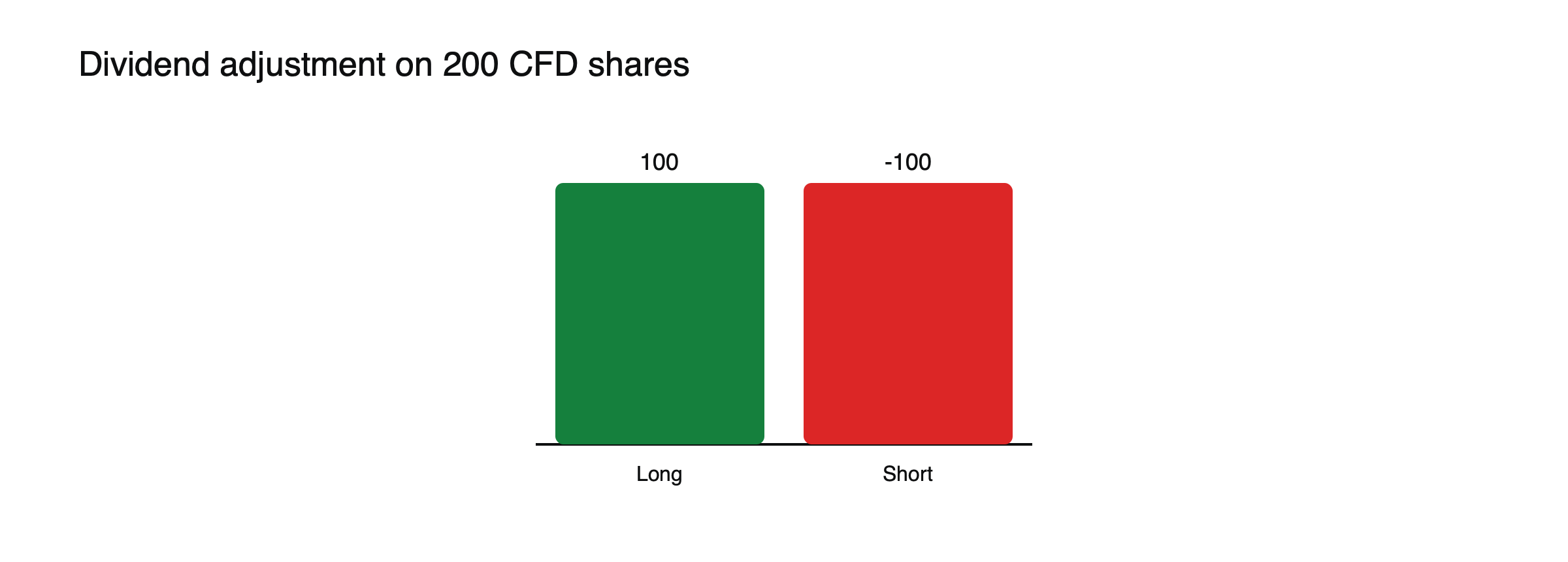
Figure: Dividend adjustments offset the ex-date price drop (example values).
Long: credited about 200 × $0.50 = $100, offsetting the price drop.
Short: debited about $100, offsetting the gain from the price drop.
Some providers credit long positions net of an amount reflecting withholding tax, so the credit can be smaller than the gross dividend. Check your provider’s terms.
The full picture for a long
Suppose a share closes at $40.00 the day before its ex-dividend date and pays a $0.50 dividend. The next morning it opens around $39.50, all else equal. A long position of 200 CFD shares shows a price loss of about $100, and the provider credits about $100, or perhaps $85 if it deducts an amount reflecting 15% withholding tax. (Illustrative figures.) The net effect on equity is close to zero, or slightly negative after any deduction. The price drop on the chart looks like a loss, but most of it is matched by the cash credit.
The full picture for a short
For a short of 200 CFD shares, the same price drop shows a gain of about $100, and the provider debits about $100, usually the gross dividend. The short gains nothing from the ex-date drop. Traders who short shares just before ex-dividend dates expecting to profit from the drop find the debit cancels it.
Why it matters
- No free lunch for shorts: the price drop on ex-date is matched by the dividend debit.
- Large special dividends can produce large adjustments.
- Stops: the ex-date price drop can trigger stops on long positions, even though the adjustment offsets it in cash.
What to check
Upcoming ex-dividend dates on any share you hold, the dividend amount, and how your provider calculates adjustments. See how stock CFDs work, what a CFD trade really costs and how short selling works with CFDs.
Special dividends
Companies sometimes pay one-off special dividends, which can be large, several percent of the share price or more. The share falls by about the special dividend on the ex-date, and CFD adjustments follow the same rules but in bigger amounts. Stops placed close to the price can trigger on the drop even though the cash adjustment offsets it, so positions held through large special dividends need particular attention.
Index CFDs and dividends
Stock index CFDs are affected too. When companies in an index go ex-dividend, the index falls slightly, and providers make dividend adjustments to index CFD positions based on the expected index points involved. Around peak dividend seasons, these adjustments can add up. See how stock index CFDs work.
The dividend-capture idea
Some traders try to buy shares just before the ex-dividend date to collect the dividend, then sell soon after. With CFDs, the price drop on the ex-date and the cash adjustment usually cancel out, while spreads, commissions and financing remain, so the strategy rarely makes sense. Any profit depends on the share recovering its drop quickly, which is a price bet rather than a dividend gain.
A dividend checklist
- Is an ex-dividend date due while the position is open?
- How large is the dividend relative to the share price?
- How does the provider calculate the adjustment for longs and shorts?
- Are stops placed far enough from the price to survive the ex-date drop?
Dividends and financing together
For positions held for weeks, dividends and financing are both part of the cost picture. A long position pays financing every night but receives dividend adjustments; a short may receive or pay financing but pays dividends. On a high-dividend share, the dividend debit on a short held through several ex-dates can be larger than any financing it earns. Adding both together for the planned holding period shows the true cost of holding.
Finding ex-dividend dates
Companies announce dividends and their dates in results releases and on their investor relations pages, and many financial websites and trading platforms list upcoming ex-dates. Checking these before opening a position, and noting them alongside earnings dates, avoids surprises on the day.
Withholding and different markets
Dividend adjustments on long positions often reflect the withholding tax that applies to dividends in the company’s home country, and those rates differ between countries and sometimes between types of account. As a result, the credit on the same size of position can vary across shares from different markets. Providers publish how they calculate adjustments, and it is worth checking before holding high-yield shares through ex-dates.
Stops on ex-dividend day, illustrated
A trader holds a long of 200 CFD shares bought at $40.00, with a stop at $39.60. The share pays a $0.50 dividend and opens at $39.50 on the ex-date, below the stop. The stop triggers at the open, closing the position for a price loss of about $100, even though the dividend credit of about $100 offsets it. The trader is now out of a position that the market never moved against, and pays spreads to re-enter. (Illustrative figures.) Moving stops by the dividend amount before the ex-date, or checking whether the provider adjusts orders automatically, avoids this. The same applies to limit orders on long positions placed near the price just before an ex-date.
Frequently asked questions
Do I need to own the CFD on the record date?
No. For CFDs, what matters is holding the position at the close before the ex-dividend date.
Why was my dividend credit smaller than the dividend?
Some providers deduct an amount reflecting withholding tax on long positions, so the credit can be less than the gross dividend.
Leverage, margin and cost figures in this article are example values for illustration. Actual terms depend on the provider, the instrument and the rules in your country.
This article is educational content and does not constitute financial, investment, legal or tax advice. Digital assets are volatile and you may lose the amount you invest.