
What Is Forex Rollover and Why Does It Happen at 5 p.m. New York Time?
Forex rollover moves open positions to the next value date at 5 p.m. New York time, applying the interest rate gap. How it works and why Wednesday is triple.
Forex rollover is the daily adjustment on positions still open at 5 p.m. New York time, the end of the FX day. Spot trades settle two business days later, so providers roll positions forward and charge or credit the two currencies’ interest rate difference, plus a fee. Wednesday’s rollover usually counts three days.
Why 5 p.m. New York?
The global FX day is conventionally measured from 5 p.m. New York time, when the trading week also opens in Sydney on Sunday. Positions open at that moment move to the next value date. Some providers express this as 10 p.m. UK time or 21:00 UTC, depending on daylight saving.
How the charge or credit is set
Rollover reflects the interest rate gap between the two currencies, often through the tom-next swap rate, plus a provider fee:
- Buying the higher-yielding currency can earn a credit, if the rate gap exceeds the fee.
- Buying the lower-yielding currency usually pays.
See how interest rate differentials drive currency pairs.
Rollover in numbers
Suppose US short-term rates are 4.5% and Japanese rates 0.5%, a gap of 4 percentage points, and the broker applies a 1% fee. (Illustrative rates.) Holding 1 standard lot of USD/JPY, about $100,000 of exposure:
- Long (holding dollars, owing yen): the 4% gap minus the 1% fee leaves about 3% a year, a credit of about $8.33 a night.
- Short (holding yen, owing dollars): the 4% gap plus the 1% fee is about 5% a year, a charge of about $13.89 a night.
The fee works against both sides, which is why the long earns less than the gap and the short pays more.
What tom-next means
Rollover is priced from the tom-next swap rate: the cost of exchanging currencies tomorrow and swapping them back the next day. It reflects overnight interest rates in the two currencies. Brokers apply it to retail positions, add their fee and express the result either as an amount per lot or as a swap in points.
Why Wednesday is triple
A spot trade on Wednesday settles on Friday; rolling it forward pushes settlement past the weekend to Monday. To cover those two extra days, positions held through Wednesday’s cut-off are charged or credited three days of rollover.
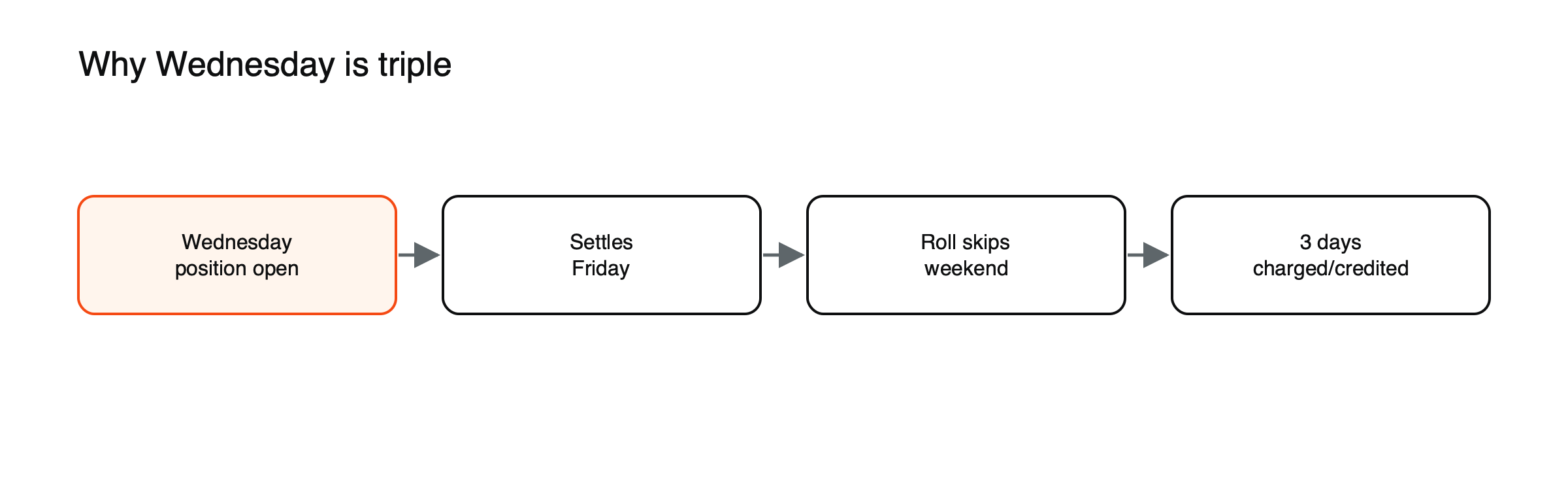
Figure: Why Wednesday’s rollover counts three days.
Triple Wednesday in numbers
Using the example above, a long USD/JPY lot held through Wednesday’s cut-off earns about $25 that night instead of $8.33, while a short pays about $41.67 instead of $13.89. Over a full week, the total is the same as seven nights of rollover; it is simply concentrated on one day.
Holidays change the pattern
When a bank holiday in either currency’s country falls in the settlement window, the extra days are charged on a different weekday. Brokers publish holiday schedules showing when multiple-day rollover applies, which is worth checking before holding positions over holiday periods.
Why it matters. For short trades closed before 5 p.m., rollover does not apply. For positions held for weeks, it can be a significant cost or income. Spreads also often widen briefly around rollover time. See how overnight financing works on a CFD position and how the forex market works.
Rollover, swap and overnight financing
Different platforms use different names for the same thing: rollover, swap, overnight interest or overnight financing. On forex CFDs they all describe the daily adjustment for holding a position past the cut-off. See how CFD overnight financing works.
Rollover and carry trades
Carry traders deliberately hold positions that earn rollover, buying higher-yielding currencies against lower-yielding ones. The income can add up over months, but it is small compared with the exchange-rate risk: a move of a few percent against the position can wipe out a year of rollover in days. See what a carry trade is and carry trade risks.
Spreads around the cut-off
In the minutes before and after 5 p.m. New York time, liquidity is thin as banks roll their books. Spreads often widen sharply, sometimes to several times their normal level, and stops can be triggered by the wider quote. Many traders avoid opening or closing positions in that window.
Using or avoiding rollover
Day traders close positions before the cut-off and never pay rollover. Swing traders holding for days should estimate it in advance, especially on pairs with large interest rate gaps, where one side earns and the other pays noticeably. Checking the broker’s current long and short swap values for each pair takes seconds and removes guesswork.
A month of rollover
Using the illustrative rates above, a long position of 1 lot of USD/JPY held for 30 nights earns about $250 of rollover, while a short position of 0.5 lots held for the same period pays about $208. (Example figures.) Over a month, rollover can be large enough to matter, but small next to price moves: a 1% move in USD/JPY on one lot is worth about $1,000.
Why the credit is smaller than it looks
Comparing two central bank rates suggests what a long position might earn, but the broker’s fee is subtracted, actual overnight funding rates can differ from policy rates and the credit is calculated on a position that can lose value. Many traders find that the rollover they receive is noticeably below the headline interest rate gap.
Rollover on exotic pairs
Exotic currencies often carry high interest rates, so rollover on pairs such as USD/TRY or USD/ZAR can be large: a meaningful credit on one side and a heavy charge on the other. Those rates can change abruptly when local central banks act or when funding markets come under stress, so rollover on exotics deserves particular attention before holding positions overnight.
Checking rollover on your platform
Most trading platforms show long and short swap values for each pair in the contract specification, often in points or in account currency per lot. Some also show the swap accrued on each open position. Looking these up before holding a position overnight, and noting which day carries the triple charge, takes less than a minute and turns rollover from a surprise on the statement into a known cost or income that can be weighed against the trade’s expected move. Rates update daily, so a value checked last month may be out of date, especially after a central bank decision in either currency.
Frequently asked questions
Do I pay rollover on a position opened and closed the same day?
No. Rollover applies only to positions still open at the daily cut-off.
Can rollover change while I hold a position?
Yes. It follows interest rates and the broker’s fee, so it can change after central bank decisions or when market funding conditions shift.
This article is educational content and does not constitute financial, investment, legal or tax advice. Digital assets are volatile and you may lose the amount you invest.
Sources
- Why is overnight funding charged (tom-next rate plus admin fee; positions held through Wednesday 10 p.m. UK time incur three days) — IG
- FX futures trading (spot FX settles in two business days) — Grey
- When can you trade forex? (5 p.m. EST Sunday to 5 p.m. EST Friday) — BlackBull Markets
- Forex 24/5 trading (21:00 UTC rollover) — Capital.com