
Why Gold and the US Dollar Usually Move in Opposite Directions
Gold is priced in dollars, so a weaker dollar often lifts it and a stronger one weighs on it. How the link works and when gold and the dollar rise together.
Gold and the US dollar usually move oppositely because gold is priced in dollars. A weaker dollar makes gold cheaper in other currencies, tending to lift demand and its dollar price; a stronger dollar does the reverse. Both also respond to US interest rates, and in a severe panic both can rise together as havens.
How the link works
- Pricing: a dollar move changes gold’s price in other currencies even if its dollar price stays flat.
- Rates: higher US rates tend to lift the dollar and raise the cost of holding gold.
- Alternatives: gold and the dollar compete as stores of value; doubts about one can help the other.
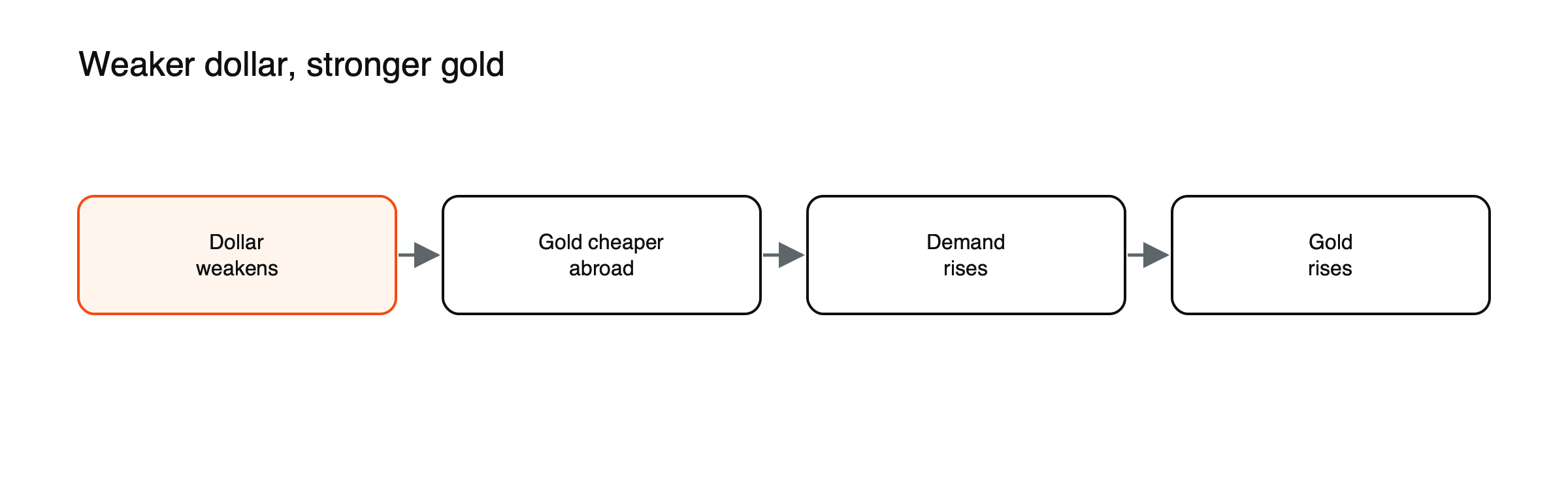
Figure: Why a weaker dollar often lifts gold.
The effect in numbers
Suppose gold stays at $2,400 an ounce while EUR/USD falls from 1.10 to 1.05. (Illustrative prices.) For a buyer in euros, gold rises from about €2,182 to €2,286, about 4.8%, without any change in its dollar price. European demand may soften as gold becomes more expensive in euros, which can in turn weigh on the dollar price. This feedback is one reason a stronger dollar tends to coincide with weaker gold.
How to watch it
Compare gold with the US Dollar Index (DXY). Because the euro makes up 57.6% of the DXY, EUR/USD often moves with gold. See what the US Dollar Index is.
Measuring the relationship
The link is easiest to see in correlation over rolling periods. Over many years, the correlation between gold and the dollar index has usually been negative, meaning they tend to move in opposite directions. But it varies: it can be strongly negative for months, then weak or even positive during crises or when central bank buying dominates. Checking a recent measurement, rather than assuming a fixed relationship, gives a better guide. See how currency correlations work.
Gold as an alternative to the dollar
Gold and the dollar compete as stores of value. When confidence in US policy, government debt or the dollar’s international role weakens, some investors and central banks shift toward gold, which can lift it even when interest rates do not favor it. Reserve managers diversifying away from the dollar have been among the biggest gold buyers since 2022. See how central bank gold buying affects the price.
When both rise together
In acute crises, investors may buy both dollars and gold for safety. Central bank buying can also lift gold even when the dollar is firm.
When gold falls with the dollar
In a dash for cash, such as March 2020, investors sold gold briefly to raise dollars.
Gold in other currencies
For traders outside the US, currency moves affect returns: gold can rise in euros or yen even when it falls in dollars.
See what moves gold prices and how commodity CFDs work.
Gold priced in other currencies
Some brokers quote gold against currencies other than the dollar, for example as XAU/EUR or XAU/JPY. These instruments combine a view on gold with a view on the currency. A trader who expects gold to rise and the yen to weaken might prefer gold in yen; one who wants exposure to gold without a dollar view might hedge the currency separately. Checking which currency a gold CFD is priced in, and the account currency, avoids unintended currency bets.
Gold, the dollar and interest rates together
Much of the gold–dollar relationship runs through interest rates. Higher US real yields tend to lift the dollar and raise the opportunity cost of gold at the same time, so the two move apart. When rate expectations fall, the dollar often weakens and gold strengthens together. Looking at real yields alongside the dollar index explains many of the days when gold and the dollar move sharply in opposite directions. See why gold falls when real yields rise.
A quick check before a gold trade
- What is the dollar doing against the euro and yen?
- Are US real yields rising or falling?
- Is the market in a calm phase or a crisis?
- Is the gold position priced in dollars, and is your account in another currency?
A day of dollar strength, illustrated
Suppose strong US jobs data lift expectations for interest rates. (Illustrative scenario.) The dollar index rises 0.8%, EUR/USD falls from 1.1000 to 1.0910, and US real yields climb. Gold falls about 1.2% in dollars. In euros, the fall is much smaller, because the weaker euro offsets most of the decline. A European investor sees a slight loss; an American investor sees a larger one. The same event, viewed in different currencies, produces different results.
Why the euro matters most
Because the euro makes up 57.6% of the dollar index, moves in EUR/USD dominate the index and are often the clearest way to see the dollar side of the gold relationship. Traders sometimes watch EUR/USD and gold together on the same screen: when both rise, the dollar is usually weakening broadly; when they diverge, something specific to gold, such as central bank buying or safe-haven demand, is likely at work.
Gold in weaker currencies
In countries whose currencies have fallen sharply, gold has often reached record highs in local terms even when its dollar price was flat or falling. For households in those countries, gold has worked as a hedge against their own currency’s decline. This is one reason gold demand can stay strong in some emerging markets during periods of currency weakness.
Common misreadings
- Assuming gold and the dollar must always move oppositely.
- Ignoring the currency of your own account when judging gold’s performance.
- Watching the dollar but not real yields, which often drive both.
Gold and the end of the dollar’s gold link
For much of the twentieth century, the dollar was tied to gold at a fixed price. When the United States ended the dollar’s convertibility into gold in 1971, gold began to trade freely, and its relationship with the dollar became the market-driven one seen today. Periods of dollar weakness and high inflation in the 1970s produced some of gold’s biggest gains. See what the Nixon shock was.
Watching what drives the dollar
Because so much of gold’s link with the dollar runs through US policy, the most useful question on any given day is why the dollar is moving. A dollar rally driven by higher US rate expectations is usually bad for gold. A dollar rally driven by global fear may coincide with gold strength. Understanding the cause, not just the direction, explains most of the exceptions to the usual pattern. See what moves currency prices. A quick look at US two-year yields and global stock markets alongside the dollar index usually answers that question within minutes of a large move, before the reasons appear in the news.
Frequently asked questions
Can gold rise while the dollar rises?
Yes. In crises, or when central banks and other buyers seek alternatives to dollar assets, both can rise together for a time.
Why did gold fall in March 2020 when the dollar rose?
Because investors sold assets, including gold, to raise dollars in a scramble for cash. Gold gave back nearly 15% over five sessions before recovering.
This article is educational content and does not constitute financial, investment, legal or tax advice. Digital assets are volatile and you may lose the amount you invest.
Sources
- U.S. Dollar Index (euro weight 57.6%) — Wikipedia
- March 2020 review and outlook (gold gave back nearly 15% over five sessions; higher real rates weigh on gold) — Nasdaq
- What’s behind the divergence between gold and real Treasury yields? (tracked closely late 1990s–2020; central banks about 1,000 tonnes a year 2022–2024) — Janus Henderson