
How Interest Rate Differentials Drive Currency Pairs
Currencies with higher or rising rates tend to attract money. How rate differentials work, what the carry trade is and what happened when it unwound in 2024.
An interest rate differential is the gap between two countries’ interest rates. Money tends to flow toward higher or rising rates, so shifts in expected differentials strongly drive currency pairs. The gap also powers the carry trade, borrowing cheaply to invest where rates are higher, which unwound violently in August 2024.
How differentials move currencies
If US rates rise relative to Japan’s, holding dollars earns more than holding yen, so investors buy dollars and USD/JPY tends to rise. What matters most is the expected change: markets react when central bank decisions or data shift the projected gap.
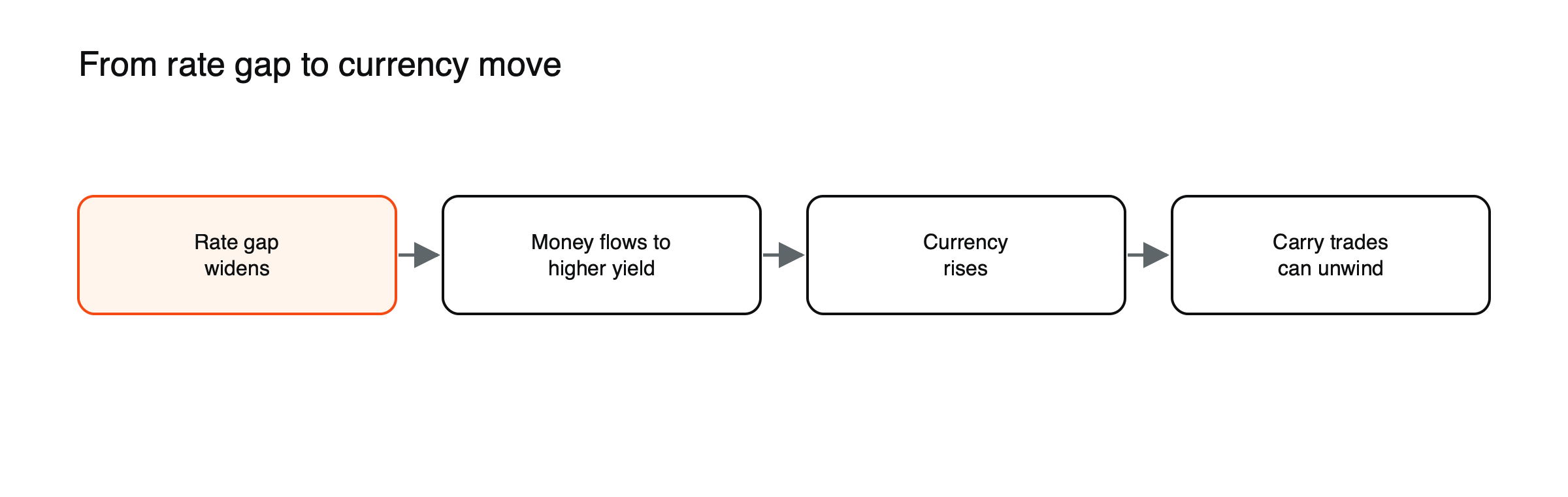
Figure: How a rate gap moves a currency, and where the risk lies.
Policy rates and market rates
Central bank policy rates are the starting point, but currency markets react more to market interest rates, especially two-year government bond yields, which reflect where traders think policy rates will be over the next couple of years. A central bank can hold its policy rate steady while its two-year yield moves sharply on changing expectations, and the currency usually follows the two-year yield. Comparing two countries’ two-year yields is a common way to measure the differential that matters for currencies.
Reading expectations from futures
Interest rate futures and overnight index swaps show what markets expect central banks to do at coming meetings. If those prices imply two US rate cuts this year and the data suddenly suggest three, the expected differential shifts within minutes, and the dollar typically weakens before any cut actually happens. Checking how much is already priced in before a central bank meeting helps explain why a widely expected decision may barely move a currency.
The carry trade
Investors borrow in a currency with near-zero rates, such as the yen for many years, and buy assets in a higher-yielding currency. They earn the rate gap as long as the exchange rate holds steady. Rollover on a spot or CFD position reflects the same gap. See what forex rollover is.
When carry trades unwind
When the Bank of Japan raised rates to 0.25% in July 2024 and US growth worries rose, the yen climbed about 14% against the dollar in under a month. Investors rushed to close yen-funded trades, which pushed the yen higher still and contributed to a 12.4% fall in Japan’s Nikkei on August 5. See why the yen rallies when global markets sell off.
The differential in forward prices
Interest rate differentials are built directly into forward exchange rates. Suppose EUR/USD trades at 1.1000, one-year US rates are 4.5% and euro rates 2.5%. (Illustrative rates.) The one-year forward rate is about 1.1000 × 1.025 ÷ 1.045 ≈ 1.0789, about 211 pips below spot. This does not mean markets expect the euro to fall; it simply reflects the cost of holding dollars rather than euros over the year. Forward points, quoted by dealers, are this differential expressed in pips, and they are the basis of the rollover charged on spot and CFD positions. See spot FX vs currency futures.
Real rates and nominal rates
A high interest rate does not attract money if inflation is eating it away. Suppose one country offers 4.5% with inflation at 4%, a real rate of about 0.5%, while another offers 2.5% with inflation of 1%, a real rate of about 1.5%. (Illustrative figures.) On a real basis, the lower nominal rate is more attractive. Currency markets often respond to real differentials, especially when inflation differs a lot between countries.
A differential move, illustrated
Suppose US two-year yields rise by a quarter of a percentage point after strong jobs data, while Japanese yields barely move. (Illustrative scenario.) The two-year spread widens in the dollar’s favor, and USD/JPY may climb by close to 1% within hours as investors adjust. If Japanese inflation data the next morning push Japanese yields higher, part of that move may reverse. Watching both sides of the spread, rather than US yields alone, explains much of the pair’s daily action.
Limits
- Risk sentiment can override differentials in a crisis.
- Hedging costs can cancel the gain for hedged investors.
- Inflation matters: a high nominal rate with high inflation may not attract money.
See how central bank decisions move currencies and what moves currency prices.
How to track differentials
Many traders keep a simple chart of the two-year yield spread for each pair they trade, plotted alongside the exchange rate. When the two lines move together, the differential is the dominant driver; when they diverge, something else, such as risk sentiment or intervention, has taken over. Central bank calendars and the market-implied path of rates complete the picture. See how to read a central bank statement.
Policy divergence produces the strongest trends
Differentials move most when two central banks head in opposite directions. In 2022, the Federal Reserve raised rates rapidly while the Bank of Japan kept its rates near zero, and the widening gap drove USD/JPY sharply higher for months. When both central banks move in the same direction at a similar pace, the differential changes little and other factors take over. Watching for the start of divergence, one bank turning while the other holds or moves the other way, is one of the most useful habits in currency analysis.
Hedged and unhedged investors
Large investors buying foreign bonds can hedge their currency exposure using forwards, but the hedge costs roughly the interest rate differential. When the gap is wide, hedging can wipe out most of the extra yield, so many investors either stay at home or buy unhedged, adding to demand for the higher-yielding currency. Shifts in how much these investors hedge can move currencies for weeks, independently of daily news.
Differentials in emerging markets
Emerging market currencies often offer much higher interest rates than major currencies, which attracts carry investors. But those differentials frequently compensate for higher inflation, political risk and the danger of sharp falls. A wide nominal gap can disappear quickly in real terms, and a sudden change in global risk appetite can override it entirely. See how emerging market currencies behave when risk appetite falls.
A routine before central bank meetings
Before a major decision, check what markets have priced in: how many cuts or hikes futures imply over the coming months, and how likely a move is at this meeting. Then consider three scenarios: the decision and guidance match expectations, they are more hawkish, or they are more dovish. For each, think about how the expected differential would change and how the currency might react. Positions can then be sized so that the least favorable scenario costs an acceptable amount. This takes a few minutes and turns the meeting from a gamble into a planned risk, while also making it easier to judge afterward whether a move was a genuine surprise or simply a reaction to details already partly expected. Writing the three scenarios down beforehand also helps.
Common misreadings
- Comparing today’s policy rates instead of expected future rates.
- Ignoring inflation when judging which rate is more attractive.
- Expecting a currency to rise on a rate hike that markets had already fully priced in.
Frequently asked questions
Which interest rate matters most for currencies?
Usually short-term market rates, such as two-year government bond yields, because they reflect expected central bank policy over the horizon most investors care about.
Why do forward rates differ from spot rates?
Because they include the interest rate differential between the two currencies over the period. The currency with the higher interest rate trades at a lower forward price.
This article is educational content and does not constitute financial, investment, legal or tax advice. Digital assets are volatile and you may lose the amount you invest.