
What Happened in the 2022 LME Nickel Squeeze?
On March 8, 2022, LME nickel more than doubled above $100,000 a tonne as Tsingshan covered a short. The LME halted trading and canceled $3.9 billion of trades.
The LME nickel squeeze came on March 8, 2022, when nickel more than doubled within hours to over $100,000 a tonne. Tsingshan, a top producer with a huge short, was forced to buy back as Russia’s invasion threatened supply. The LME suspended trading and canceled about $3.9 billion of trades, a still-controversial decision.
Timeline
- Late 2021–early 2022: Tsingshan builds a large short position to hedge its production.
- Late February 2022: Russia, a major nickel producer, invades Ukraine; prices rise.
- March 7: nickel jumps sharply; margin calls mount.
- March 8: three-month nickel hits about $101,365 a tonne; the LME halts trading and voids trades from midnight.
- March 16: trading resumes with daily price limits; a systems error briefly forces another halt.
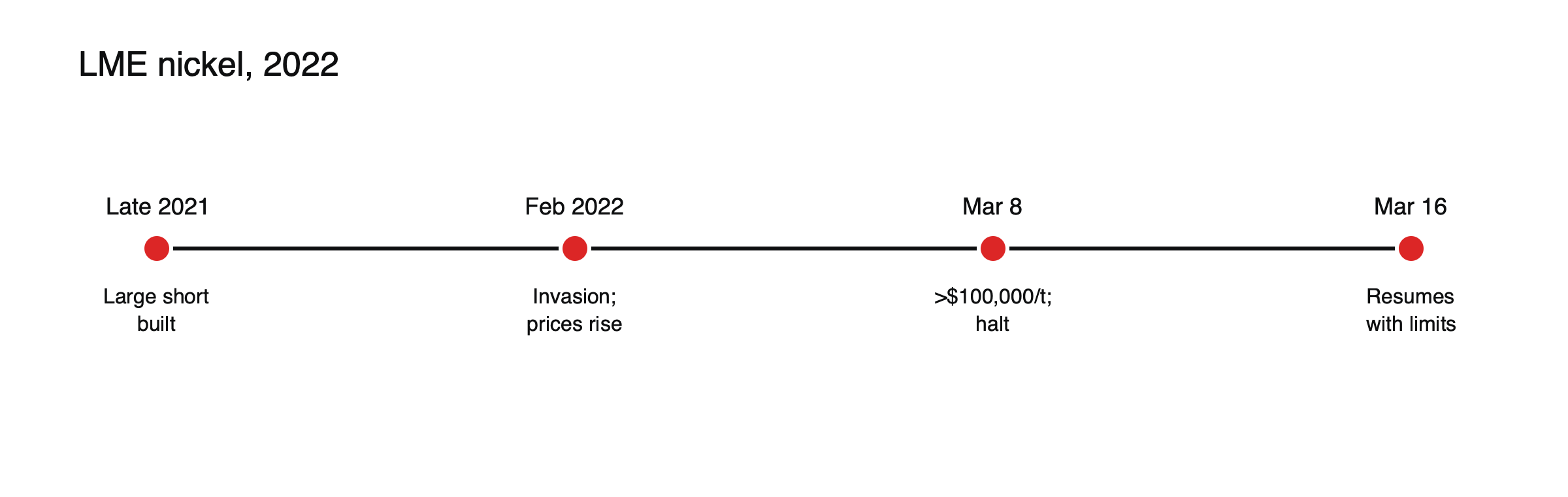
Figure: The nickel squeeze.
The market and the players
Nickel is used mainly in stainless steel and increasingly in batteries for electric vehicles. The London Metal Exchange is the main venue for trading it, and its three-month contract sets prices worldwide. Russia’s Nornickel is one of the largest producers of the high-purity nickel that can be delivered against LME contracts. Tsingshan, a Chinese company led by its founder Xiang Guangda, had become the world’s largest nickel producer by building huge operations in Indonesia, but much of its output was in forms that could not be delivered on the LME. To hedge against falling prices, it held a large short position, partly through the exchange and partly through bilateral deals with banks.
How the squeeze unfolded
When Russia invaded Ukraine, traders feared that sanctions or disruptions would cut off Russian nickel, and prices began to climb. On March 7, nickel rose by more than 60% in a single day. Every rise triggered margin calls on short positions, and holders who could not pay had to buy back contracts, pushing prices higher still. In the early hours of March 8, during thin Asian trading, the price more than doubled to above $100,000 a tonne. Tsingshan and other shorts faced margin calls running into billions of dollars, and some of the brokers and banks standing behind them risked default if the price stayed there.
The exchange’s decision
The LME suspended nickel trading on the morning of March 8 and then took the unprecedented step of canceling all trades made that day before the halt, about $3.9 billion worth, resetting prices to the previous evening’s close. The exchange said it acted to protect the market from a chain of defaults among its members. The market remained closed for about a week, and when it reopened on March 16 with daily price limits, a systems error briefly forced another halt.
Why it happened
- A concentrated short facing a supply shock.
- Margin calls forcing buying into a thin market.
- Low liquidity in a market dominated by a few large participants.
The controversy
Canceling completed trades protected some participants from default, but traders who had profited lost gains; critics said it damaged trust in the exchange.
Legal challenges
Some traders who lost profits from the canceled trades took the exchange to court, arguing that the cancellation was unlawful. In 2023, a UK court ruled in the LME’s favor, finding that it had acted within its powers in an extraordinary situation. The ruling settled the legal question but did not end the debate about whether canceling completed trades was the right response, or how it affected trust in the market.
Tsingshan’s way out
Tsingshan eventually agreed with the banks that held its positions to keep them in place without forcing immediate closure, a so-called standstill, and gradually reduced its short as prices fell. It also arranged to deliver suitable nickel from other sources. The company survived, and nickel prices fell back to well below their March peak within months as Indonesian supply kept growing.
What changed
The LME introduced daily price limits and faced regulatory reviews of its handling.
Lessons
Even large industrial markets can squeeze; exchanges may intervene in ways traders cannot predict; leverage and concentration are a dangerous mix. See what a short squeeze is, how the Hunt brothers tried to corner silver and how commodity CFDs work.
Timeline at a glance
| Date | Event |
|---|---|
| Late 2021–early 2022 | Tsingshan builds a large short to hedge production |
| February 24, 2022 | Russia invades Ukraine; nickel starts rising |
| March 7 | Nickel jumps more than 60% in a day |
| March 8 | Price tops $100,000; LME halts trading and cancels the day’s trades |
| March 16 | Trading resumes with daily limits; a systems error briefly halts it again |
| 2023 | UK court rules the LME acted lawfully |
Lessons for traders
The squeeze shows that even an industrial metal traded mainly by producers and consumers can behave like the most speculative market when a large, concentrated position meets a supply shock. It shows that margin calls can force buying or selling at any price. And it shows that exchanges can take extraordinary steps, including canceling trades, which can wipe out gains as well as losses. For CFD traders, a provider may follow such decisions or suspend trading in the affected instrument, so contract terms on market disruption are worth knowing in advance. See what moves copper prices and how commodity CFDs work.
Comparing it with other squeezes
Like the Hunt brothers’ silver episode in 1980, the nickel squeeze involved a thin market, very large positions and an exchange changing the rules under pressure. Unlike the Hunts, Tsingshan was a producer hedging real output rather than a speculator trying to corner supply, and the squeeze ran against a short rather than a long. Both show that concentration and leverage can overwhelm a market’s normal functioning. See how the Hunt brothers tried to corner silver and what happened in the Volkswagen short squeeze.
Nickel and batteries
Most nickel goes into stainless steel, but demand from batteries for electric vehicles has grown quickly, because nickel-rich battery chemistries store more energy. That growth had drawn investors and speculators into the market in the years before 2022, adding to the sense that nickel could become scarce. The squeeze made automakers and battery makers more cautious about relying on the LME price for long-term supply contracts.
How price limits work
After the squeeze, the LME introduced daily price limits for its metals, capping how far prices can move from the previous close in one day. If a price hits the limit, trading can continue only within the band. Limits slow down extreme moves and give participants time to meet margin calls, but they can also delay price discovery, leaving positions locked at the limit while the real value is uncertain.
Lessons for exchanges
The episode raised questions about how exchanges monitor large positions, especially those held partly off-exchange through banks, and how they balance protecting the system against respecting completed trades. Regulators reviewed the LME’s handling, and the exchange strengthened its oversight of over-the-counter positions linked to its contracts. For traders, the lesson is that market rules include emergency powers, and those powers can be used.
The exchange’s ownership
The London Metal Exchange has been owned since 2012 by Hong Kong Exchanges and Clearing, and many of its members and clients are Asian producers, traders and banks. The decisive price spike came during Asian trading hours, when liquidity in London-based contracts is thin. Some critics argued that the exchange’s owners and members had conflicting interests in deciding whether to cancel trades; the LME maintained that its decision was based solely on protecting market stability. The debate highlighted how much a market’s rules depend on the judgment of those who run it. For traders in any market, it is a clear reminder that liquidity and exchange governance can matter just as much as supply and demand when prices become extreme and positions crowded.
Frequently asked questions
Why did the LME cancel trades instead of letting prices stand?
It said that prices above $100,000 risked defaults by members unable to meet margin calls, which could have threatened the whole market. Critics argued it protected some participants at the expense of others.
Could it happen again?
The LME now uses daily price limits and has tightened oversight of large positions, but squeezes remain possible in any market where positions become very concentrated.
This article is educational content and does not constitute financial, investment, legal or tax advice. Digital assets are volatile and you may lose the amount you invest.
Sources
- LME forced to halt nickel trading, cancel deals (three-month nickel $101,365; trades voided from midnight; Tsingshan short) — Reuters via Euronews, March 2022
- Nickel market stays closed after historic short squeeze (about $3.9 billion of trades scrapped) — City A.M., March 2022
- Systems error triggers fresh chaos as LME suspends nickel trading again (resumed March 16 with price limits) — CNBC via NBC New York