
How to Calculate a Real Yield
Real yield = nominal − inflation, or (1 + nominal) ÷ (1 + inflation) − 1. A 4.2% bond with 3% inflation yields about 1.17% real. How to calculate and read it.
A real yield is a bond’s return after inflation: real ≈ nominal − inflation, or precisely (1 + nominal) ÷ (1 + inflation) − 1. A bond yielding 4.2% with 3% inflation has a real yield of about 1.2%, or 1.17% precisely. Markets also quote real yields directly through inflation-protected bonds such as US TIPS.
The formulas
- Approximate: real ≈ nominal − inflation
- Exact (Fisher): real = (1 + nominal) ÷ (1 + inflation) − 1
Worked example
- Nominal yield 4.2%, inflation 3.0%
- Approximate: 4.2 − 3.0 = 1.2%
- Exact: 1.042 ÷ 1.030 − 1 ≈ 1.17%
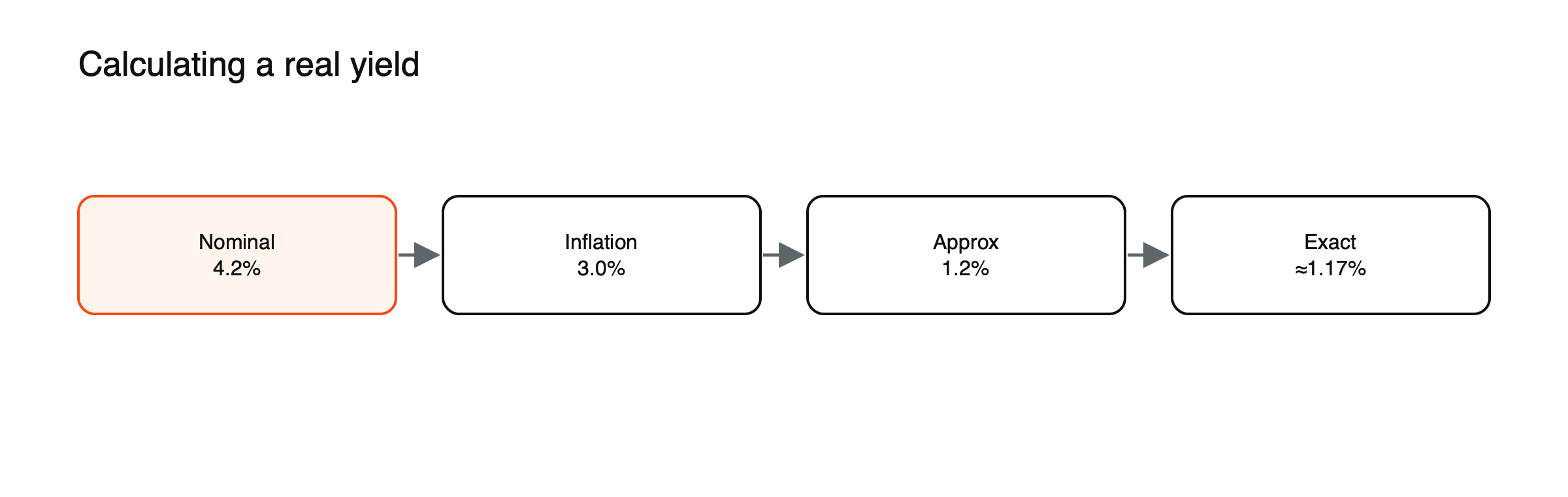
Figure: From nominal to real (example values).
If inflation were 5%, the real yield would be about −0.8%: lending at 4.2% would lose purchasing power. (Example values.)
Market real yields
Inflation-protected bonds, such as US TIPS, quote real yields directly: their principal rises with inflation, so their yield is the return above inflation. A 10-year TIPS yielding 1.9% promises about 1.9% a year plus whatever inflation turns out to be. TIPS yields are the most widely watched measure of real interest rates and change daily with markets.
Backward- vs forward-looking
Using past inflation gives a realized real yield; using expected inflation, or a TIPS yield, gives a forward-looking one. See how to read breakeven inflation from bond yields.
Realized versus expected, worked through
An investor bought a 10-year bond yielding 2% expecting inflation of 2%, a forward-looking real yield of about zero. If inflation actually averages 4%, the realized real yield is about −2% a year. Over ten years, $10,000 grows to about $12,190 in money terms but buys only about what $8,235 buys today. (Example values.) The difference between expected and realized real yields is the inflation surprise, which bondholders bear unless they own inflation-linked bonds.
Negative real yields
When nominal yields are below inflation, real yields are negative: lenders lose purchasing power. For much of the 2010s and in 2020 and 2021, real yields on many government bonds were negative, as central banks held rates near zero and bought bonds. Negative real yields encourage investors to seek returns elsewhere, often pushing up prices of shares, property and other assets.
Why real yields matter
Rising real yields raise the cost of holding assets without income, such as gold, and pressure richly valued growth stocks. See why real yields matter for gold, stocks and crypto and why gold falls when real yields rise.
Real yields and gold, illustrated
Gold pays no interest, so its appeal depends partly on what investors give up by holding it. Suppose 10-year real yields rise from 0% to 2%. (Illustrative scenario.) Holding gold now means forgoing a 2% real return on safe bonds, so demand from investors may weaken. When real yields fall, the cost of holding gold falls too. The relationship has been strong in many periods, though central bank gold buying and geopolitical demand can override it.
A real-world swing
In the 2013 taper tantrum, the 5-year TIPS real yield jumped from −1.15% to −0.16% in about a month. See what the 2013 taper tantrum was.
See how bonds work.
Real yields and growth stocks
Higher real yields raise the rate used to discount future profits, reducing the value of companies whose earnings lie far ahead. Technology and other growth stocks therefore often fall when real yields rise sharply, and rally when they fall. Watching TIPS yields can help explain moves in technology-heavy indices that nominal yields alone do not.
The real return on cash
The same arithmetic applies to savings. A deposit paying 4% when inflation is 3% earns a real return of about 1%. If inflation rises to 5% while the deposit rate stays at 4%, the real return turns negative. Comparing interest rates with inflation, rather than looking at interest rates alone, shows whether savings are growing in purchasing power.
Real yields across maturities
Real yields differ by maturity, just as nominal yields do. Short-term real yields reflect current policy rates minus near-term inflation and can swing sharply when inflation spikes. Long-term real yields reflect expectations for growth and policy over decades and move more slowly. Comparing the two shows how restrictive markets think current policy is relative to the long-run norm.
Real yields and central bank policy
Central banks try to set real interest rates high enough to slow inflation but not so high that they cause a recession. The level that is neither stimulative nor restrictive is often called the neutral rate. When real policy rates are well above estimates of neutral, policy is considered tight; when they are negative, it is considered loose. Markets watch real yields to judge how tight conditions really are.
Real yields and the dollar
Higher US real yields tend to attract investors to dollar assets, strengthening the dollar. When US real yields fall relative to other countries’, the dollar often weakens. Real yield differences are therefore one of the main drivers of major currency pairs. See how interest rate differentials move currencies.
Taxes and real returns
Taxes usually apply to the nominal interest received, not the real return. If a bond yields 4% and inflation is 3%, an investor taxed at 25% pays 1 point in tax, leaving 3% after tax and a real after-tax return of about zero. Taxes can turn small positive real yields into real losses.
Common misreadings
- Comparing nominal yields across periods with very different inflation.
- Using past inflation to judge future real returns.
Real yields over the past two decades
After the 2008 financial crisis, central banks held policy rates near zero and bought large amounts of bonds, pushing real yields on government bonds below zero for long periods. In 2020 and 2021, they fell deeply negative again. As inflation surged and central banks raised rates in 2022, real yields rose sharply and turned positive, one of the fastest increases on record, contributing to falls in shares, gold and long bonds. The episode showed how powerful a shift in real yields can be across markets.
Real yields and property
Property values depend on rents and on the yields investors require, which are linked to real interest rates. When real yields rise, investors demand higher rental yields, which pushes property prices down unless rents grow quickly. Real estate shares often react to real yield moves in a similar way to long-term bonds.
Using real yields in trading
Traders in gold, growth shares, crypto and currencies often keep a chart of 10-year real yields alongside their main markets. A sharp rise in real yields can signal pressure on all of these at once; a sharp fall can signal relief. See why real yields matter for gold, stocks and crypto.
Real yields and share valuations, illustrated
Suppose a company is expected to earn $5 a share next year, growing steadily, and investors value it using a real discount rate of 5%. (Illustrative assumptions.) If real yields rise 1 point and the discount rate moves to 6%, the share’s estimated value can fall by 15% or more, with no change in expected profits, because distant earnings are worth less today. Companies whose profits lie furthest ahead suffer most.
A real-yield checklist
- What are 10-year TIPS yields doing?
- Is the move driven by policy or growth expectations?
- Are gold, growth shares and the dollar reacting as usual?
- How do current real yields compare with recent history?
Where to find real yields
Central bank databases and financial data sites publish daily TIPS yields for 5-, 10- and 30-year maturities, alongside nominal yields and breakevens. Many charting platforms also offer them. Plotting the 10-year real yield next to gold or a growth-stock index is a simple way to see how strongly those markets react to real rates at any time. The link is usually clearest during sudden, sharp moves.
Frequently asked questions
Which inflation figure should I use?
For past returns, actual inflation; for decisions about the future, expected inflation, which can be estimated from TIPS-based breakevens or surveys.
Can real yields be negative for long?
Yes. They were negative for long stretches in the 2010s and early 2020s, mainly because of very low policy rates and central bank bond purchases.
Leverage, margin and cost figures in this article are example values for illustration. Actual terms depend on the provider, the instrument and the rules in your country.
This article is educational content and does not constitute financial, investment, legal or tax advice. Digital assets are volatile and you may lose the amount you invest.
Sources
- The taper tantrum myth? (5-year TIPS yield from −1.15% to −0.16% and 5-year breakevens from 1.99% to 1.65% between May 21 and June 25, 2013) — Econlib
- United States Treasury security (TIPS principal adjusted for inflation) — Wikipedia
- What’s behind the divergence between gold and real Treasury yields? (real yields and asset prices) — Janus Henderson