
What Happened in the 2022 UK Gilt Crisis?
After the September 2022 mini-budget, 30-year gilt yields jumped about 140 bp in three days, LDI funds faced margin calls and the BoE pledged £65 billion.
The UK gilt crisis began after the September 23, 2022 “mini-budget” of about £45 billion in unfunded tax cuts. The 30-year gilt yield rose about 140 basis points in three days, and pension funds using leveraged LDI strategies faced collateral calls that forced gilt sales. On September 28, the BoE pledged up to £65 billion of purchases.
Timeline
- September 22: the BoE raises rates to 2.25%.
- September 23: mini-budget; gilts and the pound fall sharply.
- September 26–27: the 30-year yield peaks at about 4.85% at the close (above 5% intraday); the pound nears parity with the dollar.
- September 28: the BoE announces purchases of long gilts; the 30-year yield falls more than 100 basis points that day.
- October 14: the purchase window ends; policies are reversed and the chancellor and then the prime minister leave office.
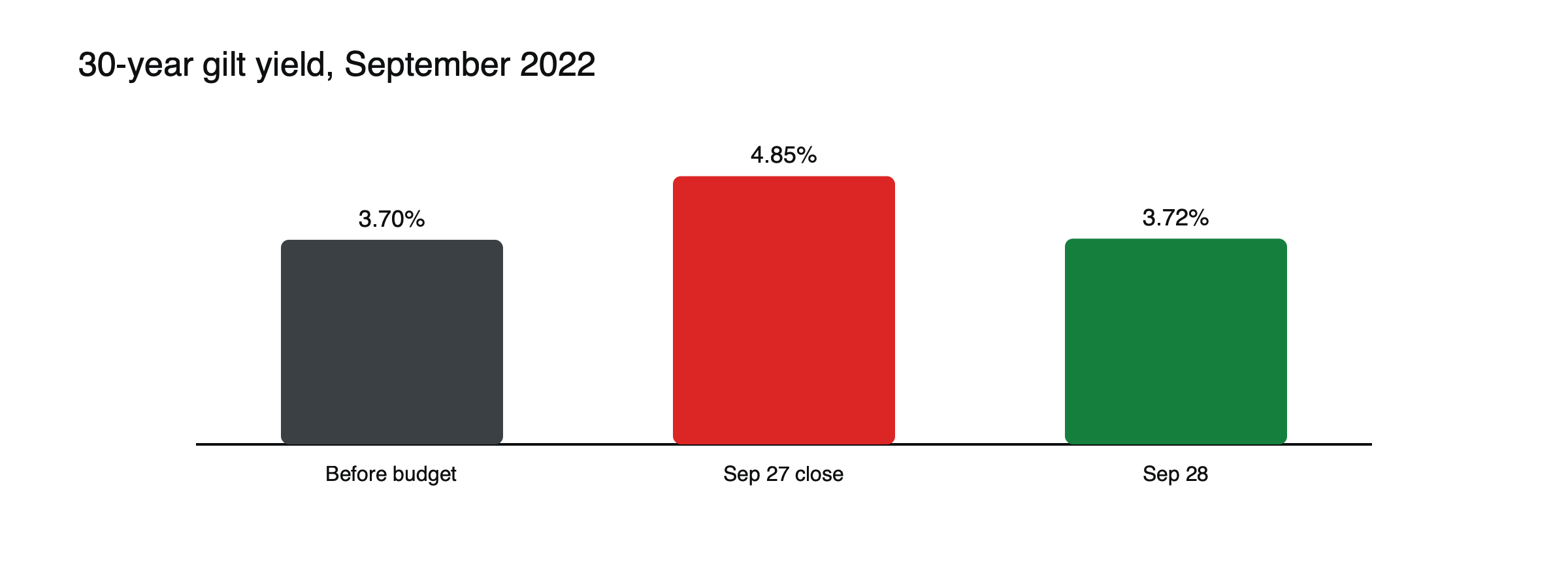
Figure: The 30-year gilt yield in September 2022. Source: Eco3min.
The mini-budget
On September 23, 2022, the new government announced about £45 billion of tax cuts without independent costings or a clear plan to pay for them, alongside large energy support. Coming as inflation was near double digits and the Bank of England was raising rates, the package raised fears of heavy borrowing and higher inflation. Investors sold gilts and the pound, which fell to a record low of about $1.0359 on September 26.
How liability-driven investment works
Many UK defined-benefit pension funds use liability-driven investment, or LDI, to match their assets to future pension payments. Because those payments stretch decades ahead, LDI strategies hold long-dated gilts and use leverage, often through repurchase agreements and swaps, to increase their sensitivity to interest rates without tying up all their capital. When yields are stable or falling, the strategy works smoothly. When yields jump, the leveraged positions lose value and funds must post more collateral quickly.
Why it spiraled
LDI funds held leveraged gilt positions. As yields jumped, they had to post collateral, selling gilts, which pushed yields higher, a “doom loop.” Pension funds and LDI funds sold about £37 billion of gilts.
The doom loop, illustrated
Suppose an LDI fund holds £100 million of long gilts but has only £25 million of its own capital, the rest financed with borrowing. (Illustrative figures.) If 30-year yields rise 1.4 points, a gilt with a duration of about 20 loses more than a quarter of its value, about £28 million, wiping out the fund’s capital. To meet collateral calls, it must sell gilts or raise cash from its pension fund clients, which takes days. Forced selling across many such funds pushes yields up further, triggering more collateral calls.
The Bank of England steps in
On September 28, the Bank of England announced temporary purchases of long-dated gilts, of up to £65 billion over about two weeks, to restore orderly markets. The 30-year yield fell more than 1 point that day. The Bank stressed that the purchases were for financial stability, not monetary policy, and ended them on October 14 as planned, while continuing to raise interest rates to fight inflation.
Effects
Two-year fixed mortgage rates jumped above 6%, and September was the worst month for a major government bond market in over 60 years.
The political aftermath
The government reversed most of the tax measures. The chancellor was dismissed on October 14, his successor reversed most of the remaining measures within days and the prime minister resigned on October 20, after about six weeks in office. Gilt yields eased as fiscal credibility was restored, though they remained well above levels earlier in the year.
Lessons
Fiscal credibility matters for bond markets; leverage in “safe” assets can create systemic risk; central banks may need to act as buyers of last resort. See why the FTSE 100 often moves opposite to the pound, what the 2013 taper tantrum was and how bonds work.
Timeline at a glance
| Date | Event |
|---|---|
| September 22, 2022 | Bank of England raises rates to 2.25% |
| September 23 | Mini-budget announced; gilts and the pound fall |
| September 26 | Pound hits record low of about $1.0359 |
| September 27 | 30-year gilt yield closes about 4.85%, above 5% intraday |
| September 28 | Bank of England announces emergency gilt purchases |
| October 14 | Purchases end; chancellor dismissed |
| October 20 | Prime minister resigns |
The effect on other markets
Sterling’s slump made headlines, while the FTSE 100, full of companies earning abroad, held up relatively well. Domestically focused shares and housebuilders fell sharply as mortgage rates jumped and lenders withdrew products. UK bank shares swung with gilt yields. See why the FTSE 100 often moves opposite to the pound.
Regulatory follow-up
Regulators later required LDI funds to hold much larger buffers of capital against rising yields, so that they could absorb larger moves without forced selling. The episode became a case study in how leverage in non-bank financial institutions can threaten government bond markets.
Lessons for traders
The crisis showed that even a major government bond market can move violently in days when fiscal credibility is questioned and leveraged investors are forced to sell. Gilt and sterling positions faced extreme volatility and gaps, and central bank intervention reversed moves abruptly. Positions sized for normal gilt volatility were badly exposed.
Why long gilts were hit hardest
LDI strategies concentrate on long-dated gilts, because pension liabilities stretch decades ahead. Those gilts have the highest duration, so a jump in yields hits their prices hardest, and forced selling by LDI funds was concentrated there. The 30-year gilt yield rose about 1.4 points in three days, a move that would normally take months or years, while shorter gilts moved less.
Fiscal credibility
The mini-budget was announced without an accompanying forecast from the Office for Budget Responsibility, the UK’s independent fiscal watchdog, which deepened doubts about how the tax cuts would be financed. Markets concluded that government borrowing could rise sharply while inflation was already high, and demanded much higher yields to lend to the government. Restoring the watchdog’s role and reversing the measures were central to calming markets.
Mortgages and households
Within days, lenders withdrew hundreds of mortgage products and repriced others, with typical two-year fixed rates rising above 6%. Households coming to the end of fixed-rate deals faced much higher payments, and housing activity slowed. The crisis showed how quickly bond market turmoil can reach ordinary borrowers.
Gilts and Treasuries
Global government bond yields were already rising in 2022 as central banks raised rates. The gilt crisis was distinct because UK yields jumped far more than US or German yields in late September, showing a UK-specific loss of confidence on top of the global trend.
Common misreadings
- Treating the crisis as a sign the UK might default.
- Assuming leverage was only a problem for hedge funds.
Sterling and gilts together
Normally, rising yields attract buyers to a currency. In late September 2022, gilts and the pound fell together, an unusual combination that signaled a loss of confidence in UK policy rather than a normal response to higher rates. That pattern, sometimes seen in emerging markets, alarmed investors and policymakers and was a key reason the Bank of England acted quickly. See what moves GBP/USD.
Leverage in unexpected places
LDI was considered a low-risk strategy, used by pension funds to reduce risk rather than take it. The crisis showed that leverage used for hedging can still create forced selling when markets move far enough, and that risks can build in parts of the financial system outside banks, where supervision is lighter. Regulators in other countries examined whether similar vulnerabilities existed in their own markets.
What traders watch now
Since the crisis, traders watch the size of LDI buffers, government borrowing plans and the independent fiscal forecasts that accompany budgets. A sharp rise in long gilt yields combined with a falling pound remains the warning sign most associated with 2022, and any repeat would draw immediate attention from the Bank of England. Traders holding sterling or gilt positions around fiscal events often reduce size until the market’s first reaction becomes fully clear.
Frequently asked questions
Why did pension funds sell gilts if they wanted to hold them?
They were forced to raise cash to meet collateral calls on leveraged positions, and gilts were the main asset they could sell quickly.
Did the Bank of England’s purchases conflict with its rate hikes?
It argued they did not, because the purchases were temporary and aimed at market functioning, while rate hikes addressed inflation.
This article is educational content and does not constitute financial, investment, legal or tax advice. Digital assets are volatile and you may lose the amount you invest.
Sources
- 2022 UK gilt crisis (£45 billion mini-budget; 30-year peak of 4.85% close on September 27; up to £65 billion of purchases from September 28 to October 14) — Eco3min
- Putting out the NBFIre (30-year gilt yield up about 140 bp in three days; about £37 billion of gilt sales) — SUERF
- How a blow-up in the gilt market sent shudders through the system (worst month for a major government bond market in over 60 years; mortgages above 6%) — ICAEW, October 2022
- Markets on edge despite Bank of England intervention (30-year above 5% intraday; BoE at 2.25% on September 22) — Federated Hermes, September 2022
- GBP/USD jumps after BoE intervention (record low 1.0359 in September 2022) — MarketPulse