
How Hurricanes and Weather Move Energy Prices
Hurricanes can shut Gulf production and refineries, home to over half of US refining, while temperatures drive gas demand. How weather moves energy prices.
Weather moves energy prices through supply and demand. Hurricanes can shut Gulf of Mexico output and Gulf Coast refineries, which hold just over half of US refining capacity, lifting gasoline prices. Temperatures drive heating and cooling demand, most of all for natural gas. After Harvey in 2017, gasoline had its biggest weekly rise since 2005.
Hurricanes and supply
- Offshore production is shut in for safety as storms approach.
- Refineries close or cut runs, reducing gasoline and diesel supply.
- Pipelines and ports can be disrupted, affecting distribution far from the coast.
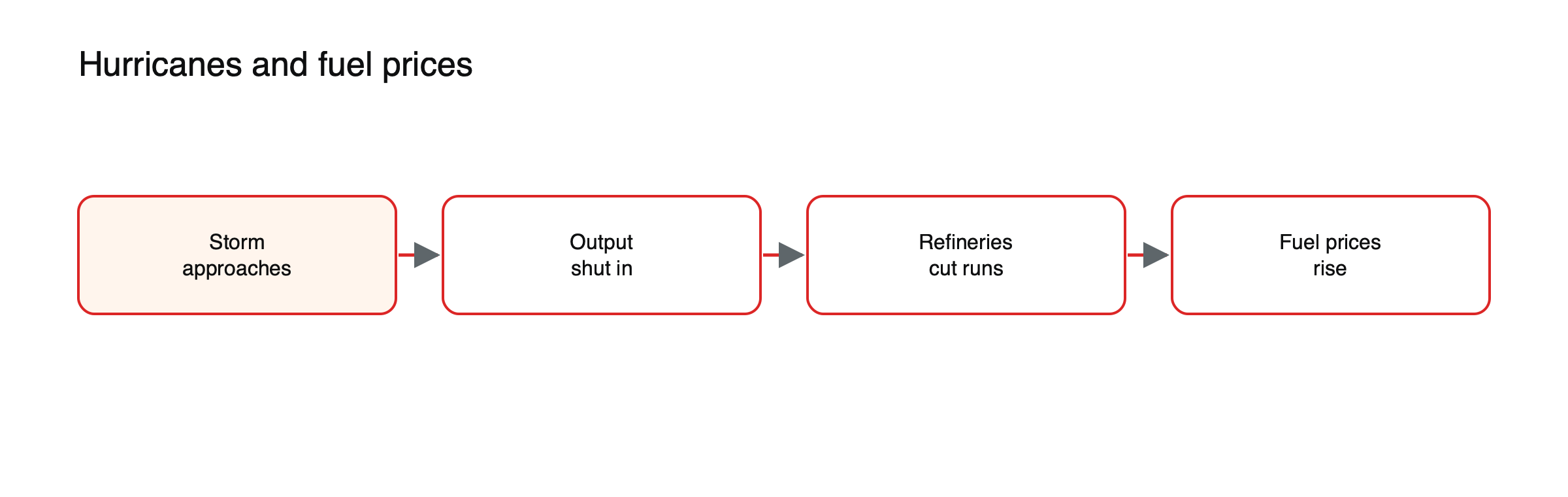
Figure: How a hurricane reaches fuel prices.
Crude prices may even fall if refinery closures reduce crude demand, while product prices rise.
Hurricane Harvey, 2017
When Hurricane Harvey struck the Texas coast in 2017, flooding forced several refineries to shut and others to cut runs. The Gulf Coast holds just over half of US refining capacity, so the loss of output was large, and gasoline prices recorded their biggest weekly rises since Hurricane Katrina in 2005. Crude oil prices did not rise in the same way, because refineries that shut stopped buying crude. The storm showed how weather can push product prices and crude prices in different directions. See what the crack spread is.
How a hurricane week unfolds
| Stage | Typical market behavior |
|---|---|
| Storm forms, forecast uncertain | Small risk premium in gasoline and gas |
| Track points to production or refining areas | Shut-ins announced; product prices rise |
| Landfall | Peak uncertainty; spreads widen |
| Damage assessed | Prices adjust to actual outages |
| Restart | Premium fades as facilities reopen |
Temperature and demand
Cold snaps lift gas and heating oil demand; heat waves lift power demand and gas burned for electricity. Forecasts, not just actual weather, move prices. See what moves natural gas prices.
Winter storms and freeze-offs
Extreme cold can cut supply as well as raise demand. Gas wells and pipelines can freeze, a problem known as freeze-offs, reducing production just as heating demand peaks. Power plants may struggle to operate, adding pressure on gas supplies. These events can produce very sharp regional price spikes, especially where systems are not built for severe cold.
Longer weather cycles
Climate patterns such as El Niño and La Niña shift the odds of mild or harsh winters and of active or quiet hurricane seasons. Forecasters publish seasonal outlooks based on them, and traders use those outlooks to judge risks months ahead, while recognizing that they are probabilities, not predictions.
Seasonal patterns
- Summer: driving season and air conditioning; hurricane season runs June to November.
- Winter: heating demand and storage drawdowns.
What traders watch. Storm tracks and forecasts, refinery outage reports, weekly inventory data and temperature outlooks. See how to read the weekly EIA oil inventory report.
See what moves crude oil prices and how commodity CFDs work.
Beyond energy
Weather also drives agricultural prices, through droughts, floods and frost during planting and growing seasons. In energy, weather mainly acts through short-term supply disruptions and heating and cooling demand; in farming, it shapes the size of entire harvests.
Offshore production and shut-ins
When a hurricane threatens the Gulf of Mexico, operators evacuate platforms and shut in production as a precaution. US regulators publish daily figures on how much oil and gas output has been shut in during a storm, and traders follow them closely. Most production returns within days if facilities are undamaged, but serious damage to platforms or pipelines can keep output offline for weeks, which turns a short-lived premium into a lasting supply loss.
Heat waves and power demand
In summer, heat waves push up electricity demand for air conditioning, and much of that electricity comes from gas-fired power plants. Prolonged heat can therefore drain gas storage during the season when it would normally be refilled, supporting prices into the following winter. Very hot weather can also reduce the efficiency of power plants and transmission lines, tightening supply further.
Weather in Europe
European energy markets are sensitive to weather in additional ways. Periods of low wind, sometimes called wind droughts, increase reliance on gas for power. Dry summers can lower river levels, limiting barge transport of fuels and the cooling water available for some power plants. Cold, still winter weeks combine high heating demand with low wind output, which can lift gas and power prices sharply.
Trading around storms
Storm forecasts change several times a day, and prices often move on each update. Spreads on energy CFDs can widen, and prices may gap when markets reopen after a storm makes landfall over a weekend. Traders who hold positions through hurricane season often keep them smaller, use wider stops and avoid adding exposure just before a storm reaches production or refining areas. The bigger risk is often buying a premium that disappears when a storm weakens or changes course.
A changing climate
Many scientists expect more frequent extreme weather events, from intense storms to heat waves and droughts. For energy markets, that could mean more frequent supply disruptions and demand spikes, and greater weight on weather forecasts in trading decisions. It also adds to the case for planning positions around seasonal risks rather than treating them as rare surprises.
Common misreadings
- Assuming every hurricane raises oil prices.
- Ignoring the difference between crude and product price reactions.
- Treating a seasonal outlook as a firm forecast.
Forecasts traders follow
Energy traders rely on official forecasts, such as hurricane track and intensity outlooks from the US National Hurricane Center, and on temperature forecasts from weather services and global weather models. Updates arrive several times a day, and markets often react when major models shift. Private forecasting firms translate these into estimates of heating and cooling demand for gas and power. The skill lies less in predicting the weather than in judging how much each forecast change alters expected supply and demand.
A hot summer and gas storage, illustrated
Suppose July is much hotter than normal across the United States. (Illustrative scenario.) Power plants burn more gas to meet air-conditioning demand, so less gas goes into storage each week than usual. By September, storage is well below its five-year average, and traders start to worry about winter. Gas prices rise in late summer, months before the heating season, because of weather that has already passed. Weather effects can therefore carry from one season into the next through storage.
A hurricane-season checklist
- Where is the storm forecast to go, and how strong will it be?
- Which production, refining or export facilities lie in its path?
- How much output has been shut in so far?
- How quickly did similar facilities restart after past storms?
- Are open positions sized for gaps and wider spreads?
How quickly refineries restart
After a storm, refineries must check equipment, restore power and water supplies and sometimes repair flood damage before restarting, which can take days for minor disruptions and weeks after severe flooding. Product prices usually stay high until restarts are announced, then fall back as supply returns. Tracking restart announcements is often more useful than watching the storm itself once it has passed. Partial restarts often come first, so product prices may ease in steps over several days rather than all at once.
Frequently asked questions
Why can oil fall while gasoline rises during a hurricane?
Because refinery shutdowns reduce gasoline supply while also reducing demand for crude, pushing the two prices in different directions.
How far ahead do weather forecasts move prices?
Short-term forecasts move prices days ahead; seasonal outlooks influence positioning months ahead, though with much more uncertainty.
This article is educational content and does not constitute financial, investment, legal or tax advice. Digital assets are volatile and you may lose the amount you invest.
Sources
- Hurricane Harvey caused Gulf Coast refinery runs to drop and gasoline prices to rise (just over half of US refining capacity on the Gulf Coast; largest weekly gasoline price rises since Katrina in 2005) — US EIA, 2017
- What’s new: release schedules (Weekly Petroleum Status Report after 10:30 a.m.; Weekly Natural Gas Storage Report Thursday 10:30 a.m.; Cushing stocks; refinery utilization) — US EIA