
What Is the Dow Jones Industrial Average?
The Dow tracks 30 large US companies weighted by share price, not market value. How it works, why price weighting matters and how it differs from the S&P 500.
The Dow Jones Industrial Average, or “the Dow,” tracks 30 large US companies and dates from 1896. Unlike most modern indices it is price-weighted: a stock with a higher share price has more influence, regardless of company size. A stock split can therefore cut a company’s weight in the Dow overnight.
How price weighting works
The Dow adds up the share prices of its 30 members and divides by a “divisor” adjusted for splits and changes. A $1 move in any member moves the index by the same number of points, whether the company is huge or relatively small. See price-weighted vs market-cap-weighted indices.
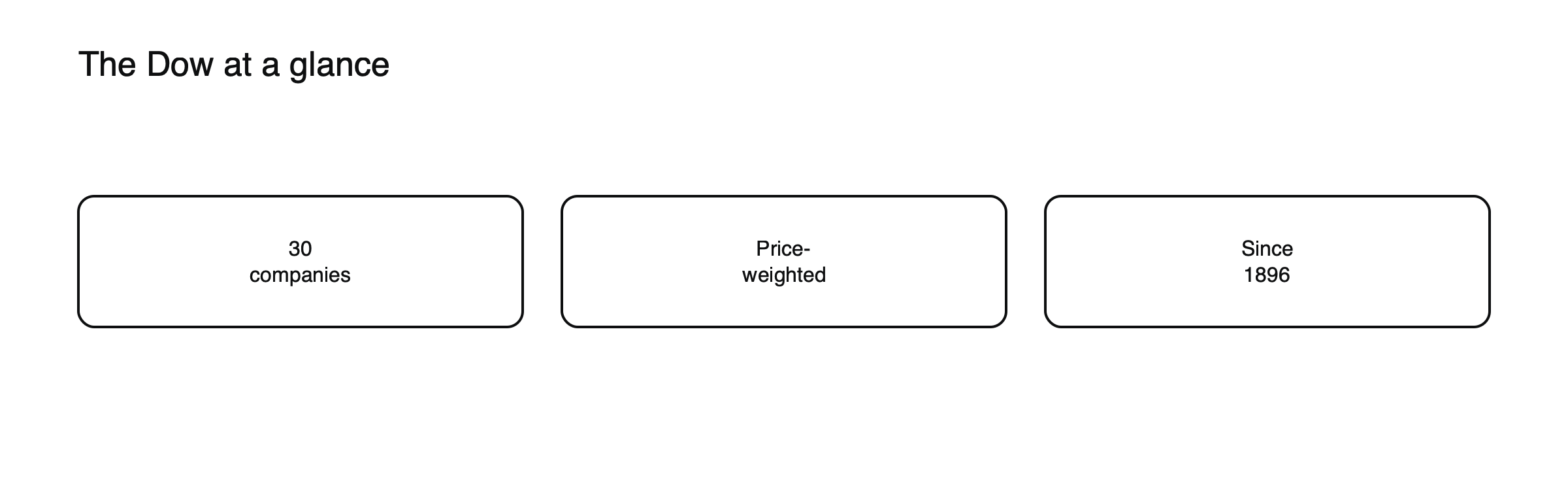
Figure: The Dow at a glance.
The divisor and points, illustrated
Because the divisor has been adjusted many times for splits and member changes, it is now well below 1. With an illustrative divisor of 0.15, a $1 change in any member’s share price moves the Dow by about 6.7 points. A $10 jump in a high-priced member moves the index about 67 points, while a $10 jump in a $50 share, a far larger percentage move, has exactly the same effect. That is the essence of price weighting.
What it contains
Thirty well-known US companies across sectors, chosen by a committee. It is far narrower than the S&P 500’s roughly 500 companies.
Membership changes
A committee chooses the Dow’s members and changes them occasionally to reflect the economy, replacing companies whose influence has faded with ones that better represent it. Over the decades, industrial companies have given way to technology, healthcare and financial firms. In November 2024, for example, Nvidia replaced Intel. Changes are infrequent, so each one attracts attention.
Splits and influence
When a member splits its shares, its price falls and the divisor is adjusted, so the company’s influence on the Dow drops. Large companies with very high share prices are sometimes left out of the Dow partly because they would dominate it; after a split, they may become candidates. See how stock splits affect a CFD position.
Why it still matters
It is widely quoted in the media and has a long history, but its narrow membership and price weighting make it a less complete picture of the market than the S&P 500. See what the S&P 500 is.
How it is traded
Through ETFs, futures and CFDs, often called “US 30.” Its high point level means a small percentage move is many points. See how stock index CFDs work and how to calculate the value of a point on an index CFD.
Record levels
The Dow reached a record close of 48,731 on December 24, 2025. Its high point level means that moves of several hundred points are common, even though in percentage terms they may be modest: a 400-point move with the index near 48,000 is less than 1%.
Another price-weighted index
Japan’s Nikkei 225 also weights by price. See what the Nikkei 225 is.
Dow and S&P 500 on the same day, illustrated
Suppose a high-priced Dow member jumps 6% on strong results while the largest technology companies fall 1%. (Illustrative scenario.) The Dow may close higher, while the S&P 500 and Nasdaq 100, dominated by technology, close lower. Headlines saying “stocks mixed” often reflect differences in weighting rather than different views of the economy.
The Dow Transportation Average
Alongside the Industrial Average, Dow Jones publishes a Transportation Average of airlines, railways, shipping and trucking companies. Some traders follow the idea, known as Dow theory, that a lasting market trend should be confirmed by both averages, since goods produced by industrial companies must be transported. It is an old idea rather than a reliable signal, but it is still widely discussed.
Trading a US 30 CFD, worked through
With the Dow near 48,000, a US 30 CFD at $1 per point is a position worth about $48,000, needing about $2,400 of margin at 20:1. A 400-point move, about 0.8%, gains or loses $400. Because of the high index level, even small values per point create large positions, so many traders use fractions of a dollar per point. (Illustrative trade.) See how to calculate the value of a point on an index CFD.
Futures and trading hours
Dow futures trade almost around the clock on weekdays, and many CFD providers quote the US 30 nearly 24 hours, pricing from futures outside the New York cash session. The biggest moves usually come at the cash open, after major economic releases and around Federal Reserve decisions.
Reading Dow headlines
Because the Dow’s level is so high, headlines often report large point moves that sound dramatic. Converting them into percentages, and checking how the S&P 500 and Nasdaq 100 moved the same day, gives a clearer picture of what actually happened in the market. A day when the Dow falls but the broader indices rise usually reflects one or two heavily weighted members rather than a general decline.
The Dow and the economy
Because its members are large, established companies across many industries, the Dow is often used as shorthand for the health of corporate America. Its narrow membership means it can diverge from the broader market for long periods, but its long history makes it useful for comparing today’s markets with past decades. Its new record highs still make headlines all around the world.
Frequently asked questions
Why is the Dow still quoted if it is narrow?
Because of its long history and familiarity. It remains a quick gauge of large US companies, though professionals usually prefer the S&P 500 as a benchmark.
Does a 1,000-point fall mean a crash?
Not necessarily. With the Dow near 48,000, a 1,000-point fall is about 2%, significant but not unusual. Percentages give a better sense of scale than points.
This article is educational content and does not constitute financial, investment, legal or tax advice. Digital assets are volatile and you may lose the amount you invest.
Sources
- Key learnings: US market indices (S&P 500 tracks 503 large companies, about 80% of the US market; Dow 30 price-weighted; Nasdaq-100 largest non-financials, about 60% tech; Russell 2000 small caps; top 10 at 40.7%) — Vested Finance, 2026
- Share index SMI (launch years: Dow 1896, S&P 500 1957, Hang Seng 1969; price- vs cap-weighted examples) — SIX Group
- Equity indices (Dow as a price-weighted average) — Better Solutions
- How the stock market performed in 2025 (S&P 500 +16.4%; Russell 2000 +11.3%; Dow record close 48,731 on December 24; Nasdaq Composite down about 21% at its April 8 low, then +52%) — ValueWalk, January 2026