
How Real Yields Connect Gold, Growth Stocks and Crypto
Real yields, interest rates after inflation, help explain gold, growth stocks and crypto. How the link works, why it weakened for gold after 2022, and limits.

Real yields are interest rates after expected inflation, usually measured with inflation-protected bonds. When they rise, assets that pay no income, such as gold, or whose value lies far ahead, such as growth stocks and crypto, look less attractive. From the late 1990s to 2020, gold tracked US real yields closely; since 2022 the link has loosened.
Why real yields matter
Gold pays no interest. When real yields are high, holding gold means giving up a positive real return elsewhere; when they are low or negative, that cost disappears.
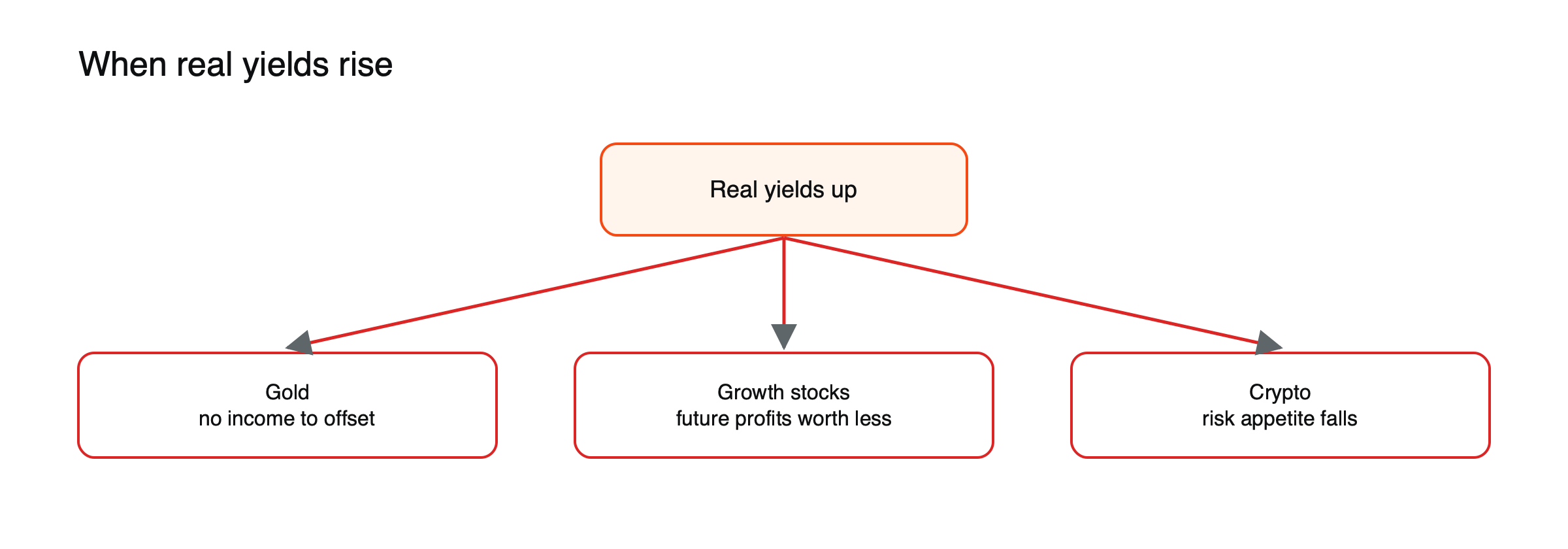
Figure: Why rising real yields weigh on three different assets.
Growth stocks are valued largely on profits expected years ahead. Higher real yields reduce what those future profits are worth today.
Crypto has traded like a long-duration risk asset; in 2022, as rates and the dollar rose, bitcoin fell about 66%. See how a strong dollar hits commodities, emerging markets and crypto.
One shock, three assets, illustrated
Suppose 10-year real yields rise from 0.5% to 2.0% over a year as a central bank tightens. (Illustrative scenario.) Gold faces a higher opportunity cost and might fall 10% to 15%. A growth-stock index, whose valuations rest on distant profits, might fall 20% or more. Bitcoin, trading as a speculative long-duration asset, might fall further still. The three move together because they share one sensitivity, not because they share fundamentals. In 2022, as real yields surged, bitcoin fell about 66%.
Why growth stocks are so sensitive
A company expected to earn most of its profits ten or twenty years from now is like a long-duration bond: its value depends heavily on the rate used to discount those distant profits. When real yields rise, that rate rises, and the present value falls sharply. Mature companies paying steady profits today are less affected. See why tech stocks are so sensitive to bond yields.
What changed for gold
Since 2022, central banks, mainly in emerging markets, have bought around 1,000 tonnes of gold a year, about double the prior decade’s pace. Gold and real yields both rose to levels not seen together in two decades. Real yields still move gold in the short term, but they no longer set its floor. See what the copper-gold ratio says about growth expectations.
Why the link loosened
From the late 1990s until about 2020, gold tracked US real yields closely, rising when they fell and falling when they rose. After 2022, gold kept rising even as real yields climbed to levels not seen in years. Heavy central bank buying, geopolitical tensions and efforts by some countries to reduce reliance on the dollar added a source of demand that real yields do not capture. Real yields still matter for gold’s direction over weeks and months, but they no longer explain its level on their own. See why gold falls when real yields rise.
Crypto and real yields
Bitcoin and other crypto assets have no cash flows, and much of their demand comes from speculative and leveraged buyers. When real yields and the dollar rise, financial conditions tighten, leverage becomes more expensive and appetite for speculative assets falls. That has made crypto behave like an amplified version of growth stocks in rate-driven sell-offs. See how crypto reacts to economic data.
How to use real yields
Watch the direction of real yields alongside the dollar and central bank policy. A sharp rise in real yields has often meant pressure on gold, growth stocks and crypto at the same time. For the wider cycle, see stocks, bonds and commodities across the rate cycle.
Reading the signal
Not every rise in nominal yields is a rise in real yields. If yields rise because inflation expectations climb, real yields may be flat, and gold may even benefit. If yields rise because the central bank is tightening, real yields rise and these assets suffer. Splitting nominal moves into real yields and breakevens tells you which story is under way. See how to read breakeven inflation.
When real yields fall
The same logic works in reverse. When central banks cut rates or markets expect easier policy, real yields fall, reducing the cost of holding gold and raising the present value of distant profits. Gold, growth stocks and crypto have often rallied together in such periods, as in 2020 when real yields turned deeply negative.
Watchlist
- 10-year TIPS yield and its direction
- The dollar index
- Central bank guidance on future rates
- Central bank gold purchases
- Crypto funding rates and leverage
Regimes at a glance
| Real yields | Gold | Growth stocks | Crypto |
|---|---|---|---|
| Falling sharply | Usually supported | Often rally | Often rally strongly |
| Low and stable | Neutral to supportive | Supportive | Supportive |
| Rising gradually | Headwind | Headwind for richly valued names | Headwind |
| Rising sharply | Often falls | Often falls sharply | Often falls more |
(General tendencies; other factors can dominate.)
Growth versus value
Rising real yields tend to hurt growth stocks more than value stocks, whose profits are larger today and whose valuations depend less on distant earnings. In 2022, as real yields jumped, value shares held up much better than growth shares. Falling real yields often reverse the pattern. See growth vs value stocks.
Real yields and emerging markets
Higher US real yields tend to draw capital toward the United States and strengthen the dollar, putting pressure on emerging market currencies and assets that depend on foreign funding. The 2013 taper tantrum, driven by a jump in real yields, is a classic example. See what the 2013 taper tantrum was.
Common misreadings
- Assuming gold always falls when real yields rise.
- Treating crypto as a hedge against rising rates.
A long view
Through most of the 2010s, real yields were low or negative, supporting gold, growth stocks and, later, crypto. In 2020 and 2021, they fell deeply negative as central banks cut rates to zero and bought bonds, coinciding with booms in technology shares and crypto. In 2022, the sharp rise in real yields marked the end of that environment and coincided with steep falls in all three. The long pattern shows how much these assets owed to cheap real money.
Crypto leverage and real yields, illustrated
Suppose crypto traders hold large leveraged long positions, financed at rates that rise with policy rates. (Illustrative scenario.) When real yields jump and financing costs rise, holding those positions becomes more expensive, and falling prices trigger margin calls and liquidations. Forced selling deepens the decline, which is why crypto’s reaction to rising real yields is often larger than that of growth stocks.
Portfolio implications
An investor holding gold, growth stocks and crypto may think of them as three different bets, but they share sensitivity to real yields. In a period of sharply rising real yields, all three can fall together, reducing the benefit of holding them side by side. Adding assets that benefit from higher real yields, such as short-term government bonds, can offset part of that exposure.
Signs the relationship is shifting
The links between real yields and these assets are strong but not permanent. When gold rises despite rising real yields, or crypto ignores rate moves for months, other forces are at work: central bank buying, geopolitical demand or crypto-specific flows such as fund inflows. Checking whether the usual relationships hold, rather than assuming they do, avoids trading on a model that has temporarily stopped working. A good habit is to compare the direction of each asset with real yields every week; persistent divergence for a month or more suggests a different driver has taken over. Two or three weeks of divergence can simply be market noise; two or three months usually is not.
Frequently asked questions
Do real yields affect all stocks equally?
No. Companies with distant profits, such as fast-growing technology firms, are most sensitive; mature, cash-generating companies much less.
Why can gold rise when real yields rise?
When other sources of demand, such as central bank buying or geopolitical fear, outweigh the opportunity cost of holding gold.
This article is educational content and does not constitute financial, investment, legal or tax advice. Digital assets are volatile and you may lose the amount you invest.
Sources
- What’s behind the divergence between gold and real Treasury yields? (tracked closely late 1990s–2020; central banks about 1,000 tonnes a year 2022–2024; real yields still drive direction) — Janus Henderson
- The Dollar Index (bitcoin fell about 66% in 2022 as rates rose) — BIT Knowledge Hub
- March 2020 review (higher real rates make gold relatively less attractive) — Nasdaq