
Why Defensive Stocks Tend to Hold Up Late in the Cycle
Defensive stocks can hold up late in the cycle because demand is steadier and earnings are less cyclical. Utilities, staples and healthcare still differ.
Defensive stocks late in the cycle tend to hold up because their revenues depend less on discretionary spending and capital investment. Consumers still buy food, medicine, electricity and basic household products when growth slows. That steadier demand can make earnings less cyclical, although defensive sectors can still fall in a broad market sell-off.
Stable demand is the main reason
Consumer staples, utilities and parts of healthcare are usually called defensive because demand for their products changes less with the economy than demand for cars, machinery, travel or construction.
A household can postpone a new vehicle. It is harder to stop buying groceries or electricity.
That difference matters late in the cycle, when interest rates are often restrictive, credit is less available and companies begin to cut discretionary spending. Cyclical businesses feel the slowdown sooner. Defensive businesses can keep a larger share of their revenue base intact.
Earnings visibility becomes more valuable when growth becomes uncertain
Investors do not need defensive companies to grow quickly. They need the earnings path to be easier to estimate than the path for more cyclical businesses.
When macro forecasts are being revised down, a company with stable demand can look relatively attractive even if its absolute growth rate is modest. The market may assign a higher value to predictability when the probability of recession is rising.
Research on sector behavior supports the basic distinction. Studies of equity-sector connectedness describe utilities, consumer staples and healthcare as sectors with more defensive earnings profiles, while industrials, financials and consumer durables tend to be more sensitive to the economic cycle.
Lower beta helps, but it is not immunity
Many defensive stocks have lower historical sensitivity to broad market moves. That can reduce the size of a drawdown when the index falls.
But a defensive stock is still a stock. During a fast liquidity event, investors may sell almost everything. Correlations can rise, valuation multiples can compress and even companies with stable earnings can drop sharply.
The COVID-19 sell-off in February and March 2020 is a useful example. The S&P 500 fell 33.8% from February 19 to March 23 in the market period identified by S&P Dow Jones Indices. Some defensive strategies reduced losses, but there was no universal shield. Index construction, valuation and sector exposure mattered.
Ranked: why defensives gain relative appeal late in the cycle
1. Revenue is less sensitive to discretionary demand
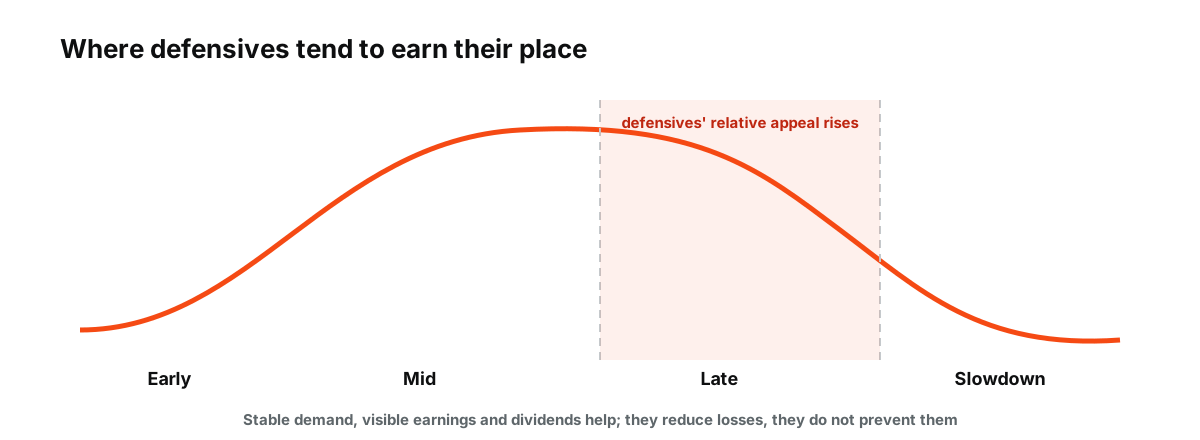
Figure: A stylized cycle, not a forecast. Defensives are about relative resilience; in 2020 the S&P 500 still fell 33.8% from February 19 to March 23.
Necessities tend to have more stable volumes than big-ticket purchases.
2. Earnings estimates can be less volatile
When analysts are cutting forecasts for cyclical sectors, stable earnings can become relatively scarce.
3. Cash flow can support dividends
Mature defensive companies often return cash to shareholders. That can matter more when capital gains become less certain, although dividends can still be reduced and are never guaranteed.
4. Lower economic beta can reduce drawdowns
A business with less cyclical revenue may see smaller earnings swings during a slowdown.
5. Investors rotate before the recession is official
Markets trade expectations. Defensive leadership can begin while GDP is still growing if investors believe the cycle is aging.
Utilities show why “defensive” needs context
Utilities have stable demand, but they are capital-intensive and often carry substantial debt. Higher bond yields can hurt them in two ways: financing becomes more expensive and income-focused investors get a more competitive yield from bonds.
That means a late-cycle environment with falling growth and falling yields can be friendlier to utilities than one with falling growth and still-rising yields.
The business may be defensive while the valuation remains rate-sensitive.
Healthcare has its own non-macro risks
Healthcare demand is often less cyclical, but the sector can face policy, patent, reimbursement and drug-development risks. A recession does not remove those.
The same applies to consumer staples. Stable demand does not protect a company from overpaying for acquisitions, losing market share or entering a downturn at an expensive valuation.
“Defensive” describes economic sensitivity, not quality.
What to watch late in the cycle
A defensive rotation is more credible when several signals line up:
- manufacturing and consumer surveys are weakening;
- credit spreads are widening;
- earnings revisions are deteriorating in cyclical sectors;
- unemployment is beginning to rise;
- the yield curve and rate expectations point to slower growth;
- market breadth narrows and investors favor stable cash flows.
If growth reaccelerates, that rotation can unwind quickly as cyclicals regain earnings momentum.
The relative question matters more than the absolute one
Defensive stocks do not need to rise to “work” in a late-cycle market. They may simply fall less than more economically sensitive sectors.
That is why defensive leadership should be read as a change in market preference, not as proof that a downturn has started. The market is paying more for resilience because confidence in future growth has fallen.
Late-cycle performance, illustrated
Suppose that over the year before a recession, the broad index falls 8%, technology and industrial shares fall 15% and consumer staples, utilities and healthcare fall 2% on average. (Illustrative figures.) The defensive group has not made money, but it has lost far less, which is what investors mean when they say defensives hold up. In the early recovery that follows, the order often reverses, with cyclical shares rebounding fastest.
Defensives and interest rates
Many defensive companies pay steady dividends and are valued partly like bonds. When bond yields rise, those dividends look less attractive by comparison, and defensive shares can lag even as growth slows. When yields fall late in the cycle, as investors anticipate rate cuts, defensives can benefit twice: from their steady earnings and from lower yields. See how interest rates affect stock prices.
Dividends as a cushion
Steady dividends can provide part of the return when share prices stall, and a higher dividend yield can attract income investors as growth prospects weaken. Dividends are not guaranteed, and companies under pressure can cut them, but mature defensive businesses have often maintained them through slowdowns. See how dividend yield is calculated.
Defensive exposure through indices
Some indices are naturally more defensive than others. The FTSE 100, with large consumer staples, healthcare and utility companies, has often held up better than technology-heavy indices in late-cycle slowdowns, while the Nasdaq 100 tends to be more sensitive to growth and rates. Choosing which index to trade is therefore partly a choice about cyclical exposure. See cyclical vs defensive stocks and what moves stock market indices.
When defensives lag
In strong expansions, especially when growth shares lead, defensive sectors often lag badly, and investors who move into them too early can miss large gains. Defensive leadership is a sign that investors are preparing for slower growth, not a guarantee that a recession is coming.
Valuation risk
Because investors seek safety late in the cycle, defensive shares can become expensive. When they trade at high valuations relative to their usual levels, even steady earnings may not prevent losses if growth fears ease and investors rotate back into cyclical shares. Paying too much for safety is a common late-cycle mistake.
Defensive sectors and low-volatility strategies
Low-volatility strategies select shares with the smallest price swings, which often overlap with defensive sectors but are not the same. A low-volatility portfolio may include some technology or financial companies with steady prices, and it may exclude defensive companies that have become volatile. Both approaches aim to reduce drawdowns, but they can behave differently, especially when interest rates move sharply. See how stock beta is calculated.
Rotation can reverse quickly
Defensive leadership can end abruptly when investors gain confidence that a slowdown will be mild. Signs that a slowdown will be mild, such as stabilizing manufacturing surveys, falling credit spreads and rising earnings forecasts for cyclical sectors, often trigger that reversal. Investors who stay defensive too long can miss the early stage of the next expansion, which is often when cyclical shares rise fastest. Defensive positioning works best as a measured adjustment rather than an all-or-nothing bet. Gradual, deliberate shifts in sector weights, rather than sudden wholesale moves, leave room to adjust as new economic data and earnings arrive.
Frequently asked questions
Which sectors count as defensive?
Consumer staples, utilities and healthcare are the usual examples, because demand for their products changes relatively little with the economy.
Do defensive stocks rise in recessions?
Not necessarily. They often fall less than the market, but in a broad sell-off they can still decline.
This article is educational content and does not constitute financial, investment, legal or tax advice. Digital assets are volatile and you may lose the amount you invest.