
What the 2020–2021 Retail Trading Boom Changed
The retail trading boom changed brokerage access, options activity, social-media influence and market-structure debates. Some changes proved permanent.
The 2020–2021 retail trading boom did more than create a few spectacular meme-stock charts. It accelerated commission-free access, pushed options and mobile trading into the mainstream, made social media a visible source of market coordination, and forced regulators to revisit payment for order flow, digital engagement, clearing, short interest and settlement mechanics.
Retail participation was already rising before the meme-stock moment
The pandemic did not invent retail trading.
US brokerage access had been getting cheaper and easier for years. Major platforms eliminated commissions on many stock trades, mobile apps reduced the friction of opening an account, and fractional shares made high-priced stocks accessible with small amounts of capital.
A 2021 Federal Reserve Financial Stability Report noted that direct stock ownership among younger consumers had risen materially after 2013. It also highlighted the removal of commissions at major retail brokerages as one factor expanding access to equity and options trading.
Then 2020 added unusual conditions:
- households spent more time at home;
- market volatility was extreme;
- fiscal transfers and elevated savings increased liquid balances for some households;
- sports betting and other forms of entertainment were disrupted;
- a historic crash was followed by a rapid market rebound.
The result was an environment in which a larger group of individuals began trading actively at the same time.
Zero commissions changed what “cheap” trading meant
Removing explicit commissions made frequent trading feel free.
It was not economically free.
Investors still faced bid-ask spreads, price impact, taxes in some jurisdictions and the behavioral cost of making more decisions. Brokers also continued to earn money through mechanisms such as payment for order flow, interest on cash and securities lending.
The retail boom made those economics more visible.
The SEC’s 2021 GameStop report examined how individual-investor orders are often routed through wholesalers rather than public exchanges and highlighted payment for order flow as an area for further policy consideration.
That debate outlived the meme-stock episode because it concerns the basic incentives of commission-free brokerage.
Options moved closer to the center of retail market culture
Options had existed for decades, but mobile interfaces made them easier to access.
Short-dated call options became especially prominent in discussions around speculative stocks. A small option premium can create exposure to a much larger notional position, which makes the payoff look attractive when a stock is moving quickly.
The risk is equally nonlinear.
An option can expire worthless even if the investor’s directional idea was broadly right but the timing or magnitude was wrong. Implied volatility can collapse after an event. Liquidity can deteriorate in far out-of-the-money contracts.
The retail boom normalized options terminology for a much broader audience. It also pushed regulators to examine whether platform design and approval processes adequately communicate those risks.
Social media became part of market microstructure
Markets have always had stories, rumors and crowds.
The 2021 meme-stock episode made the speed and visibility of online coordination impossible to ignore.
The SEC report described GameStop as combining large price moves, high volume, substantial short interest, frequent Reddit mentions and intense mainstream-media coverage.
Social media did not create the shares or the short positions. It changed how quickly a narrative could gather participants.
That matters because attention is a scarce market input. A stock discussed by millions of people can attract liquidity, options activity and short-term demand far beyond what its prior investor base would have generated.
The market learned to treat social-media attention as something that can affect order flow, at least temporarily.
GameStop exposed the plumbing behind a trade
For many new investors, the most important lesson of January 2021 was that pressing “buy” is not the final step.
Trades have to be routed, executed, cleared and settled. Brokers have capital and margin obligations to clearing organizations. Extreme volatility can raise those requirements quickly.
Several retail broker-dealers temporarily restricted activity in certain securities during the meme-stock episode. The SEC identified the forces that can lead brokers to restrict trading as one of the areas deserving additional study.
That episode pulled clearing and collateral mechanics out of the back office and into public debate.
A market can be liquid at the screen level while the intermediaries supporting that activity face very different balance-sheet constraints.
Short interest became a mainstream metric
Before 2021, short interest was a specialist term for many retail investors.
The GameStop episode made it part of everyday market commentary.
A heavily shorted stock can experience a sharp squeeze when the price rises and short sellers reduce positions. Options hedging by dealers can add another source of demand in certain circumstances.
But the phrase “short squeeze” also became overused.
Not every fast rally is caused by shorts. High short interest does not guarantee a squeeze. A company can be heavily shorted for legitimate fundamental reasons and continue falling.
The lasting change was not that short interest became a magic indicator. It became part of the public toolkit.
Digital engagement practices became a regulatory issue
The visual design of a trading app used to be treated mostly as a product question.
After the retail boom, regulators increasingly treated it as a market-conduct question too.
The SEC examined digital engagement practices such as prompts, predictive analytics, gamelike features and behavioral design. The concern was not that an app should be difficult to use. It was whether design choices could encourage trading frequency or risk-taking in ways users did not fully understand.
That debate continues beyond any one app because personalization is becoming more sophisticated.
The more a platform can predict what keeps a user engaged, the more important the distinction between helpful interface design and behavioral pressure becomes.
Retail order flow became impossible to dismiss as noise
Professional investors once had a habit of describing retail flows as small, uninformed or transient.
The 2020–2021 period challenged that assumption.
Individual investors could become a meaningful source of marginal demand in specific stocks and options. Their behavior also interacted with wholesalers, market makers, hedge funds and institutional hedging flows.
Retail investors did not replace institutions. They became a more visible part of the market ecosystem.
That change matters for anyone analyzing positioning or unusual volume. A move driven by household participation can still affect professional portfolios through volatility, liquidity and relative-performance pressure.
What proved temporary and what lasted
Some features of the boom faded as people returned to normal routines and speculative conditions cooled.
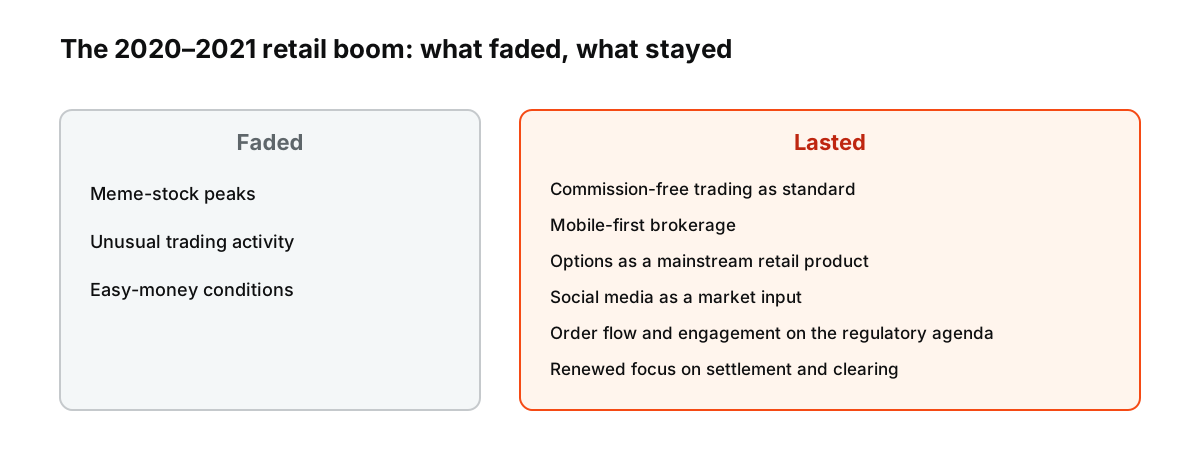
Figure: The article’s split between what faded and what stayed after the 2020–2021 boom.
Many meme stocks fell sharply from their peaks. Trading activity normalized. Easy-money conditions ended when inflation and interest rates rose.
Other changes remained:
- commission-free equity trading became standard in the US retail market;
- mobile-first brokerage stayed normal;
- options became a more common retail product;
- social-media narratives remained a market input;
- digital engagement and payment for order flow stayed on the regulatory agenda;
- settlement and clearing infrastructure received renewed attention.
The episode mattered because it accelerated trends that were already underway.
The lasting lesson is that access changes behavior and structure together
Reducing friction brings more people into markets. That can improve access and competition.
It also changes order flow, product use, broker economics and the speed at which narratives travel.
The 2020–2021 retail boom was not a separate market operating alongside Wall Street. It was a demonstration that a new distribution channel can alter the behavior of the entire trading system.
The charts were memorable. The structural changes were more important.
Sources
- Staff Report on Equity and Options Market Structure Conditions in Early 2021 — SEC, October 2021
- SEC Staff Releases Report on Equity and Options Market Structure Conditions in Early 2021 — SEC, October 18, 2021
- Financial Stability Report: Asset Valuation — Federal Reserve, November 2021
- Wealth Inequality and COVID-19: Evidence from the Distributional Financial Accounts — Federal Reserve, August 2021