
What It Means When Stocks Climb a Wall of Worry
A wall-of-worry rally happens when prices rise despite persistent fear because expectations are low. Sentiment, positioning and improving data explain it.
When stocks “climb a wall of worry,” prices rise while investors can still list plenty of reasons to be cautious. The move usually happens because expectations and positioning were already pessimistic. Markets do not require the news to become good. They can rise when the news becomes merely less bad than investors had prepared for.
Markets trade the gap between expectations and reality
A company can report weak earnings and still rally if investors expected something worse. The same principle applies to the whole market.
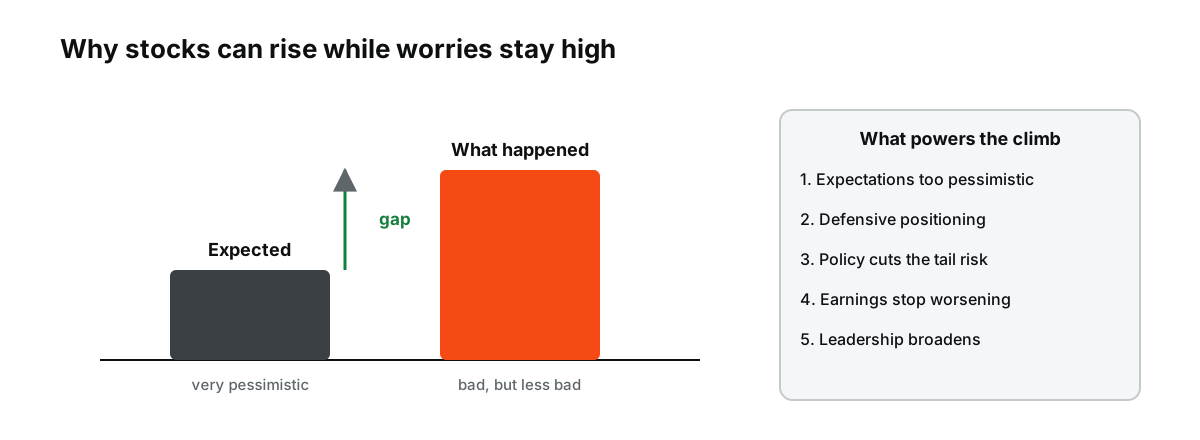
Figure: Illustrative. Prices respond to the gap between what was expected and what happened, not to whether the news is good.
If investors have already priced recession, falling profits and tighter credit, a small improvement can force prices higher. Economic data may still look poor in absolute terms, but the probability of the worst-case scenario has fallen.
That is the core of the “wall of worry” idea. The worries are visible. The surprise is that prices have already absorbed enough of them.
Pessimistic positioning can turn good-enough news into buying
Sentiment affects positioning. Investors who expect a large decline may hold more cash, less equity exposure or short positions.
If the decline does not arrive, those positions create potential demand. Shorts cover. Underweight investors add exposure. Systematic strategies can increase risk as volatility falls.
The rally can therefore feed on the absence of new bad news.
This does not require investors to become optimistic. It only requires them to become less defensive.
March and April 2020 showed how quickly expectations can shift
The COVID-19 crash produced an extreme test of investor psychology.
NBER researchers surveyed Vanguard investors around the February 2020 market high, again after stocks had fallen more than 20% in March, and again in April after a substantial partial recovery. After the crash, investors became much more pessimistic about near-term economic and market outcomes. Yet the market had already begun recovering before the economic damage was fully visible in official data.
The episode captures the awkward feature of market bottoms: prices can turn while the news flow still feels terrible.
Volatility can remain high even as prices rise
The VIX measures option-implied expectations of near-term S&P 500 volatility. It is often called a “fear gauge,” though that nickname oversimplifies what it measures.
A wall-of-worry rally does not require the VIX to fall to calm levels immediately. Volatility can remain elevated while stocks recover because investors still see a wide range of possible outcomes.
The more useful signal is whether volatility is falling from extreme levels while prices stop making new lows. That can indicate that the distribution of feared outcomes is narrowing.
Ranked: what usually powers a wall-of-worry rally
1. Expectations were already too pessimistic
Prices had discounted a worse path than the one that starts to emerge.
2. Positioning is defensive
Cash balances, hedges and short positions create buyers if the market refuses to fall further.
3. The policy response improves the tail risk
Central-bank liquidity, fiscal support or stabilization in credit markets can reduce the probability of systemic outcomes even while growth remains weak.
4. Earnings stop getting worse at the margin
Analysts can still be cutting forecasts, but the pace of downgrades slows.
5. Market leadership broadens
A rally becomes more credible when gains spread beyond a small group of defensive or mega-cap stocks.
The phrase does not mean worries are bullish
There is a dangerous way to use “wall of worry”: treating every negative headline as evidence that stocks must rise.
Fear can be justified. Recessions can deepen. Credit events can force deleveraging. Earnings can fall more than expected. High investor anxiety does not guarantee a market bottom.
Research on investor sentiment finds that sentiment can affect returns most strongly in stocks that are difficult to value and difficult to arbitrage, such as small, volatile or unprofitable companies. It also finds that very high sentiment can precede weaker future returns in some parts of the market. Sentiment is a condition, not a timing signal by itself.
What to watch while the market climbs
A wall-of-worry rally becomes more durable when price action is joined by improving fundamentals.
Watch whether:
- credit spreads are narrowing;
- earnings revisions are stabilizing;
- market breadth is improving;
- volatility is falling;
- cyclicals begin to participate;
- economic surprises become less negative;
- the policy response is reducing liquidity stress rather than simply supporting prices.
If prices rise while credit stress and earnings expectations keep deteriorating, the rally may be more fragile.
The useful interpretation
“Climbing a wall of worry” is a description of expectations catching up with a less-bad reality. It often appears when investors remain emotionally cautious but their portfolios are already positioned for a very poor outcome.
That is why markets can recover before confidence does.
A wall-of-worry rally, illustrated
Suppose an index falls 25% over a year as investors fear a recession. (Illustrative scenario.) Surveys show deep pessimism, many funds hold extra cash and short positions are high. Over the next six months, economic data stay weak but not as bad as feared, inflation eases and earnings forecasts stop falling. The index rises 20% while headlines still warn of recession. Investors who waited for the news to improve before buying find that much of the recovery has already happened by the time it does.
2023 as an example
Going into 2023, many forecasters expected a US recession after the sharp interest rate rises of 2022. The recession did not arrive that year, inflation fell and large technology companies reported strong results, and US indices rose substantially through the year despite persistent warnings. The pattern fitted the wall-of-worry description: expectations had become so gloomy that a merely resilient economy was enough to lift prices.
Measuring the worry
Investors gauge pessimism through surveys of individual investors and fund managers, the amount of cash funds hold, the ratio of put to call options traded and the level of short interest. Extreme readings do not time turning points, but they show how much bad news is already reflected in positioning. See what short interest is.
The opposite pattern
Traders sometimes describe the reverse as a slope of hope: prices fall while investors remain optimistic, buying each dip in the belief that the decline will soon end. Just as pessimism can fuel a rally, complacency can prolong a decline, because there are few investors left to capitulate and turn into buyers.
What it means for index traders
For index CFD traders, a wall-of-worry rally is a reminder that waiting for clear good news can mean missing large moves, while buying purely because sentiment is bleak can mean buying into a decline that continues. Watching breadth, volatility and credit markets alongside price helps judge whether a rally is broadening. See what market breadth tells you, what the VIX is and what moves stock market indices.
Common misreadings
- Treating every negative headline as a reason prices must rise.
- Assuming a rally must fail because the news is still bad.
Why sentiment extremes matter
When almost everyone already expects bad outcomes, most of those who intend to sell have done so, leaving fewer sellers and more potential buyers if the outcome is less severe. The reverse applies at euphoric peaks. That is why extremes in sentiment can mark turning points, even though sentiment can stay extreme for months before prices turn.
A wall-of-worry checklist
- Are surveys and positioning deeply pessimistic?
- Is the data turning less bad, even if still weak?
- Are credit spreads narrowing and volatility falling?
- Is the rally spreading beyond a few stocks?
- Are earnings forecasts stabilizing?
After the wall is climbed
Once worries fade and optimism returns, the forces behind a wall-of-worry rally weaken: cash has been invested, shorts have covered and expectations have risen. Later gains then depend more on earnings delivering. Many strong rallies slow at this stage, which is a reason to reassess risk as sentiment improves rather than only when it is gloomy. Rising optimism is a reason for more care, not less.
Frequently asked questions
Where does the phrase come from?
It is a long-standing market saying describing prices that rise despite persistent worries, as if climbing over them.
Does a wall of worry mean the rally will last?
Not on its own. Rallies are more durable when improving data, earnings and credit conditions join the price recovery.
This article is educational content and does not constitute financial, investment, legal or tax advice. Digital assets are volatile and you may lose the amount you invest.