
What ESMA’s 2018 CFD Rules Changed for Retail Traders
From August 2018, EU retail CFD traders faced leverage caps, a 50% margin close-out, negative balance protection and standard risk warnings. What changed.
ESMA’s CFD rules, applied across the EU from August 1, 2018, set the first EU-wide retail protections: leverage caps from 30:1 to 2:1 by asset, close-out when equity falls to 50% of required margin, negative balance protection, a ban on incentives and a standard warning showing the share of clients who lose money.
Timeline
- January 18, 2018: ESMA calls for evidence on restricting CFDs and binary options.
- March 23, 2018: ESMA’s board agrees the measures.
- July 2, 2018: binary options banned for retail clients.
- August 1, 2018: CFD restrictions take effect.
- 2019 onward: national regulators make the measures permanent in their own rules.
What changed
Leverage caps: 30:1 for major currency pairs; 20:1 for other pairs, gold and major indices; 10:1 for other commodities and minor indices; 5:1 for individual shares; 2:1 for cryptocurrencies. See leverage limits in the EU, UK and Australia compared.
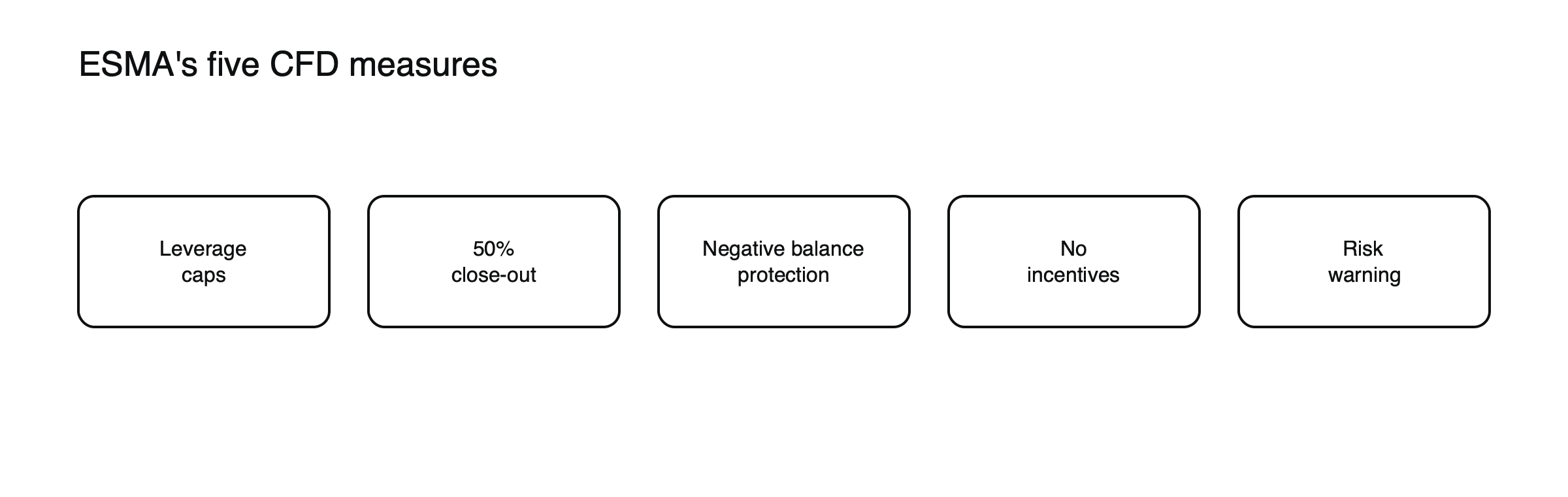
Figure: The five retail protections ESMA introduced.
Margin close-out: providers must close positions when account equity falls to 50% of the required margin.
Negative balance protection: retail clients cannot lose more than the money in their account.
No incentives: bonuses and similar inducements banned.
Risk warning: a standard warning including the provider’s percentage of losing retail accounts.
Leverage caps, illustrated
Suppose a trader with €1,000 wants exposure to a major currency pair. (Illustrative scenario.) Before the rules, some providers offered leverage of 500:1, allowing a position worth €500,000; a move of just 0.2% against the trader would wipe out the deposit. Under the 30:1 cap, the maximum position is €30,000, and it would take a 3.3% adverse move to lose the full deposit. For individual shares, the 5:1 cap limits the same deposit to €5,000 of exposure; for crypto, the 2:1 cap limits it to €2,000.
The 50% close-out rule, illustrated
Suppose a trader posts €1,000 of margin for a position and the account has no other funds. (Illustrative scenario.) If losses reduce account equity to €500, half the required margin, the provider must begin closing positions. The rule aims to stop losses before the account is wiped out, though fast markets and gaps can still cause larger losses, which is where negative balance protection takes over.
Why ESMA acted
National regulators’ studies found that 74% to 89% of retail CFD accounts typically lost money, with average losses of €1,600 to €29,000 per client.
Binary options
Alongside the CFD restrictions, ESMA banned the marketing, distribution and sale of binary options to retail clients from July 2, 2018. Binary options, which pay a fixed amount if a condition is met and nothing otherwise, had been linked to widespread losses and fraud.
From temporary to permanent
ESMA’s measures were temporary product intervention powers, renewed every three months. During 2019, national regulators across the EU adopted equivalent rules on a permanent basis, and the UK’s Financial Conduct Authority applied similar permanent rules to CFDs from August 2019. Australia’s regulator later introduced comparable leverage limits from March 29, 2021, after finding that retail clients of 13 CFD issuers lost more than $774 million in five weeks of 2020. See leverage limits in the EU, UK and Australia compared.
What it meant for traders
Smaller positions for the same deposit, losses capped at account balance, and clearer cost and risk disclosures. Some traders moved to “professional” status, losing these protections. See why the UK banned crypto derivatives for retail investors and why best execution matters for traders.
The leverage schedule
| Underlying | Maximum leverage | Minimum margin |
|---|---|---|
| Major currency pairs | 30:1 | 3.33% |
| Other currency pairs, gold, major indices | 20:1 | 5% |
| Other commodities, minor indices | 10:1 | 10% |
| Individual shares and other references | 5:1 | 20% |
| Cryptocurrencies | 2:1 | 50% |
Professional clients
Clients who meet criteria on trading activity, portfolio size and professional experience can apply to be treated as professional, which removes the retail protections, including leverage caps and negative balance protection. Regulators have warned that some firms encouraged retail clients to opt up inappropriately, and they have scrutinized such practices. See what negative balance protection is.
The industry’s response
Many providers saw trading volumes and revenues fall after the rules took effect, and some moved retail clients to entities outside the EU where higher leverage was still permitted. Regulators responded by restricting marketing of non-EU entities to EU clients. Over time, the rules became the standard reference point for retail CFD protection worldwide.
The risk warning
Providers must display a standard warning stating that CFDs are complex instruments with a high risk of losing money rapidly due to leverage, along with the percentage of their own retail accounts that lose money. The firm-specific percentage, updated regularly, gives prospective clients a concrete measure of how often retail traders lose with that provider.
Before and after, illustrated
Suppose a trader deposited €2,000 and traded a major currency pair before and after the rules. (Illustrative scenario.) Before August 2018, a provider offering 200:1 might allow a €400,000 position, where a 0.5% adverse move would wipe out the account and, in a gap, could leave a negative balance. After the rules, the maximum is €60,000, a 3.3% move would be needed to wipe out the deposit, the provider must start closing positions when equity halves and the account cannot go below zero.
No more bonuses
The ban on incentives covers deposit bonuses, trading credits and gifts that encourage clients to trade more. Regulators had found that such offers drew inexperienced traders into larger positions than they would otherwise take. Information services and research tools remain permitted.
Enforcement
National regulators supervise compliance and have fined firms for breaches, such as failing to close positions at the 50% level or inappropriately classifying retail clients as professional.
Common misreadings
- Believing the rules banned CFDs.
- Assuming negative balance protection removes all losses.
The scale of losses
National regulators’ studies found that between 74% and 89% of retail CFD accounts typically lost money, with average losses per client ranging from about €1,600 to €29,000 depending on the study. These figures, gathered across several countries, convinced ESMA that disclosure alone was not enough and that limits on product features were needed.
Margin calls and close-outs
Before the rules, providers often issued margin calls asking clients to add funds as losses grew, and some allowed accounts to fall well below required margin. The 50% close-out rule made automatic closing mandatory, removing the temptation to keep losing positions open in hope of a recovery. Clients can still add funds to avoid reaching the threshold.
The UK after Brexit
The UK’s Financial Conduct Authority adopted permanent rules closely matching ESMA’s in 2019, before the UK left the EU, and has kept them since. It went further on crypto, banning crypto derivatives for retail clients from January 2021. See why the UK banned crypto derivatives for retail investors.
What remains the trader’s responsibility
The rules limit leverage and losses, but they do not prevent losses. Traders still choose position sizes, stop levels and how much of their savings to put at risk. Lower leverage gives more room before a close-out, but using the maximum leverage on every trade can still lead to rapid losses.
Choosing a provider
- Check which regulator authorizes the entity you deal with.
- Confirm negative balance protection and the close-out level.
- Read the published share of losing retail accounts.
- Be wary of offers to reclassify you as a professional client.
- Compare spreads and overnight financing costs, not just leverage.
How the rules affected costs
With lower leverage, traders need more margin for the same exposure, which some saw as a cost. But the rules did not cap spreads or financing charges, so comparing these remains important. Some providers lowered spreads to stay competitive after the rules reduced trading volumes, while others introduced tiered pricing for larger clients. The overall effect on costs varied from provider to provider. Comparing total costs over a typical month of trading gives a much clearer picture.
Frequently asked questions
Do the rules apply outside the EU?
They apply to firms serving EU retail clients; other jurisdictions have their own rules, though many have adopted similar limits.
Why is crypto leverage so low?
Because crypto prices are especially volatile, so ESMA set the strictest cap, 2:1, for crypto CFDs.
This article is educational content and does not constitute financial, investment, legal or tax advice. Digital assets are volatile and you may lose the amount you invest.
Sources
- ESMA agrees to prohibit binary options and restrict CFDs (March 23, 2018 agreement; 74%–89% of retail accounts lose money; January 18, 2018 call for evidence) — ESMA
- ESMA adopts CFD and binary options measures (binary options from July 2, 2018; CFDs from August 1, 2018; full leverage schedule; 50% close-out) — Finadium
- ESMA adopts final product intervention measures (investors cannot lose more than they put in) — ESMA
- ASIC product intervention order strengthens CFD protections (from March 29, 2021; 30:1 major pairs; $774 million losses in five weeks of 2020) — Mondo Visione