
What Is Leverage in CFD Trading?
Leverage lets you control a larger CFD position with a smaller deposit, magnifying gains and losses. How leverage ratios work, an example and the limits.
Leverage in CFD trading means controlling a position larger than the money you put up. At 30:1, $1,000 controls a $30,000 position, and a 2% move against you costs $600, or 60% of your margin. In the EU, UK and Australia, retail leverage is capped from 30:1 down to 2:1 depending on the asset.
Why leverage exists in CFD trading
A CFD lets you take a position on the price of a share, index, currency, commodity or cryptocurrency without buying the asset itself. Because no asset changes hands, the provider only needs a deposit to cover potential losses, not the full value of the position. That deposit is the margin, and the gap between it and the position’s value is the leverage. Leverage makes small price moves large enough to matter for traders with limited capital, which is why it is built into almost every CFD account. It is also the main reason most retail CFD accounts lose money. See what a CFD is.
How leverage ratios work
Leverage = position value ÷ margin. A ratio of 30:1 means margin of 1/30, or about 3.33% of the position. A ratio of 5:1 means 20% margin.
Leverage and margin, side by side
| Leverage | Margin as a share of the position | Position controlled by $1,000 |
|---|---|---|
| 30:1 | 3.33% | $30,000 |
| 20:1 | 5% | $20,000 |
| 10:1 | 10% | $10,000 |
| 5:1 | 20% | $5,000 |
| 2:1 | 50% | $2,000 |
Leverage, margin rate and exposure are three ways of describing the same arrangement. A higher ratio means a smaller deposit for the same position and a smaller price move needed to wipe that deposit out.
Worked example
- Deposit used as margin: $1,000
- Leverage: 30:1 (example value)
- Position value: $30,000
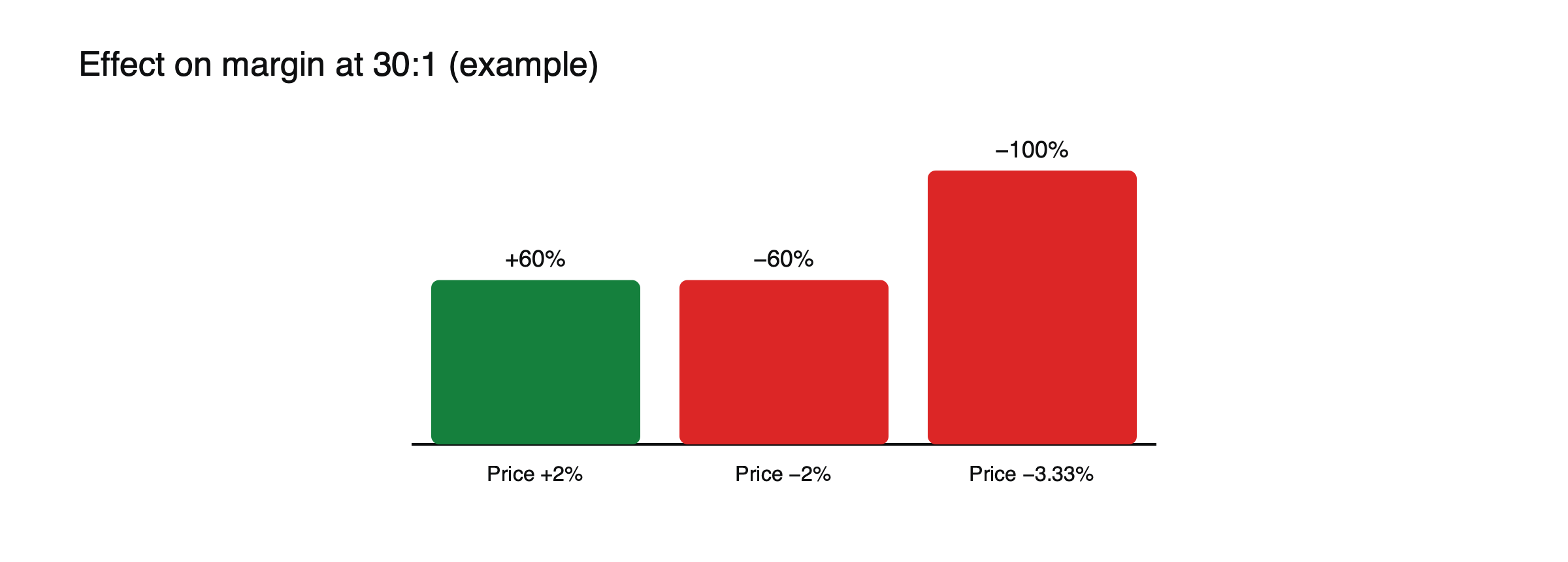
Figure: At 30:1, small price moves become large changes in margin (example values).
| Price move | Profit or loss | Share of margin |
|---|---|---|
| +2% | +$600 | +60% |
| −2% | −$600 | −60% |
| −3.33% | −$1,000 | −100% |
Without leverage, the same $1,000 would gain or lose $20 on a 2% move.
A second example: a share CFD at 5:1
You put up $2,000 of margin to open a $10,000 position in a share CFD at 5:1. (Example values.)
- A 10% rise gains $1,000, half your margin.
- A 10% fall loses $1,000, also half your margin.
- A 20% fall would wipe out the whole $2,000.
Single shares can fall 10% or 20% on one earnings report, so even the lower leverage allowed on shares leaves a position exposed to large moves.
Maximum leverage and the leverage you actually use
The ratio your provider allows is a ceiling, not a recommendation. What matters is effective leverage: the total value of your open positions divided by your account equity. Suppose your account holds $10,000 and you open a $50,000 position in a currency pair that allows 30:1. The provider requires about $1,667 of margin, but your effective leverage is 5:1, because the whole account stands behind the trade. A 2% move against you costs $1,000, 10% of the account. Had you used the full 30:1 on the whole account, a $300,000 position, the same move would cost $6,000. Thinking in effective leverage keeps the focus on what a move does to your account, not to a single position’s margin.
Leverage against normal daily moves
Leverage is only meaningful against how much an asset usually moves. As rough, illustrative ranges: a major currency pair may move around 0.5% to 1% on a typical day, crude oil 2% to 3%, a large share 1% to 2% and bitcoin 3% to 5%. At 30:1, a 1% currency move equals 30% of the margin; at 10:1, a 3% oil move equals 30%; at 2:1, a 5% bitcoin move equals 10%. The regulatory caps were set partly with these differences in mind: the more volatile the asset, the lower the leverage allowed.
Leverage also multiplies costs
Overnight financing is charged on the full position, not on your margin. A $30,000 position financed at an illustrative 6% a year costs about $4.93 a day, roughly $148 a month. On $1,000 of margin, that is about 15% of the deposit every month, before any price move. Spreads are also paid on the full position. The higher the leverage, the larger these costs are relative to the money you put in. See how CFD overnight financing works.
Why leverage is risky
Losses build quickly, and providers close positions automatically when your account falls below required levels. See what happens in a margin call and a stop-out.
Regulatory limits
EU rules cap retail leverage at 30:1 for major currency pairs, 20:1 for non-major pairs, gold and major indices, 10:1 for other commodities, 5:1 for shares and 2:1 for crypto. See leverage limits in the EU, UK and Australia compared.
What the regulators found
When the European Securities and Markets Authority restricted CFDs for retail clients in 2018, it identified excessive leverage as the main problem and noted that between 74% and 89% of retail CFD accounts typically lost money. Its measures combined the leverage caps with a margin close-out rule at 50% of required margin, negative balance protection and standard risk warnings. Similar rules were later adopted by the UK and Australia. See what negative balance protection is.
Professional clients and higher leverage
Clients who qualify as professional, usually by meeting criteria on trading activity, portfolio size and financial-sector experience, can access higher leverage in these jurisdictions. In exchange, they give up some retail protections. Higher leverage suits very few traders, and the protections lost are often the ones that matter most in a sudden market move.
Providers outside these rules
Some providers regulated in other jurisdictions offer much higher leverage, sometimes several hundred to one. The same arithmetic applies: at very high leverage, a move of a fraction of a percent can wipe out the margin. Protections such as negative balance protection, margin close-out rules and segregation of client money may differ or not apply, so checking who regulates a provider and what it guarantees matters as much as the leverage on offer.
Choosing your leverage from your risk
A practical way to set leverage is to work backward from the loss you will accept. Suppose your account holds $10,000 and you are willing to lose 1%, $100, if a EUR/USD trade fails. Your stop is 50 pips away, and one standard lot moves about $10 per pip. (Example values.)
- Position size = $100 ÷ (50 × $10) = 0.2 lots
- Position value at 1.1000 ≈ $22,000
- Effective leverage ≈ 2.2:1
The provider would allow up to 30:1, but the trade only needs about 2.2:1 to express the idea at the chosen risk. Leverage becomes the result of a risk decision rather than the starting point. Writing down the effective leverage of each open position, alongside the stop and the amount at risk, makes it much harder for leverage to creep up unnoticed over a busy week. See how to size a CFD position using risk per trade.
How leverage leads to a margin call
Leverage shapes how quickly an account reaches its warning levels. With most of an account committed as margin, a small adverse move pushes equity toward the margin requirement, triggering a margin call, and a slightly larger one triggers automatic closure at the stop-out level, often 50% of required margin. With low effective leverage, the same move barely changes the margin level. See what happens in a margin call and a stop-out and equity, free margin and margin level explained.
Leverage and decision-making
High leverage also changes behavior. When a small move produces a large gain or loss relative to the deposit, every tick feels important, and traders tend to close winners too early and hold losers too long. Lower leverage makes swings feel smaller, which makes it easier to follow a plan. Many experienced traders treat this as one of leverage’s least discussed costs.
Using leverage more safely
Use less than the maximum, size positions by how much you are willing to lose rather than by available margin, and set stops. See how to size a CFD position using risk per trade and what margin is in CFD trading.
Leverage before and after the 2018 rules
Before European regulators intervened, retail CFD and forex accounts were commonly offered leverage far above today’s caps, and heavy losses among inexperienced clients were widespread. The 2018 measures began as temporary restrictions and were later adopted permanently by national regulators, with the UK and Australia introducing similar regimes. The result is that the same trade can carry very different maximum leverage depending on where a client lives and how the provider is regulated. See leverage limits by country.
Leverage in other products
CFDs are not the only leveraged products. Share trading on margin through a brokerage typically allows much lower leverage, often around 2:1 for retail accounts in the United States. Exchange-traded futures set margin by contract and can imply leverage similar to or higher than CFDs. Crypto perpetual futures on offshore exchanges have offered leverage of 100:1 or more. The mechanics differ, but the core arithmetic is the same: the larger the position relative to the money committed, the smaller the move needed to wipe that money out. See what perpetual futures are.
Leverage across asset classes
| Asset | Retail cap under EU rules | Typical drivers of large moves |
|---|---|---|
| Major currency pairs | 30:1 | Central bank decisions, economic data |
| Non-major pairs, gold, major indices | 20:1 | Risk sentiment, rates, earnings seasons |
| Other commodities, minor indices | 10:1 | Supply shocks, inventory data |
| Individual shares | 5:1 | Earnings, company news |
| Cryptocurrencies | 2:1 | Sentiment, liquidations, regulation |
Frequently asked questions
Does lower leverage mean lower risk?
It means each price move has a smaller effect on your margin and account, so the same move takes longer to cause serious damage. The asset’s own risk is unchanged; lower leverage simply leaves more room for it.
Can I choose a lower leverage than the maximum?
Yes. Many platforms let you set lower leverage per account or per instrument, and you can always use less by opening smaller positions relative to your equity.
Is leverage the same as borrowing?
In effect, yes: you gain exposure to more than you deposit. With CFDs there is no separate loan, but overnight financing works like interest on the part of the position you have not paid for.
Leverage, margin and cost figures in this article are example values for illustration. Actual terms depend on the provider, the instrument and the rules in your country.
This article is educational content and does not constitute financial, investment, legal or tax advice. Digital assets are volatile and you may lose the amount you invest.