
How to Set a Take-Profit Level That Fits the Trade
Define the stop first, find a realistic target, check reward to risk and adjust for costs: how to set a take-profit level that fits the trade, with an example.
To set a take-profit order that fits the trade, start with where the trade is wrong (your stop), find a realistic target from market structure, check that the reward justifies the risk after costs, then place the order. A long at 100 with a stop at 95 and a target at 110 offers a 2:1 reward-to-risk ratio.
Before you start
You need a clear trade idea, an entry level and a view of nearby support and resistance. See support and resistance.
Building the target
Define the stop first
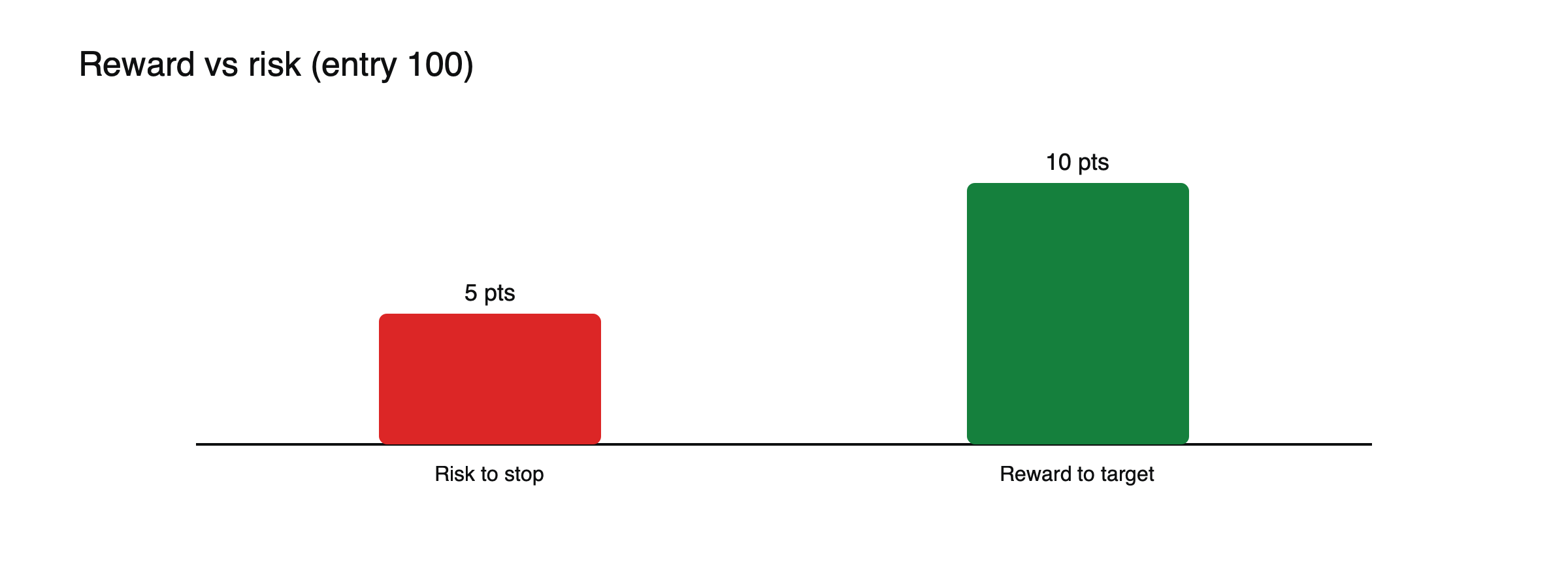
Figure: A 2:1 reward-to-risk setup (example values).
The stop marks where your idea is proven wrong. The distance from entry to stop is your risk per unit. See how stop-loss orders work.
Find a realistic target
Look for a level the market has reacted to before, such as prior highs or a resistance zone, rather than a round number.
Check reward to risk
Reward-to-risk = (target − entry) ÷ (entry − stop). Entry 100, stop 95, target 110: 10 ÷ 5 = 2:1. A higher ratio means you can be right less often and still come out ahead.
Reward-to-risk compares the distance to your target with the distance to your stop. A target 110 points away with a stop 50 points away gives a ratio of 2.2 to 1.
Adjust for costs
Subtract spread, commission and expected financing from the reward. See what a CFD trade really costs.
Place the order
A take-profit is a limit order: it fills at your level or better, but only if the market trades there.
A target, worked through
You plan to buy EUR/USD at 1.1000. The idea is wrong below a support zone, so the stop goes at 1.0950, 50 pips away. The nearest resistance sits around 1.1110, so the take-profit goes just below it, at about 1.1110, 110 pips away. (Example prices.)
- Reward-to-risk before costs = 110 ÷ 50 = 2.2
- With a 1.5-pip spread, the effective reward is about 108.5 pips and the risk about 51.5 pips, a ratio of about 2.1
- To break even over many such trades, you would need to win about 32% of them
The target came from the chart, the stop from the trade idea, and the ratio checked whether the two together were worth taking.
Reward-to-risk and win rate
| Reward-to-risk | Win rate needed to break even |
|---|---|
| 1 to 1 | 50% |
| 1.5 to 1 | 40% |
| 2 to 1 | 33% |
| 3 to 1 | 25% |
(Before costs.) A higher ratio lowers the win rate you need, but targets further away are reached less often. The goal is not the largest ratio but a realistic combination of ratio and probability.
Taking profit in stages
Some traders split a position: they close part at a first target and leave the rest with a trailing stop or a second target. Taking partial profit reduces the chance of a winning trade turning into a loss, at the cost of a smaller gain if the move runs much further. See what a trailing stop is.
When the market gaps toward your target
A take-profit is a limit order, so if the market gaps past it, the order usually fills at the better opening price rather than at your level. That favorable slippage is the mirror image of a stop filling badly in a gap.
Common mistakes
- Setting targets so far away they are rarely reached.
- Moving the target further once the trade is winning, then giving back gains.
- Ignoring that a 2:1 ratio still needs a reasonable win rate.
For sizing, see how to size a CFD position using risk per trade. For the basics, read what a CFD is.
When a fixed target does not fit
In a strong trend with no obvious resistance ahead, a fixed take-profit can cut a winning trade short. In those cases, a trailing stop or a time-based exit may suit the trade better than a target picked without a clear level behind it.
Ways to choose a target
- Market structure: just before a resistance zone for a long, or a support zone for a short, where the price has turned before.
- Measured moves: the size of a previous swing projected from the breakout point.
- Volatility: a multiple of the market’s average daily range, sized to how far it typically travels in your holding period.
- Round numbers: levels such as 1.1000 or 5,000 attract orders, so targets are often placed just before them.
Structure-based targets are usually the most defensible, because they rest on levels where real orders have appeared before.
What the numbers add up to
Suppose you take many trades like the example above, with a reward-to-risk of about 2.1 after costs, and win 40% of them. Risking $100 each time, the average result per trade is about 0.4 × $210 − 0.6 × $100 = $24. (Illustrative figures.) A modest edge per trade, repeated over many trades, is what a consistent take-profit and stop process aims to produce. If the win rate fell to 30%, the same ratio would lose about $7 per trade, which shows how sensitive the result is to both numbers.
Time also matters
A distant target may take weeks to reach, and every night a position stays open adds financing. A trade that needs a long time to reach its target must earn enough to cover that cost. Some traders add a time limit to the plan: if the target is not reached within a set number of days, they close the trade and reassess, rather than letting costs grow while the idea goes nowhere.
Take-profits on short positions
For a short, the take-profit sits below the entry, usually just above a support zone, and fills as a buy limit when the price falls to it. The same reward-to-risk logic applies in reverse.
Recording targets
Writing each planned target, the reason for it and whether it was reached in a trading journal shows over time whether your targets are realistic. If most trades reverse before reaching them, the targets may be too ambitious for the markets you trade. See how to keep a trading journal. Adjusting the method based on that record, rather than on a disappointing trade, is what makes the journal worth keeping.
Frequently asked questions
Should every trade have a take-profit?
Not necessarily, but every trade should have an exit plan. For many trades, a take-profit at a clear level is the simplest; for trend-following trades, a trailing stop may replace it.
Can I move my take-profit while the trade is open?
Yes, but moving it further away just because the trade is going well often turns gains into losses. Changes should follow new information from the market, not hope.
This article is educational content and does not constitute financial, investment, legal or tax advice. Digital assets are volatile and you may lose the amount you invest.