
What Is a Trailing Stop and When Does It Help?
A trailing stop moves with the price in your favor and stays put when it turns, locking in gains. How it works, a worked example and when it helps or hurts.
A trailing stop is a stop-loss that follows the price at a set distance as a trade moves in your favor and stays put when the price turns, locking in part of a gain automatically. It helps in clear trends and hurts in choppy markets, where normal swings can close a trade that would have recovered.
How it works
You choose a distance, in points or percent. For a long position:
- As the price rises, the stop rises with it, always the same distance below the highest price reached.
- When the price falls, the stop stays where it is.
- If the price falls to the stop, the position closes.
Worked example
- Buy at 100, trailing distance 5: initial stop at 95.
- Price rises to 110: stop moves to 105.
- Price falls to 105: the position closes, locking in about 5 points of profit, before costs.
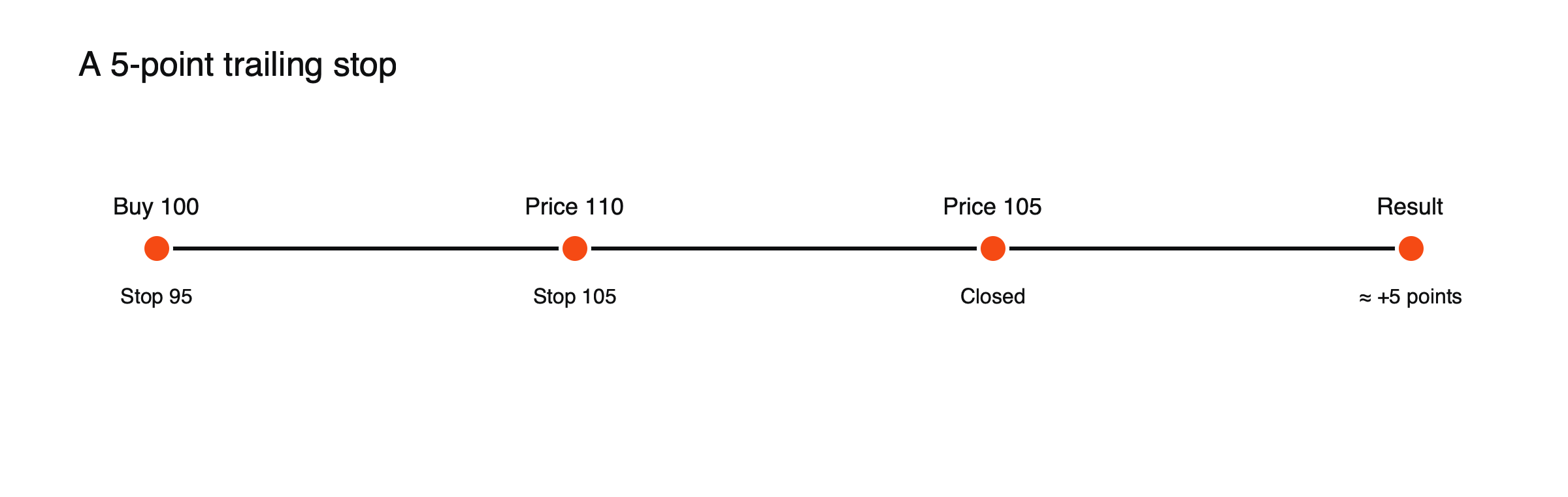
Figure: A 5-point trailing stop locks in part of a gain (example values).
A trend with pullbacks, worked through
Buy at 100 with a trailing distance of 5. (Example values.)
- Price rises to 108: the stop moves to 103.
- Price pulls back to 104: the stop stays at 103, and the position survives.
- Price climbs to 115: the stop moves to 110.
- Price falls to 110: the position closes, about 10 points of profit before costs.
The trailing stop let the trade survive one pullback and captured two-thirds of the move from entry to the peak.
Fixed distance or percentage?
Trailing distances can be set in points or as a percentage. A fixed distance stays the same as the price rises, so it becomes relatively tighter on a large move; a percentage widens as the price rises. On a share CFD rising from 100 to 120, a 5-point trail sits at 115, while a 5% trail sits at 114. For assets that can move a long way, a percentage often fits better.
Volatility-based trailing
Some traders set the trailing distance as a multiple of the average daily range, so the stop is wider in volatile periods and tighter in quiet ones. This adapts better than a fixed number but usually needs manual adjustment or a platform that supports it.
When it helps
- Strong trends, where letting profits run matters.
- When you cannot watch the market, since the stop adjusts automatically.
When it hurts
- Choppy markets: a distance that is too tight gets hit by normal swings.
- Gaps: like any stop, it fills at the next available price. See how stop-loss orders work and why they can slip.
Trailing stop or fixed take-profit?
A take-profit closes a trade at a set target; a trailing stop lets it run until the price turns by your chosen distance. The take-profit is better when you expect the price to stop at a known level, such as a major resistance zone. The trailing stop is better when you expect a trend to continue but cannot know how far. Some traders use both: they take part of the position off at a target and trail the rest. See how to set a take-profit level.
Trailing by hand
You can also trail a stop manually, moving it after each new swing high or low rather than tick by tick. Manual trailing follows the market’s structure more closely but needs attention and discipline, and the temptation to skip an adjustment, or to widen the stop, is always there.
Check how your platform handles it
Some trailing stops are managed by your trading terminal and stop working if it is closed; others are held on the provider’s server. Check which applies before relying on one.
Choosing the distance
Base it on how much the market normally moves, for example a multiple of its typical daily range, rather than a round number. See how to size a CFD position using risk per trade and market, limit and stop orders. For the basics, read what a CFD is.
Trailing a short position
For a short, the trailing stop sits above the price and moves down as the price falls. Sell at 100 with a trailing distance of 5: the stop starts at 105. If the price drops to 90, the stop moves to 95. If the price then rises to 95, the position closes, about 5 points of profit before costs. (Example values.) The logic mirrors the long case: the stop follows the trade’s best price and never moves against it.
Costs, spreads and the trailing distance
Trailing stops on a long position are usually triggered by the bid price, which sits below the price shown on many charts by the spread. In markets with wide spreads, or when spreads widen around news, a trailing stop can be hit even though the chart never seemed to reach it. Allowing for the spread when choosing the distance, and avoiding very tight trails in instruments with wide spreads, reduces these surprises.
Choosing a distance: tight, medium or wide
| Distance | Keeps more of a gain | Survives normal pullbacks | Best suited to |
|---|---|---|---|
| Tight | Yes | Rarely | Short, fast moves |
| Medium | Often | Often | Steady trends |
| Wide | Less | Usually | Long, volatile trends |
There is no right answer for every trade; the distance expresses how much of a pullback you are prepared to sit through to stay in a move.
Common trailing mistakes
- Setting a distance smaller than the market’s normal daily swing.
- Using a trailing stop from the very first minute, before the trade has had room to work.
- Relying on a terminal-based trailing stop and then switching the computer off.
Testing a distance on past charts
Before relying on a trailing stop, it helps to replay it on past price data for the same market. Pick a distance, mark where the stop would have trailed during several past trends and pullbacks, and note where it would have closed the trade. Repeating this with two or three distances shows which one kept trades open through normal pullbacks without giving back too much at the end. The exercise takes less than an hour and replaces guesswork with evidence from the market you actually trade.
Frequently asked questions
Does a trailing stop work when my computer is off?
Only if the provider holds it on its servers. Trailing stops managed by a desktop terminal stop adjusting when the terminal is closed, though the last stop level may remain active.
Can a trailing stop move backward?
No. A trailing stop only moves in the direction of the trade. If the price turns, it stays put until either the price recovers or the stop is hit.
This article is educational content and does not constitute financial, investment, legal or tax advice. Digital assets are volatile and you may lose the amount you invest.