
What Are Contango and Backwardation?
Contango is when later futures prices sit above near ones; backwardation is the reverse. What causes each, what they signal and how they affect positions.
Contango and backwardation describe a futures curve’s shape. In contango, later contracts are priced above near ones, usually reflecting storage and financing costs. In backwardation, later contracts are cheaper, usually because supply is tight now. In April 2020, oil’s steep contango, as storage ran out, preceded WTI settling at −$37.63.
Contango
- What it looks like: prices rise with each later month.
- Common causes: ample supply, storage and financing costs.
- Effect on long positions that roll: you sell the cheaper expiring contract and buy a dearer one, which drags on returns over time.
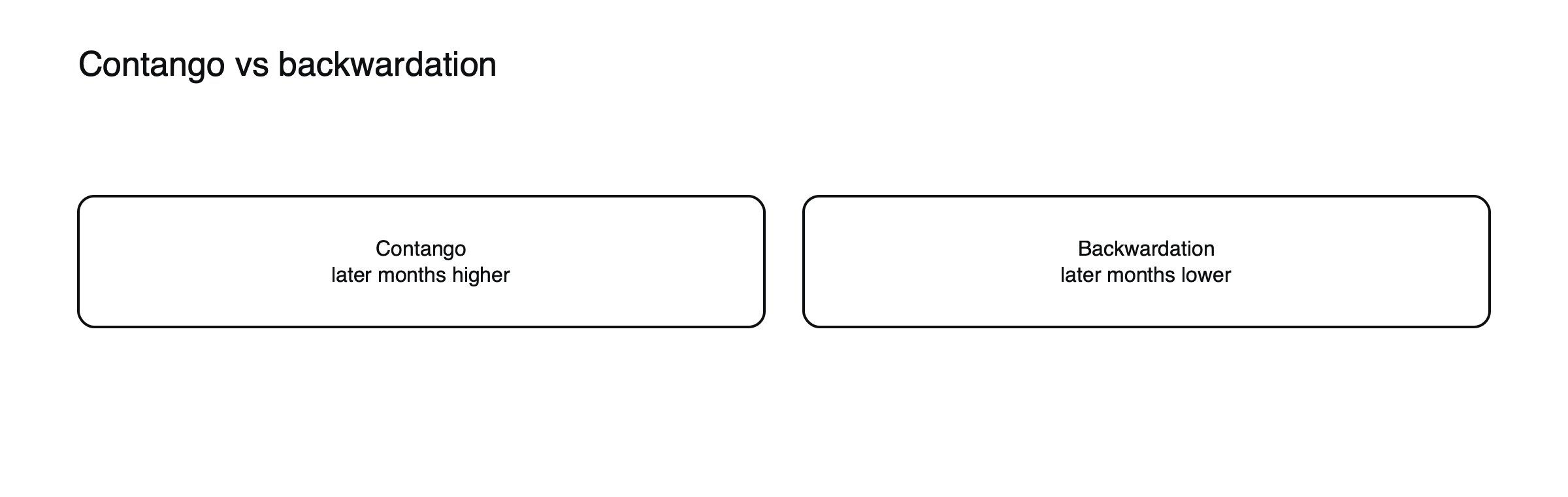
Figure: The two curve shapes.
Backwardation
- What it looks like: prices fall with each later month.
- Common causes: tight supply, strong current demand.
- Effect on rolling longs: you buy the next contract cheaper, which can add to returns.
The cost of rolling, in numbers
Suppose the front-month oil contract trades at $80 and the contract three months later at $82. (Illustrative prices.) A long position that rolls each month from the expiring contract into the next gives up roughly the price difference between neighboring months, here about $0.67 a month, or close to 1% of the price. If the curve stays the same shape, those roll costs add up to roughly 10% over a year, even if the front-month price never changes. In backwardation the effect reverses, and rolling longs gain a similar amount. That is why the shape of the curve can matter as much as the direction of prices for anyone holding positions for months.
Why storage shapes the curve
In contango, the price gap between months is limited by the cost of buying the commodity now, storing it and selling it forward. If the gap grows larger than storage and financing costs, traders buy, store and sell futures, which narrows it. When storage fills up, as happened with oil in April 2020, that limit breaks down: no one can take more oil, and the nearby price can collapse relative to later months. Backwardation has no such cap, because there is no way to borrow tomorrow’s supply today, so it can become very steep in shortages.
Convenience yield
Holding a physical commodity has a benefit beyond its price: a refinery with crude in its tanks can keep running, and a manufacturer with metal in stock can meet orders. Economists call this the convenience yield. When supplies are scarce, it rises, and users will pay more for delivery now than later, pushing the curve into backwardation. When supplies are plentiful, it falls toward zero and storage costs dominate, producing contango.
What the curve tells you
Steep contango can signal oversupply; backwardation can signal shortage. Changes in curve shape are often watched as closely as the price itself. See how to read a futures curve.
Why it matters for CFDs
Futures-based CFDs adjust at each roll, and cash CFDs charge or credit financing that reflects the curve. In contango, holding long positions for months usually costs more. See how a futures roll adjusts a commodity CFD price.
Examples beyond oil
Curves differ by commodity. Natural gas often shows seasonal shapes, with winter contracts priced above summer ones because demand peaks in the cold months. Agricultural curves can jump between harvest and pre-harvest months. Gold usually trades in mild contango, reflecting financing costs, because storage is cheap and supplies are ample relative to demand. Reading a curve therefore means knowing what normal looks like for that commodity before judging whether its current shape is unusual.
The 2020 example
As demand collapsed, nearby oil had nowhere to go, and the May contract fell below the June contract by more than $58 at settlement on April 20.
See spot vs futures prices and how commodity CFDs work.
What happened to funds in 2020
Funds that track oil by holding near-dated futures were hit hard by the extreme contango of 2020. To avoid the problems of the expiring contract, some moved their holdings into later months, which reduced the damage but meant they no longer followed the front-month price closely. The episode showed investors that a fund labeled “oil” can deliver returns very different from the oil price, depending on how it handles the curve.
Using the curve as a signal
Traders watch changes in curve shape as a guide to supply and demand. A curve moving from contango into backwardation can signal tightening supply before it shows in headline prices, while a deepening contango can point to growing surpluses. Spreads between specific months, such as the first and second contracts, are followed closely for this reason. They are not trading signals on their own, but they add context that the price alone does not give. See how to read a futures curve.
Common misreadings
- Assuming a commodity in contango must fall in price.
- Ignoring roll costs when holding futures-based positions for months.
- Treating every curve as if it had the same normal shape.
How the curve shows up in CFD costs
For cash commodity CFDs, providers often build the curve’s shape into overnight financing, so long positions in contango carry an extra daily charge and shorts may receive a credit. For futures-based CFDs, the same effect appears as an adjustment at each roll. Checking the long and short financing rates before holding a commodity position for weeks shows what the curve will cost or pay. Small differences can add up quickly over several months.
Frequently asked questions
Is contango bad?
It is not good or bad in itself; it describes the curve. But for long positions held through several rolls, contango is a cost and backwardation a benefit.
Can a curve be in contango and backwardation at the same time?
Yes. A curve can slope upward in the near months and downward further out, or the reverse, depending on expected changes in supply and demand at different dates.
This article is educational content and does not constitute financial, investment, legal or tax advice. Digital assets are volatile and you may lose the amount you invest.
Sources
- May WTI crude prices recover ahead of the contract expiry (−$37.63 settle; steep contango; traders roll or take delivery at Cushing) — ICIS, April 2020
- US crude futures plunge below zero (May WTI −$37.63, June $20.43; investors overlooked monthly expiry) — Hart Energy, April 2020
- Oil price below $0? (contango; Cushing storage running out) — XTB