
How Gold Is Priced: The LBMA Gold Price Explained
The LBMA Gold Price is set twice daily at 10:30 and 15:00 London time in an electronic auction. How it works and how it differs from live spot prices.
The LBMA Gold Price is the main global gold benchmark, set twice each London business day, at 10:30 and 15:00, in US dollars per troy ounce. It comes from an electronic auction run by ICE Benchmark Administration, which replaced the London Gold Fix in March 2015. Traders watch continuous spot and futures prices in between.
How the auction works
- The administrator proposes a starting price.
- Participants submit buy and sell orders at that price.
- If buying and selling are too far apart, the price is adjusted and a new round runs.
- When the imbalance falls within a threshold, the auction ends and the price is published as the LBMA Gold Price AM or PM.
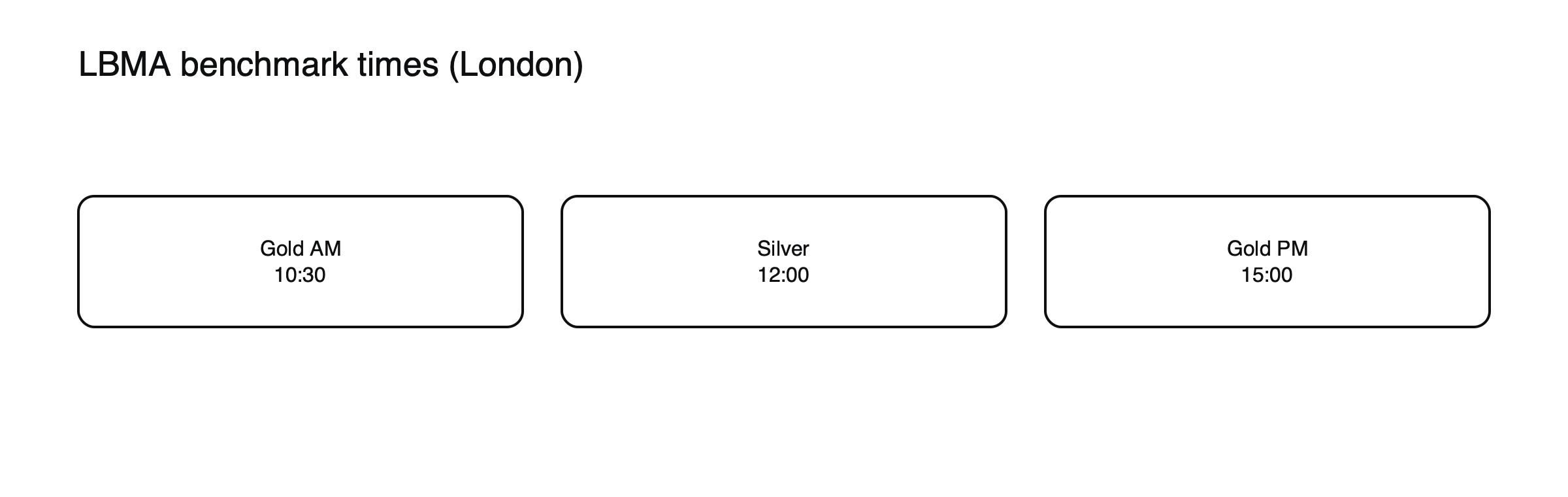
Figure: LBMA benchmark auction times.
Who takes part
Participants in the auction are approved banks and trading firms active in the London market. They submit orders on behalf of themselves and their clients, and the aggregated orders determine the result. Because the process is electronic and recorded, it can be audited, and the administrator publishes information about participants and volumes.
Why a benchmark matters
A single, widely recognized price is useful for settling contracts, valuing holdings and pricing transactions. Producers, refiners, jewelers, central banks and funds use the LBMA Gold Price to agree on a value without having to negotiate a price each time. Many contracts specify that payment will be based on the morning or afternoon price on a given day.
History
London prices were set twice a day from 1919 under the London Gold Fix, run by a small group of banks. In March 2015, it moved to a regulated, electronic auction; it became an FCA-regulated benchmark from April 1, 2015.
Why the old fix was replaced
After scandals around other financial benchmarks in the early 2010s, regulators and market participants pushed for benchmarks that were transparent, auditable and run by independent administrators. The old fix, set by a small group of banks in a teleconference, was seen as falling short of those standards. The move to an electronic, regulated auction aimed to restore confidence in the price.
Benchmark vs live price
- LBMA Gold Price: two fixed prices a day, for settlement and valuation.
- Spot price: continuous over-the-counter quotes, mainly in London.
- Futures price: exchange-traded contracts, such as on COMEX, for later delivery.
Gold CFDs usually track spot or futures, not the twice-daily benchmark. See spot vs futures prices.
Silver and other metals. The LBMA Silver Price is set once daily at noon London time; platinum and palladium have their own auctions.
See what moves gold prices and how commodity CFDs work.
London’s place in physical gold
London is the center of the global over-the-counter gold market, where large bars meeting LBMA standards are held in vaults and traded between banks, refiners and investors. Much of the world’s physical gold trading is settled there, which is why the London benchmark is so widely used. New York’s COMEX futures market, by contrast, is the main venue for exchange-traded gold futures. The two markets are closely linked, and prices between them usually differ only slightly.
Using the benchmark as a trader
For CFD traders, the LBMA Gold Price is rarely the price they trade, since CFDs follow continuous spot or futures quotes. It is still useful as a reference: it appears in news reports, it is used to value funds and it can explain why some contracts or valuations differ from the live price. Comparing your CFD price with the benchmark at 10:30 or 15:00 London time shows how closely they align.
An auction, illustrated
Suppose the administrator opens the morning auction at $2,400.00. (Illustrative figures.) At that price, participants want to buy 50,000 ounces and sell 30,000, an imbalance of 20,000 ounces. Because buying exceeds selling by more than the allowed threshold, the price is raised, say to $2,401.00, and a new round runs. Now buyers want 41,000 ounces and sellers offer 39,500, an imbalance of 1,500 ounces, within the threshold. The auction ends, and $2,401.00 is published as the LBMA Gold Price AM. Any remaining imbalance is shared among participants according to set rules. The process usually takes a few rounds and a few minutes.
Troy ounces
Gold is priced per troy ounce, a unit of about 31.1 grams, slightly heavier than the ounce used for everyday goods. Prices quoted per gram or per kilogram, common in some countries, can be converted from the troy ounce price. Gold CFDs are almost always quoted per troy ounce in dollars, with lot sizes set by each provider.
London Good Delivery
The London market trades large bars that meet the LBMA’s Good Delivery standards for purity, weight and appearance, and come from accredited refiners. A typical gold bar of this kind weighs around 400 troy ounces, roughly 12.5 kilograms. These standards make bars interchangeable between participants, so gold can change hands without being moved or tested again, which is part of what makes London’s market so liquid.
Common misreadings
- Treating the benchmark as the live price at all times of day.
- Assuming a CFD will settle at the LBMA price.
- Confusing the London benchmark with COMEX futures prices.
London and New York compared
| London market | COMEX (New York) | |
|---|---|---|
| Type | Over-the-counter, physical bars | Exchange-traded futures |
| Main price | Continuous spot quotes and the twice-daily benchmark | Futures for set delivery months |
| Typical bar | Around 400 troy ounces | Contracts of 100 troy ounces |
| Main users | Banks, refiners, central banks, funds | Hedgers, funds, speculators |
When the two prices drift apart
Prices in London and New York usually stay within a small gap, because traders can move gold between the two markets to profit from any difference. But when moving metal becomes slow or expensive, for example because of transport disruptions or concerns about trade restrictions, futures in New York can trade at an unusual premium to London spot prices, and large amounts of gold may be shipped across the Atlantic until the gap closes. Such episodes are reminders that gold is a physical commodity, and that the benchmark, spot and futures prices can briefly tell different stories.
A short timeline
- 1919: twice-daily London price setting begins.
- March 2015: the London Gold Fix is replaced by an electronic auction.
- April 2015: the new benchmark becomes FCA-regulated.
Why funds care about the benchmark
Many gold funds and other products value their holdings using the LBMA Gold Price, so the benchmark affects the published value of billions of dollars of investments every single day. Contracts between miners, refiners and buyers often reference it as well. That very wide use is why the auction is regulated and audited, and why its integrity matters well beyond London’s own market.
Frequently asked questions
Can I buy gold at the LBMA Gold Price?
Some institutional clients can place orders in the auction through participants. Retail traders usually buy and sell at continuous market prices instead.
Why are there two prices a day?
The morning and afternoon prices give users two reference points, one during European hours and one when US markets are also open.
This article is educational content and does not constitute financial, investment, legal or tax advice. Digital assets are volatile and you may lose the amount you invest.
Sources
- LBMA Gold Price FAQs (IBA operates an electronic auction; set twice daily at 10:30 and 15:00 UK time in US dollars; London Gold Fix ceased March 19, 2015) — LBMA
- ICE Benchmark Administration launches LBMA Gold Price (replacing the London Gold Fix established in 1919; FCA-regulated from April 1, 2015) — ICE, March 2015
- Prices and data (silver set at 12:00 noon London time; platinum and palladium auctions) — LBMA