
How Emerging Market Currencies Behave When Risk Appetite Falls
Emerging market currencies often fall sharply when risk appetite drops, as money returns to the dollar. Why it happens, what made 1997 and 2022 severe.
Emerging market currencies tend to fall when risk appetite drops, as foreign investors pull money out and borrowers rush to repay dollar debts. Moves are large: USD/ZAR and USD/TRY can move 1,000 pips or more on a typical day. A strong dollar and rising US rates usually make the pressure worse.
Why they fall in risk-off
- Capital flows: foreign money that came in for higher yields leaves quickly.
- Dollar debt: a weaker local currency makes dollar borrowings costlier to repay.
- Thin markets: lower liquidity means bigger price moves for the same flows.
- Commodity links: many emerging economies export commodities whose prices fall in a downturn.
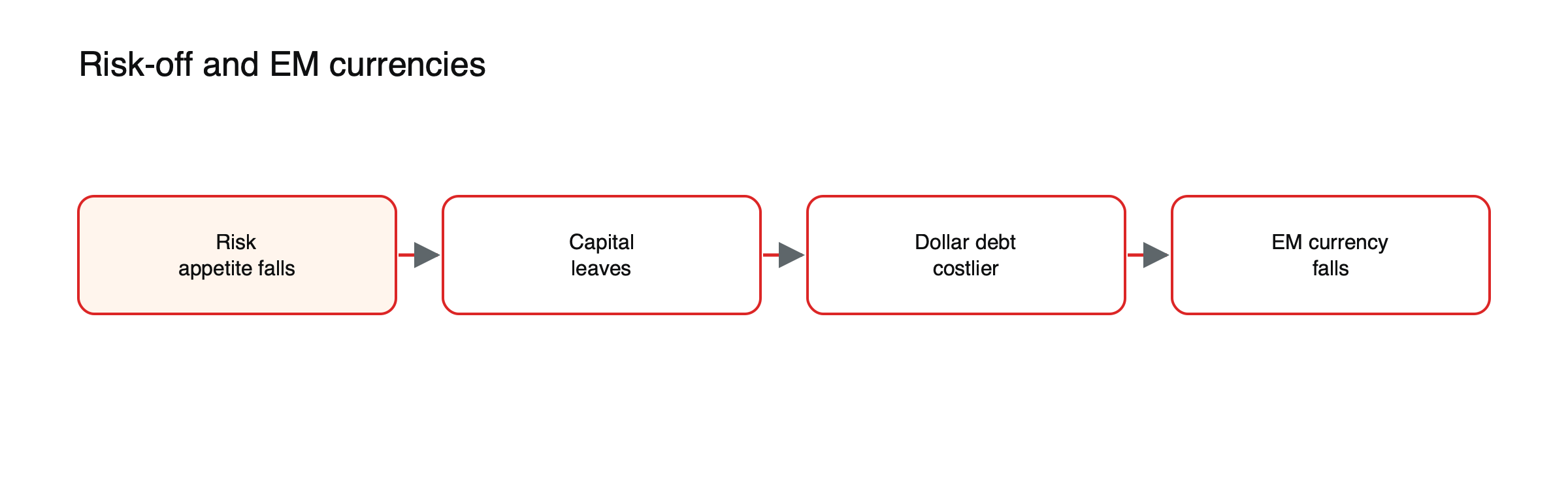
Figure: How risk-off pressure reaches emerging-market currencies.
Vulnerability indicators
| Indicator | Why it matters |
|---|---|
| Current account deficit | The country relies on foreign money to fund spending |
| Short-term foreign debt | Debt that must be rolled over can trigger a crisis if lenders pull back |
| Foreign exchange reserves | Larger reserves let the central bank cushion falls |
| Inflation | High inflation erodes confidence and real returns |
| Foreign ownership of local bonds | Large foreign holdings can leave quickly |
| Political stability | Policy surprises raise risk premiums |
Countries scoring badly on several measures usually fall furthest when global risk appetite drops.
The 1997 crisis
Thailand’s baht peg broke in July, setting off a regional crisis as capital fled. See what caused the 1997 Asian financial crisis.
The 2013 taper tantrum
In 2013, signals that the Federal Reserve would slow its bond purchases pushed US yields up sharply. Investors pulled money from emerging markets, and the currencies of countries with large current account deficits and high inflation fell hard; analysts grouped several of them as especially fragile. The episode showed that a change in US policy, not a local crisis, can be enough to trigger a broad emerging market sell-off.
The 2022 dollar surge
The Fed’s rapid hikes pushed the dollar index to a 20-year high, weighing on emerging-market currencies and assets. See how a strong dollar hits commodities, emerging markets and crypto.
Country-specific crises
Some emerging market currency crises are mainly homegrown, driven by unorthodox policies, political shocks or debt problems in one country. These can happen even when global risk appetite is healthy, and they can be severe: currencies can lose a large share of their value in weeks, sometimes accompanied by capital controls that make it hard to exit positions. Watching local politics and central bank independence matters as much as watching global markets.
What helps some currencies hold up
Large foreign reserves, current account surpluses, credible central banks and high real interest rates. Countries with these tend to fall less.
Carry and emerging markets
High interest rates make many emerging market currencies attractive for carry trades in calm periods, as investors earn the rate gap against low-yielding funding currencies. That income can vanish in a single risk-off week, because these currencies tend to fall sharply just when carry trades are being unwound. The higher the yield, the more important it is to ask what risks it is compensating for. See what the carry trade is.
A risk-off move, illustrated
Suppose global stocks fall 4% over a week on recession fears. (Illustrative figures.) Major currency pairs move about 1% to 2%, while several emerging market currencies fall 4% to 6% against the dollar, spreads on them double and some quotes become patchy. A position sized like a major-pair trade would lose several times the expected amount, which is why emerging market positions need far smaller sizes for the same risk.
What it means for traders
Spreads widen sharply in stress, gaps are common and leverage caps are lower: 20:1 for non-major pairs under EU retail rules. Size positions for much larger moves than on major pairs. See which currency pairs are the most volatile, risk-on vs risk-off and what moves currency prices.
Signals to watch
Traders follow US yields and the dollar index, global stock indices, commodity prices, credit spreads on emerging market bonds and flows into emerging market funds. A combination of rising US yields, a strong dollar and falling commodity prices has often been a difficult backdrop for emerging market currencies. Local central bank decisions and political news then decide which ones suffer most. See what the US dollar index is.
How emerging central banks respond
When their currencies fall sharply, emerging market central banks have several options. They can raise interest rates to make holding the currency more attractive, sell foreign reserves to support it, tighten rules on capital leaving the country or simply let the currency adjust. Large, early rate rises have sometimes stabilized a currency quickly; hesitant responses have often led to deeper falls. Watching how a central bank reacts in the first days of stress says a lot about how the episode will develop.
Local currency debt and dollar debt
Countries and companies that borrow mostly in their own currency are less exposed to a currency fall than those that borrow in dollars, because their debts do not grow when the currency weakens. Over the past two decades many emerging governments have shifted toward borrowing in local currency, which has made some of them more resilient. Corporate dollar debt can still be a weak spot, as companies earning local currency find repayments suddenly more expensive.
Commodity exporters and importers
Not all emerging market currencies react the same way to every shock. Exporters of oil, metals or farm products tend to suffer when global growth slows and commodity prices fall, while importers can benefit from cheaper energy. A spike in oil prices can do the reverse, helping exporters and hurting importers. Knowing which side of the commodity trade a country sits on helps explain why some emerging currencies hold up while others slide.
Trading costs and access
Emerging market pairs usually have wider spreads, higher rollover costs or credits depending on the direction, and thinner liquidity, especially around local holidays and outside local trading hours. Some brokers restrict or pause trading in certain currencies during stress. Checking the contract specifications, including margin requirements and trading hours, is part of preparing for any position in these pairs.
Common misreadings
- Treating a high interest rate as compensation that cannot be lost.
- Assuming all emerging currencies move together.
- Sizing positions as if they were major pairs.
Lessons from past episodes
Several patterns repeat across emerging market sell-offs. Currencies with pegs or heavily managed rates tend to hold until they break, then fall sharply. Countries that raise rates early and decisively usually recover sooner than those that delay. Contagion is common at first, as investors sell a whole region, before fundamentals separate the stronger currencies from the weaker ones. And recoveries can be fast once global conditions improve, rewarding those who distinguished between temporary panic and lasting damage.
Building a watchlist
Traders who follow emerging market currencies often keep a short list of indicators for each country: the current account balance, foreign exchange reserves compared with short-term debt, inflation and the central bank’s policy rate, the share of local bonds held by foreigners and upcoming elections. Updating the list every few months, and comparing countries side by side, shows which currencies are most exposed before the next risk-off episode rather than during it. Combined with a check of global drivers such as US yields and the dollar, it gives a simple framework for judging where the next pressure is likely to appear. Many traders also note which of these currencies their broker offers, the typical spread and swap on each, and whether trading pauses during local holidays, so that practical constraints are known before a position is opened rather than discovered during a stressful market. Those details can matter just as much as the economic indicators when markets turn.
Frequently asked questions
Do all emerging market currencies fall together?
Often at first, as investors sell a broad group. Over the following weeks, countries with stronger fundamentals, such as large reserves and current account surpluses, usually recover faster.
Can emerging market currencies be safe havens?
Rarely. A few with very strong fundamentals hold up relatively well, but in global sell-offs investors generally prefer the dollar, yen and Swiss franc.
This article is educational content and does not constitute financial, investment, legal or tax advice. Digital assets are volatile and you may lose the amount you invest.
Sources
- The 10 most volatile forex pairs (USD/ZAR 1,000–1,500 pips; USD/TRY 1,000–2,000 pips) — Dukascopy
- Why the strong dollar could be a source of concern (emerging markets and dollar debt) — AJ Bell, September 2022
- The Dollar Index (20-year high in September 2022) — BIT Knowledge Hub
- ESMA adopts CFD measures (20:1 non-major pairs) — Finadium