
What Moves GBP/USD?
GBP/USD moves on Bank of England vs Fed policy, UK data and politics. Why sterling reacted so sharply to the 2016 vote and the 2022 mini-budget.
GBP/USD, known as “cable,” moves on the gap between Bank of England and Federal Reserve policy, UK inflation and growth data, and politics. Sterling has a history of sharp moves on political shocks: it fell about 17% in the months after the 2016 EU referendum and hit a record low near $1.035 after the September 2022 mini-budget.
Rates and data
When UK inflation or wages surprise higher, markets expect the Bank of England to keep rates higher, which tends to support sterling. US data and Fed decisions push the other way. See how central bank decisions move currencies.
Why UK wages matter so much
The Bank of England pays close attention to pay growth, because wages feed into prices for services, which make up a large part of UK inflation. A monthly labour market report showing stronger-than-expected pay growth can lift sterling as much as an inflation report, since it suggests price pressures will last and rates will stay higher. Weaker pay data have the opposite effect. For traders, the UK labour report is one of the most important dates in the sterling calendar, alongside inflation and Bank of England meetings.
The rate gap at work
Suppose markets expect the Bank of England to keep rates near 4.5% for longer, while the Federal Reserve is expected to cut toward 4%. (Illustrative rates.) Holding sterling then pays a little more than holding dollars, and the expected gap widening in sterling’s favor tends to support GBP/USD. If UK inflation then falls faster than expected and markets bring forward Bank of England cuts, the support fades, even if nothing changes in the United States.
Politics and fiscal credibility
The UK runs a current account deficit, so it relies on foreign investors. Events that shake confidence can hit sterling hard:
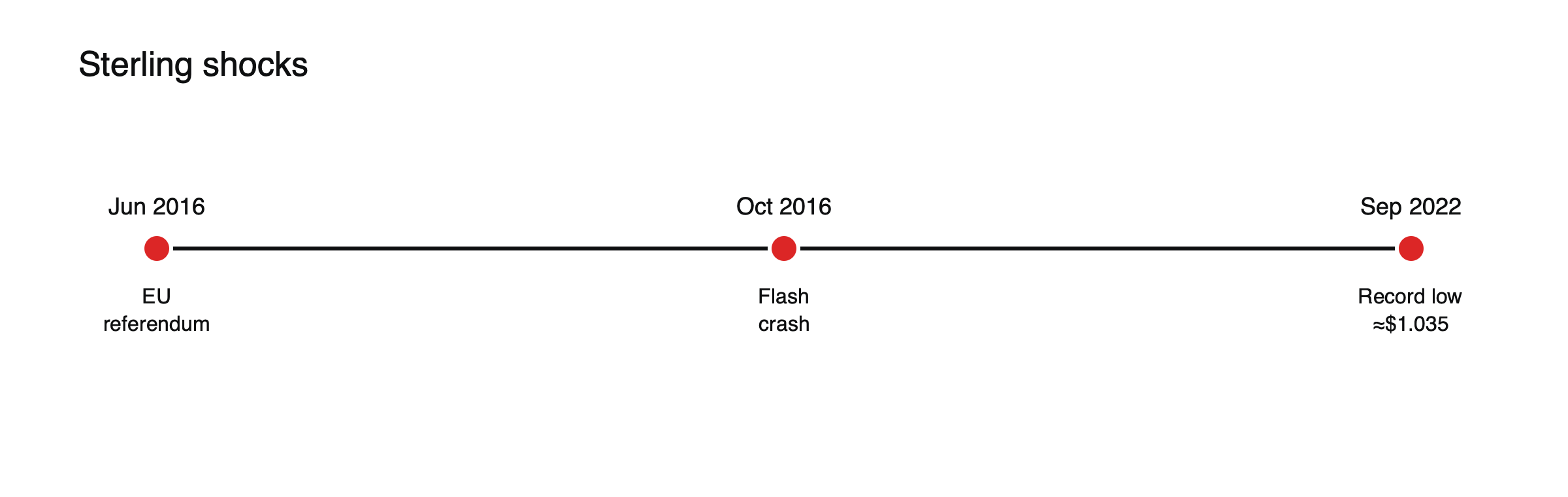
Figure: Three sterling shocks.
- 2016: after the EU referendum, sterling fell about 17% over the following months.
- September 2022: unfunded tax cuts sent gilt yields soaring and the pound to a record low. See how fiscal deficits affect rates, currencies and stocks.
Liquidity and flash moves. Sterling is the fourth most traded currency, with about 10% of turnover. Even so, it can drop sharply in thin hours, as in the October 2016 flash crash. See what caused the 2016 pound flash crash.
September 2022 in more detail
In late September 2022, the UK government announced large tax cuts without saying how they would be paid for. Investors sold UK government bonds, or gilts, pushing yields up sharply, and sterling fell to a record low of about $1.0359. Pension funds using leveraged bond strategies faced margin calls, and the Bank of England stepped in to buy gilts to restore order, after which sterling rebounded. Within weeks, most of the tax measures were reversed and the government changed. The episode showed how quickly confidence in a country’s public finances can feed through to its currency when it depends on foreign capital.
Brexit’s long shadow
The 2016 referendum result knocked sterling down sharply, and for several years afterward the pound reacted to every twist in negotiations with the European Union. Trade frictions and uncertainty about the UK’s economic model kept a risk premium on the currency. As the terms of the exit were settled, Brexit faded as a day-to-day driver, but it remains part of why sterling can be more sensitive to politics than some other major currencies.
The sterling data calendar
| Release | Why it matters |
|---|---|
| UK consumer price inflation | Main input for Bank of England decisions |
| UK labour market report | Pay growth drives services inflation |
| Bank of England decisions and minutes | Set rates and show how the vote split |
| UK budgets and fiscal statements | Affect confidence in public finances |
| US jobs and inflation data | Move the dollar side of the pair |
What to watch
Bank of England meetings, UK inflation and wage data, US data, UK budgets and political events. See what moves currency prices.
Cable and EUR/GBP
GBP/USD reflects sterling against the dollar, so US news moves it as much as UK news. EUR/GBP isolates sterling against the euro, so it responds mainly to differences between the UK and the euro area. When the dollar is moving strongly in either direction, EUR/GBP can be a cleaner way to express a view on the UK economy alone, while cable carries the dollar’s swings as well. See currency correlation.
Practical notes for trading GBP/USD
Cable is a major pair with deep liquidity, but its spreads are usually a little wider and its moves a little larger than EUR/USD’s. One standard lot is worth about $10 per pip. It is most active during the London morning and the London–New York overlap, and it can move sharply on Bank of England surprises, UK political news and thin-market episodes such as the 2016 flash crash. Sizing positions with that extra volatility in mind, rather than copying EUR/USD sizes, keeps risk consistent. See how to calculate forex position size.
A Bank of England surprise, illustrated
Suppose markets are almost certain the Bank of England will hold rates, but the vote shows several policymakers wanting a cut and the statement hints that inflation is falling faster than expected. (Illustrative scenario.) Traders bring forward their expectations for lower UK rates, short-term gilt yields drop and GBP/USD may fall by around half a percent within minutes. The decision itself, an unchanged rate, was exactly as expected; the vote split and the language moved the currency.
Why sterling reacts to risk appetite
The UK spends more abroad than it earns, so it relies on foreign investors to buy its assets. When global investors become cautious, demand for those assets can drop, and sterling tends to weaken against the dollar more than the euro does. That makes GBP/USD partly a risk-sensitive pair: it often falls when global stocks fall, even without UK-specific news.
Reading gilts and sterling together
Watching UK government bond yields alongside sterling helps separate good news from bad. When gilt yields rise and sterling rises too, markets are usually pricing higher Bank of England rates, which supports the currency. When gilt yields rise but sterling falls, investors may be demanding more compensation for holding UK debt, a sign of worry about public finances, as in 2022. The direction of the two together often says more than either one alone. Checking both screens before reacting to a sterling move takes only a few seconds.
Common misreadings
- Assuming every UK political headline moves sterling; most do not unless they change the fiscal or rate outlook.
- Reading the Bank of England decision without the vote split and minutes.
- Forgetting that a strong US jobs report can move cable more than any UK release that week.
Frequently asked questions
Why is GBP/USD called cable?
The name dates from the 19th century, when exchange rates between London and New York were transmitted by a telegraph cable under the Atlantic.
Does a stronger UK economy always lift sterling?
Usually, if it raises expectations of higher Bank of England rates. But if strong growth comes with worries about government borrowing or politics, sterling can still fall.
This article is educational content and does not constitute financial, investment, legal or tax advice. Digital assets are volatile and you may lose the amount you invest.
Sources
- Flash crash of the pound baffles traders (sterling down 17% since the June referendum; 31-year low) — Markets Media, October 2016
- GBP/USD jumps after BoE intervention (record low 1.0359 in September 2022) — MarketPulse
- Global FX trading approaches $10 trillion (sterling share 10.2%) — Crowdfund Insider, citing BIS