
What Happened in the August 2024 Yen Carry Trade Unwind?
In July–August 2024 the yen jumped about 14% in under a month as carry trades unwound, and Japan's Nikkei fell 12.4% in a day. The timeline, causes and lessons.
The yen carry trade unwind of July and August 2024 was a rapid reversal of trades funded with cheap yen. The yen rose about 14% against the dollar in under a month, and on August 5 the Nikkei 225 fell 12.4%, its worst day since 1987. Global stocks and crypto fell too, then rebounded.
How the yen carry trade worked
For years, Japan kept interest rates at or below zero while rates elsewhere rose. That made the yen the world’s cheapest currency to borrow. Investors borrowed yen, converted it into dollars, Mexican pesos or other higher-yielding currencies, and invested in bonds, deposits or shares that paid far more than the borrowing cost. The weaker the yen became, the better the trade looked, because the yen debt shrank in dollar terms while the income kept flowing. By mid-2024 the strategy had become crowded, and the yen had fallen to its weakest level against the dollar in decades. See what a carry trade is.
The trade in numbers
Suppose an investor borrowed ¥100 million at close to zero interest when the dollar bought about 160 yen, converting it into about $625,000 and investing it at 5%, roughly $31,250 a year. (Illustrative example.) When the dollar fell to about 142 yen, repaying the ¥100 million required about $704,000, a currency loss of about $79,000, roughly two and a half years of the expected income wiped out in a few weeks. With leverage, the loss as a share of the investor’s own capital was much larger, which is why so many positions were closed at once.
The weak yen before the turn
In the months before the unwind, Japan’s Ministry of Finance had already intervened to support the yen, selling dollars in the spring and again around July 11 and 12, when the currency traded near 161.8 per dollar. Intervention slowed the yen’s fall but did not change its direction, because the interest rate gap still favored the dollar. That changed only when the gap itself began to narrow from both ends: the Bank of Japan raised rates on July 31, and two days later weak US jobs data made faster US rate cuts look likely. The episode is a reminder that intervention buys time, while a shift in interest rate expectations is what turns a currency. Watching for that turn, not just intervention, gave traders an earlier warning. See what currency intervention is.
Timeline
- Early July 2024: the yen trades near 161 per dollar, its weakest in decades; Japan intervenes around July 11–12.
- July 31: the Bank of Japan raises its rate to 0.25% and signals less bond buying.
- August 2: weak US jobs data raises fears of a US slowdown and faster Fed cuts.
- August 5: the Nikkei falls 12.4%; Europe’s STOXX 600 falls as much as 3.6%; bitcoin drops.
- August 6: markets rebound sharply.
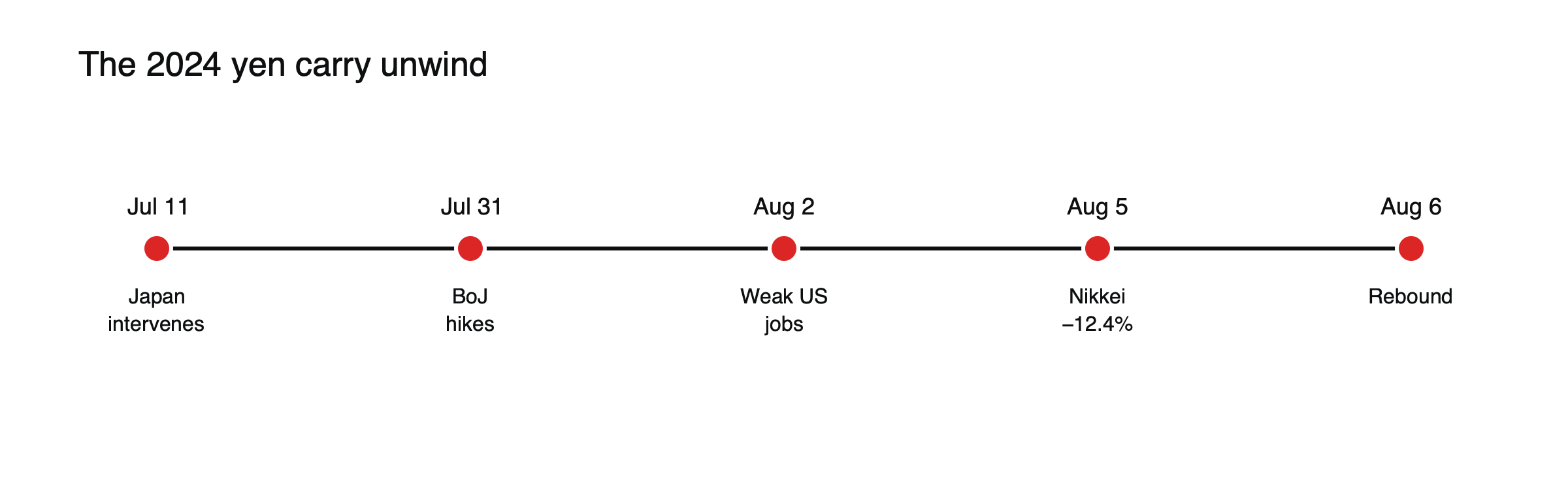
Figure: Four weeks from intervention to crash and rebound.
The days around August 5
The selling built over several sessions. The Nikkei 225 fell 2.5% on Thursday, August 1, and 5.8% on Friday, August 2, after weak US jobs data. On Monday, August 5, it dropped 12.4%, its worst day since the 1987 crash. The dollar fell to around 142 yen during the turmoil, from about 161 in early July. Wall Street’s main volatility index briefly spiked to about 65 during the day, one of its highest readings on record, and the S&P 500 fell about 3%. The next day the Nikkei rebounded 10.2%, its largest one-day gain on record.
The Bank of Japan steps back
On August 7, the Bank of Japan’s deputy governor, Shinichi Uchida, told an audience in Hakodate that the central bank would not raise interest rates when financial markets were unstable. The statement, a clear softening of the tone set at the July 31 meeting, pushed the dollar back above 147 yen and helped Japanese shares extend their recovery. Analysts at the time estimated that only part of the speculative carry trade had been unwound, with one bank putting the figure at around half to 60%, so volatility remained elevated for some weeks.
Why it happened
Years of near-zero Japanese rates made the yen the main funding currency for carry trades. When the rate gap narrowed from both sides, a higher Japanese rate and expected US cuts, the yen jumped, and leveraged positions were closed at once, pushing it higher still. See what the carry trade is.
Who was affected
Hedge funds and investors using yen funding, Japanese stocks, global tech shares and crypto, as well as retail traders holding long positions in yen pairs such as USD/JPY and AUD/JPY.
Why the move fed on itself
Carry trades unwind in a loop. A rising yen creates losses for those who borrowed it; to cut those losses, they buy yen to repay their debt; that buying pushes the yen higher, creating more losses for others. At the same time, investors sell the assets the borrowed money had bought, from Japanese shares to global technology stocks and cryptocurrencies, which spreads the shock across markets. Volatility rises, risk models tell funds to cut positions further, and the loop continues until enough of the crowded trade has been closed.
How markets recovered
Markets rebounded the next day, and much of the volatility faded within weeks, though the yen kept part of its gains as the rate gap narrowed.
Lessons
- Crowded trades unwind fast.
- Safe-haven currencies can surge when funding trades reverse. See what a safe-haven currency is.
- Spillovers across markets are real but can reverse quickly. See what moves currency prices, why volatility in one market spills into others and carry trade mistakes that hurt in a risk-off move.
What it means for traders today
For retail traders, the August 2024 episode showed how quickly a long-running trend can reverse when the conditions behind it change. Anyone long USD/JPY or AUD/JPY with high leverage, relying on positive rollover, saw years of interest income erased in days. It also showed that the yen’s safe-haven role can reassert itself suddenly, and that moves in one currency can ripple into shares and crypto within hours. Watching the Bank of Japan’s language, the interest rate gap with the United States and signs of crowded positioning helps judge when a carry trade is becoming fragile. See what moves USD/JPY and carry trade risks.
Frequently asked questions
Was the carry trade unwind fully over in August 2024?
Estimates at the time suggested only part of it had been closed. Volatility eased within weeks, but positions remained sensitive to further changes in Japanese and US interest rates.
Why did a small Bank of Japan rate rise matter so much?
Because so much money had been borrowed in yen on the assumption that rates would stay near zero. A small rise, combined with expected US rate cuts, changed the trade’s arithmetic for a very crowded market.
This article is educational content and does not constitute financial, investment, legal or tax advice. Digital assets are volatile and you may lose the amount you invest.
Sources
- Carry trade unwind: is it really over? (yen +14% July 10–August 5; rebound the next day) — Schwab via Advisor Perspectives
- The yen carry trade that crashed the markets (Nikkei −12.4%, worst since 1987; STOXX 600 −3.6%; bitcoin fell) — Money by CJ
- What is the yen carry trade? (BoJ to 0.25%; less bond buying) — GKToday
- History of Japan’s intervention (July 11–12, 2024; yen near 161.8) — Investing.com / Reuters
- Bank of Japan reassures markets (Nikkei −2.5% and −5.8% before −12.4% on August 5, +10.2% on August 6; dollar back above 147 yen; JPMorgan estimate of 50–60% unwound) — FinanzaOnline, August 7, 2024
- Japanese stocks rise after BOJ official plays down rate hike (Uchida in Hakodate: no rate rises when markets are unstable) — CNN, August 7, 2024
- Yen carry trade unwind: 2024 episode (USD/JPY near 161 on July 3, around 142 intraday on August 5; VIX briefly 65) — Lambda Finance, 2026
- The yen carry trade unwind: what it means for US day traders (BOJ to around 0.25% on July 31; VIX to 65; S&P 500 down 3% on August 5) — Day Trading Toolkit