
Why ETF Prices Can Trade Away From Their NAV
An ETF's price can drift from the value of its holdings when markets are closed, illiquid or stressed. Why premiums and discounts appear, with the 2020 example.
An ETF’s price usually stays close to its net asset value (NAV), the value of its holdings, because authorized participants create or redeem shares to profit from any gap. Prices can still drift to a premium or discount when underlying markets are closed, illiquid or stressed: in March 2020, one bond ETF traded 6.2% below NAV.
How the gap is normally closed
If the ETF trades below NAV, authorized participants buy ETF shares and redeem them for the underlying assets; if it trades above, they create new shares. This arbitrage keeps prices aligned.
A premium, illustrated
Suppose an ETF’s holdings are worth $50.00 a share, but heavy buying pushes the ETF to $50.20, a 0.4% premium. An authorized participant buys the underlying securities for $50.00 a share’s worth, delivers them to the fund for new ETF shares and sells those shares at $50.20, earning about $0.20 per share before costs. As new shares are sold, the price falls back toward $50.00. The reverse happens at a discount. (Example values.)
When gaps appear
- Different trading hours: an ETF of Asian stocks trading during US hours prices in news before the underlying markets reopen.
- Illiquid holdings: corporate bonds trade less often than ETF shares, so the NAV can be stale.
- Market stress: when dealers pull back, arbitrage slows, as in March 2020.
- Small or new ETFs with thin trading.
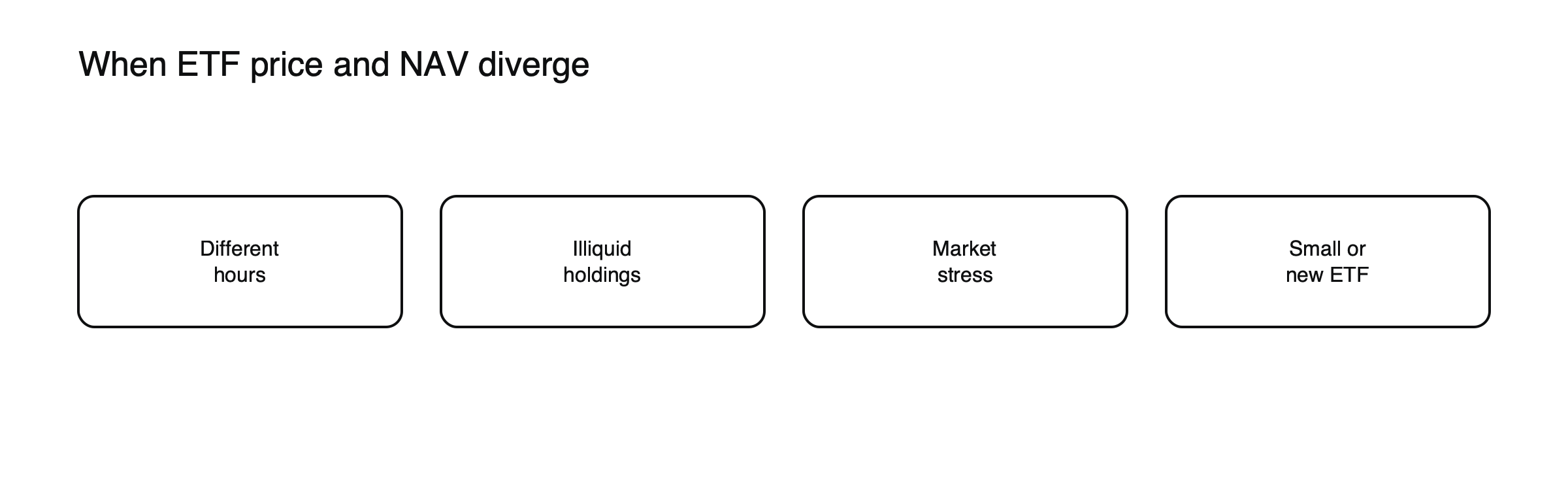
Figure: Why price and NAV can split.
March 2020
In mid-March 2020, as investors rushed to raise cash, bond markets became extremely hard to trade. Bond ETFs kept trading on exchanges, and their prices fell faster than the published values of their holdings, which were based on bond prices that were no longer realistic. On March 12, 2020, one bond ETF traded about 6.2% below its NAV. As central bank support restored order, the discounts closed.
Which price is “right”?
In stressed bond markets, the ETF price may reflect current conditions better than a NAV based on stale bond prices.
What it means for traders
Check the premium or discount before trading, use limit orders and avoid trading right at the open or close in volatile markets. CFDs on ETFs follow the ETF’s market price, not its NAV.
See what an ETF is, how to compare ETFs that track the same index and how the 2020 crash hit every asset class.
NAV and indicative values
The NAV is usually calculated once a day, after markets close. During the day, many exchanges publish an indicative value, sometimes called iNAV, estimating the value of the holdings in real time. Comparing the ETF’s price with this indicative value shows whether it is trading at a premium or discount at that moment, though the estimate itself can be stale for holdings that trade rarely or in closed markets.
Foreign markets, illustrated
An ETF holding Japanese shares trades in New York while Tokyo is closed. If major news arrives during New York hours, the ETF price moves immediately, while the NAV still reflects Tokyo’s last close. The ETF may then show an apparent premium or discount that reflects new information rather than mispricing. When Tokyo reopens, the gap usually narrows as the underlying shares adjust. (Illustrative scenario.)
Trading tips
Use limit orders rather than market orders, especially for less liquid ETFs. Avoid the first and last minutes of trading in volatile markets, when spreads can be wider. Check the premium or discount and the indicative value before large trades. For funds holding foreign or illiquid assets, expect wider and more variable gaps.
Why arbitrage can slow
Authorized participants create and redeem shares only when it is profitable after costs. If the underlying securities are expensive or difficult to trade, as with bonds in a crisis, the cost of arbitrage rises and gaps can persist. Authorized participants are also not obliged to act; in stressed conditions, some may step back to protect their own balance sheets, slowing the process further.
Small and new ETFs
Small funds may have few market makers and authorized participants active in them, so spreads can be wider and premiums or discounts larger. New funds may trade thinly until they attract assets. Checking typical spreads and premiums over recent weeks shows how reliably a fund trades near its value.
Commodity and crypto products
Products holding commodities or crypto assets can show premiums or discounts when the underlying market trades at different hours from the exchange, or when creating new shares is restricted. Gaps also arise when futures-based products roll contracts.
Closed-end funds compared
Closed-end funds also trade on exchanges, but they have a fixed number of shares and no creation or redemption process. Their prices can trade at large and persistent premiums or discounts to the value of their holdings, sometimes 10% or more for long periods. The ETF structure’s arbitrage mechanism is what usually keeps its gaps small.
Common misreadings
- Treating every discount as a bargain.
- Assuming the NAV is always more accurate than the market price.
Looking at a fund’s history
Many providers publish how often and by how much a fund has traded at a premium or discount over recent quarters. A fund that almost always trades within a few hundredths of a percent of its value is easy to trade; one that regularly shows gaps of 0.5% or more needs more care, such as using limit orders near the indicative value.
How market makers quote ETFs
Market makers continually quote buy and sell prices for ETF shares, based on the value of the underlying holdings and their own costs of hedging. When the underlying markets are open and liquid, their quotes are tight and close to the indicative value. When markets are closed or stressed, they widen quotes to protect themselves, which shows up as wider spreads and larger premiums or discounts.
Bond ETFs in normal times
Outside crises, bond ETFs usually trade at small premiums when investors are buying and small discounts when they are selling, reflecting the cost of trading the underlying bonds. These modest gaps are a normal feature rather than a warning sign, and they tend to be larger for funds holding less liquid corporate or emerging market bonds.
CFDs and premiums
A CFD on an ETF follows the ETF’s market price, including any premium or discount. A trader buying through a CFD at a premium pays that premium just as a shareholder would, and loses it if the premium disappears.
A simple routine
- Check the indicative value before trading.
- Compare it with the bid and ask.
- Use a limit order near the indicative value.
- Avoid trading when the underlying market is closed unless necessary.
Premiums in sudden demand
When a new or popular product attracts heavy buying, especially one whose underlying assets are hard to deliver quickly, its price can rise above its value until creation catches up. The same can happen if a provider temporarily stops creating new shares, for example because of limits on holdings. In such cases, buying at a premium means paying more than the assets are worth, and the premium can vanish suddenly when creations resume or demand fades. Checking whether a product is creating new shares, and how its price compares with its holdings, avoids paying an inflated price.
Frequently asked questions
Does a discount mean the ETF is cheap?
Not necessarily. In stressed or closed markets, the ETF price may reflect current conditions better than the NAV.
How large are typical premiums and discounts?
For large ETFs on liquid markets, they are usually tiny, often a few hundredths of a percent. They can be larger for funds holding bonds, foreign shares or less liquid assets.
This article is educational content and does not constitute financial, investment, legal or tax advice. Digital assets are volatile and you may lose the amount you invest.