
How Volatility Decay Erodes Leveraged ETF Returns
Leveraged ETFs reset daily, so in choppy markets they lose value even when the index ends flat. If an index goes +10% then −9.09%, a 3x ETF ends 5.5% down.
Leveraged ETFs aim for a multiple, such as 2x or 3x, of an index’s daily return and reset daily. In choppy markets they lose value even when the index ends flat, called volatility decay. If an index rises 10% then falls 9.09%, it is flat, but a 2x ETF is down about 1.8% and a 3x about 5.5%.
Worked example
| Day | Index | 2x ETF | 3x ETF |
|---|---|---|---|
| Start | 100 | 100 | 100 |
| Day 1: index +10% | 110 | 120 | 130 |
| Day 2: index −9.09% | 100 | 98.18 | 94.55 |
| Net | 0% | −1.8% | −5.5% |
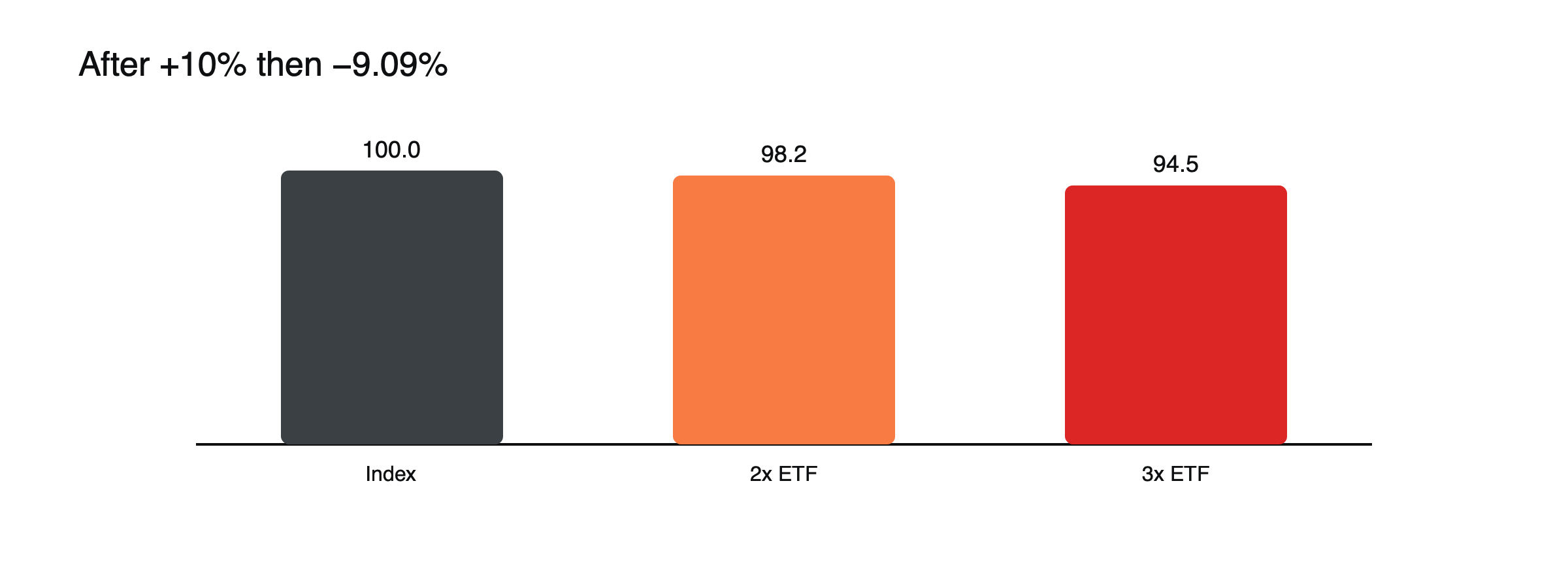
Figure: Volatility decay (example values).
(Example values, before fees.)
Ten choppy days, illustrated
| After 10 days of alternating +3% and −3% | Result |
|---|---|
| Index | About −0.45% |
| 2x ETF | About −1.8% |
| 3x ETF | About −4.0% |
(Example values, before fees.) The index barely moves, yet the 3x fund loses about nine times as much. Over a month or a year of similar conditions, the gap grows much larger.
Ten trending days, illustrated
| After 10 days of +1% each day | Result |
|---|---|
| Index | About +10.5% |
| 2x ETF | About +21.9% |
| 3x ETF | About +34.4% |
In a steady trend, the 3x fund returns more than three times the index’s 10.5%. Daily compounding helps in calm trends and hurts in choppy markets. (Example values, before fees.)
Why it happens
Each day’s leveraged gain or loss is applied to a new base. After a rise, the fund is bigger, so the following fall removes more in dollar terms; the effect grows with volatility and leverage.
When leveraged ETFs can beat their multiple
In steady trends with low volatility, daily compounding can produce more than the stated multiple over time. In sideways, volatile markets, it works against you.
Costs. Leveraged ETFs also charge higher fees and bear financing costs embedded in their derivatives.
The rule of thumb
Over longer periods, a leveraged ETF’s return tends to fall short of its multiple by an amount that grows with the square of the leverage and with the index’s volatility. Doubling volatility roughly quadruples the drag; moving from 2x to 3x leverage roughly triples it. That is why 3x funds on volatile indices can lose heavily over a year even when the index ends higher.
A sharp single-day move
Daily resetting also means a single extreme day can be devastating. A 3x fund loses about 30% if its index falls 10% in a day, and a product with higher leverage, or one tracking something more volatile, can lose almost everything, as some volatility products did in February 2018. See what Volmageddon was.
What it means for traders
They are designed for short holding periods. For longer leveraged exposure, compare with a CFD position whose leverage does not reset daily. See what inverse ETFs are, how leverage changes the math on a trade and what an ETF is.
Leveraged ETF or CFD?
A leveraged ETF fixes its leverage each day by rebalancing; a CFD’s exposure stays at the size chosen until the trader changes it. Over a few days, the difference is small; over months in choppy markets, the ETF’s results can drift far from a simple multiple, while the CFD’s gain or loss follows the price exactly but incurs daily financing and margin requirements. Losses on a leveraged ETF are limited to the amount invested; CFD losses are limited for EU retail clients by negative balance protection. See ETF CFDs vs buying ETF shares.
Rebalancing at the close
Large leveraged and inverse ETFs must trade near the end of each day to reset their exposure, buying after rises and selling after falls. On volatile days, these flows can add to market moves in the final minutes of trading, which some analysts watch as a source of late-day pressure.
Who uses leveraged ETFs
Leveraged ETFs are used mostly by short-term traders who want amplified exposure for a day or a few days without a margin account. Some investors use them briefly to increase exposure around specific events. Fund documents typically state that they are intended for investors who monitor positions daily and understand the effects of daily compounding.
Leveraged ETFs on single shares
Leveraged products on individual shares have become available in some markets. Because single shares are more volatile than indices, the decay from daily resetting can be severe, and a single bad day can erase a large part of the fund’s value. They carry the risks of leveraged index products, magnified.
Fees in numbers
Many leveraged ETFs charge around 1% a year, compared with a few hundredths of a percent for plain index ETFs, and also bear the costs of the swaps or futures used to create leverage. On a $10,000 holding, that is about $100 a year in fees alone, before financing costs inside the fund.
Monitoring a position
Because results drift from the multiple over time, holders of leveraged ETFs often compare the fund’s performance with the index’s each day and rebalance, for example reducing the position after a strong rise to keep exposure at the intended level. Without monitoring, exposure can grow or shrink unintentionally.
Common misreadings
- Expecting a 3x fund to deliver three times the index over months.
- Treating a leveraged ETF as a long-term holding.
A choppy month, illustrated
Over 20 trading days in which an index alternates between rising and falling 2%, the index ends about 0.4% lower. A 2x ETF ends about 1.6% lower and a 3x ETF about 3.5% lower. (Example values, before fees.) In a month with larger daily swings, the losses grow much faster, because the drag increases with the square of volatility.
Getting leverage another way
Traders wanting leveraged exposure for longer than a few days sometimes prefer a CFD or futures position, whose exposure does not reset daily. The trade-off is that losses can exceed the initial margin outside negative balance protection, and financing must be paid. A leveraged ETF limits losses to the amount invested but builds in daily compounding effects.
Inverse leveraged funds
Funds offering −2x or −3x the daily return combine the effects of leverage and shorting. They suffer the same decay in choppy markets and can lose heavily in sharp rallies, making them some of the most volatile products available to individual investors. See what inverse ETFs are.
Taxes
Leveraged ETFs can generate gains from their derivative positions that may be distributed to investors, and tax treatment varies by country. Short holding periods may also affect how gains are taxed. Checking local rules before trading frequently is worthwhile.
A checklist before buying
- What multiple does the fund target, and over what period?
- How volatile is the underlying index?
- How long do you plan to hold?
- What are the fund’s fees?
- How will you monitor and rebalance the position?
Leveraged ETFs in crashes
In sharp crashes, leveraged long funds lose a multiple of the index’s daily fall, and the volatile days that usually follow compound the damage. A 3x fund on an index that falls 30% over a few weeks with large daily swings can lose most of its value, leaving little capital to benefit if the index later recovers. For this reason, many traders exit leveraged positions quickly when volatility rises, rather than waiting for a recovery that may never come.
Frequently asked questions
Do leveraged ETFs always lose value over time?
Not always. In strong, steady trends they can beat their multiple. In volatile, sideways markets they tend to lose value.
How long should leveraged ETFs be held?
They are generally designed for periods of a day or a few days, and fund documents usually warn that longer-term results can differ significantly from the stated multiple.
Leverage, margin and cost figures in this article are example values for illustration. Actual terms depend on the provider, the instrument and the rules in your country.
This article is educational content and does not constitute financial, investment, legal or tax advice. Digital assets are volatile and you may lose the amount you invest.