
What Was the 2013 Taper Tantrum?
In May 2013 Bernanke said the Fed could slow bond buying; the 10-year yield rose from 1.6% to 3% by September and EM currencies fell. What happened and why.
The taper tantrum was the bond sell-off after Fed Chair Ben Bernanke said on May 22, 2013, that bond purchases could be slowed, or “tapered,” soon. The 10-year Treasury yield rose from about 1.6% in early May to about 3% by September, and emerging-market currencies fell, though tapering only began in 2014.
Timeline
- 2008–2013: the Fed buys Treasuries and mortgage bonds, tripling its balance sheet.
- May 22, 2013: Bernanke says purchases could be reduced “in the next few meetings.”
- June 19: a press conference confirms the plan; yields jump again.
- Early September: the 10-year yield reaches about 3%.
- December 2013: the Fed announces a $10 billion monthly reduction, starting in January 2014.
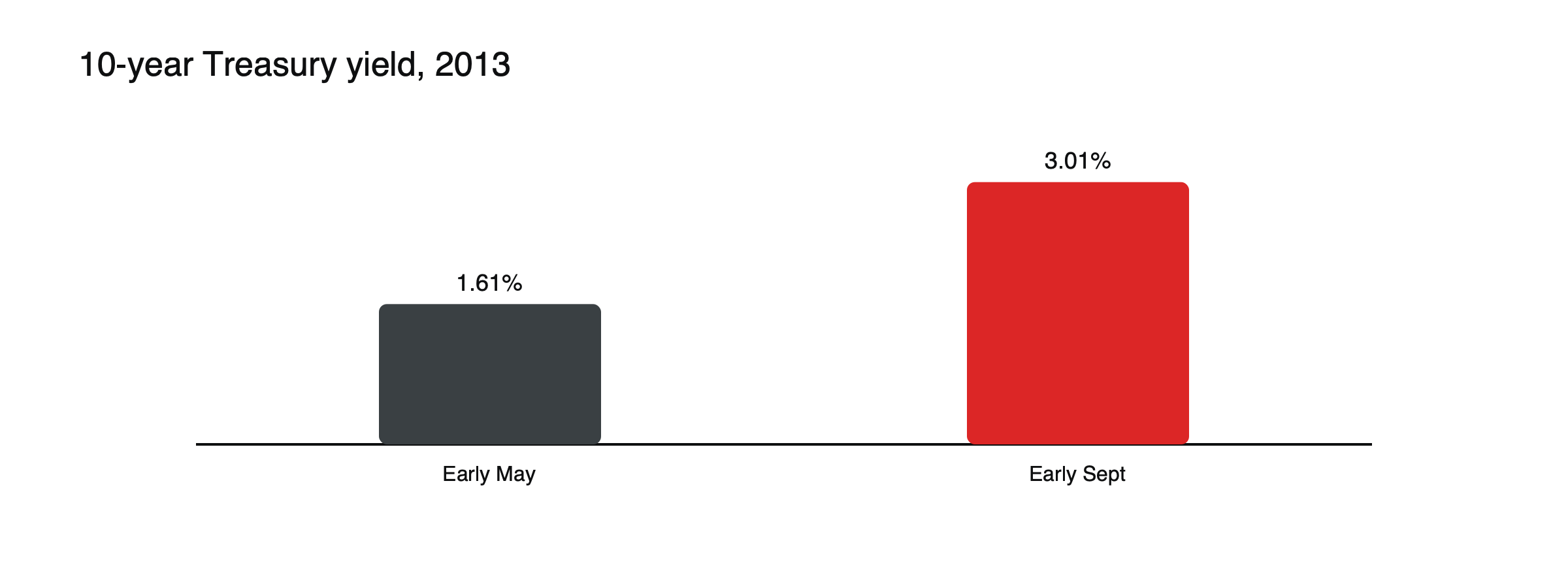
Figure: The taper tantrum. Source: Wolf Street.
The background: three rounds of buying
After the 2008 financial crisis, the Federal Reserve cut its policy rate to near zero and bought large amounts of Treasuries and mortgage-backed securities to push long-term rates down. By 2013, under its third program, it was buying about $85 billion of bonds a month. Markets had come to see this buying as a fixture, supporting bond prices, risk assets and capital flows into emerging markets. Any hint that it might slow was bound to matter.
The words that moved markets
On May 22, 2013, in testimony to Congress, Fed Chair Ben Bernanke said the Fed could reduce its purchases in the next few meetings if the economy kept improving. He did not announce a change, and the policy rate was not expected to rise for years. But investors had not expected even a slowdown in buying so soon, and they rushed to reprice. At the June 19 press conference, Bernanke outlined a possible timetable, and yields jumped again.
Why it happened
Markets had come to rely on Fed buying, and the signal came earlier than expected. Real yields drove the move: the 5-year TIPS yield rose from −1.15% to −0.16% in about a month while breakevens fell.
Real yields did the work
The rise in Treasury yields came mostly from real yields, not inflation expectations. Between May 21 and June 25, the 5-year TIPS yield rose from about −1.15% to about −0.16%, while the 5-year breakeven fell from about 1.99% to about 1.65%. Markets were not worried about inflation; they were pricing less central bank support and a higher path for real rates. See how to calculate a real yield.
Who was hit
The “Fragile Five” emerging markets, Brazil, India, Indonesia, Turkey and South Africa, saw capital outflows and currency falls; gold fell nearly 20% between May and early September.
Emerging markets under pressure
Years of near-zero US rates had pushed investors into higher-yielding emerging markets. When US yields jumped, money flowed out. Countries with large current account deficits and dependence on foreign funding, dubbed the Fragile Five, saw their currencies fall sharply and had to raise interest rates or tighten policy to stem outflows. The episode showed how US monetary policy can transmit shocks around the world. See emerging-market vs developed-market stocks.
Gold and other markets
Gold, which had already been falling, dropped nearly 20% between May and early September 2013 as real yields rose. US mortgage rates climbed with Treasury yields, cooling the housing recovery. Share markets wobbled but recovered, and US stocks ended 2013 strongly, a reminder that a bond market tantrum does not always become a lasting equity sell-off.
How it ended
The Fed did not start reducing purchases until December 2013, when it announced a $10 billion monthly reduction from January 2014, and it ended the program later in 2014. By then, markets had adjusted, and the actual tapering caused little disruption. The 10-year yield, about 3% in early September 2013, eased in 2014.
Lessons
How a central bank communicates can move markets as much as what it does. When the Fed signaled tapering in 2021, markets were better prepared and yields barely moved. See how to calculate a real yield, what quantitative easing is and how bonds work.
Timeline at a glance
| Date | Event | 10-year yield |
|---|---|---|
| Early May 2013 | Fed buying about $85 billion a month | About 1.6% |
| May 22 | Bernanke testimony | Starts rising |
| June 19 | Press conference outlines timetable | Jumps again |
| Early September | Peak of the move | About 3.0% |
| December 2013 | $10 billion reduction announced | Around 3% |
| 2014 | Purchases wound down | Eases |
Lessons for traders
The tantrum showed how a change in expectations, without any change in policy, can move bond yields by more than a full percentage point in months. It hit assets that depended on low real yields, such as gold, emerging market currencies and long bonds, at the same time. Traders holding leveraged positions in those markets faced sharp losses. Watching central bank language, and how much markets have priced in, matters as much as watching actual decisions. See how central bank meetings move markets.
The 2021 contrast
When the Fed began signaling another taper in 2021, it communicated far more gradually and explicitly, and markets barely reacted. The lesson had been learned on both sides: central banks now try to prepare markets well in advance of changes to bond buying.
Comparing 2013 and 2022
Both episodes involved sharp rises in Treasury yields driven by changing expectations of Fed policy. In 2013, the move came from expectations of slower bond buying, with no rate rises in sight and inflation low; yields rose about 1.4 points over four months. In 2022, it came from actual rate hikes in response to high inflation, and the 10-year yield rose from about 1.5% to about 4.2% over the year. The 2013 tantrum was a shock to expectations; 2022 was a shock to both expectations and inflation.
Forward guidance
The tantrum taught central banks how powerful their words can be. Since then, they have tried to guide expectations more carefully, signaling changes to bond buying or rates well in advance and repeating the message until markets have absorbed it. Traders now parse central bank statements closely for shifts in language, because the words often move markets before the decisions do.
Housing and mortgages
US mortgage rates track longer Treasury yields, and they rose sharply in mid-2013 as yields jumped. Refinancing activity fell and the housing recovery slowed for a time. The episode showed how quickly bond market moves pass through to households.
Common misreadings
- Believing the Fed raised rates in 2013.
- Assuming the tantrum caused a lasting stock market decline.
Lessons for other central banks
Central banks worldwide studied the tantrum. When they later considered slowing or ending their own bond purchases, many announced plans months in advance, set out timetables and repeated them often, aiming to avoid sudden repricing. The episode also made central banks more aware of how their actions affect other countries, especially emerging markets dependent on foreign capital.
Positioning matters
Part of the reason yields jumped so sharply in 2013 was that many investors held similar positions, betting that low yields and steady Fed buying would continue. When the outlook changed, they all tried to adjust at once. Crowded positioning turns a change in expectations into a disorderly move, a pattern seen again in later episodes across markets.
Reading similar moments today
Whenever a central bank hints at reducing support, through slower bond buying, a faster run-off of its balance sheet or earlier rate rises, traders compare the market’s reaction with 2013. The key questions are how much of the change was already expected, how crowded positions are and whether the move is in real yields or inflation expectations. Large surprises in crowded markets tend to produce tantrums; well-signaled changes usually do not. History clearly suggests careful preparation matters most.
Frequently asked questions
Did the Fed raise rates in 2013?
No. The policy rate stayed near zero until December 2015. The tantrum was about slowing bond purchases, not raising rates.
Why were emerging markets hit so hard?
Because they relied on foreign capital that had been drawn by low US yields; when US yields rose, that capital left.
This article is educational content and does not constitute financial, investment, legal or tax advice. Digital assets are volatile and you may lose the amount you invest.
Sources
- What happens next, now that the 10-year yield hit 3% (from 1.61% in early May to 3.01% in early September 2013; first $10 billion taper scheduled for January) — Wolf Street, December 2013
- The Federal Reserve’s response to the global financial crisis (Bernanke testimony May 22, 2013; press conference June 19) — arXiv
- Bond anniversaire: taper tantrum 10 years on (Fragile Five) — Carmignac, May 2023
- What does a taper tantrum mean for assets? (gold fell nearly 20% between May 1 and September 5, 2013) — investingLive, citing ING
- The taper tantrum myth? (5-year TIPS yield from −1.15% to −0.16% and 5-year breakevens from 1.99% to 1.65% between May 21 and June 25, 2013) — Econlib
- No taper tantrum this time? (10-year yield from about 2% in May 2013 to about 3% in December; 2021 taper signal met calmly) — FRED Blog, St. Louis Fed