
Treasury Bills vs Notes vs Bonds
Treasury bills mature in a year or less with no coupon; notes in 2 to 10 years and bonds in 20 or 30 years, paying interest twice a year. How the three compare.
Treasury bills, notes and bonds are the main types of US government debt, split by maturity. Bills mature in a year or less and are sold at a discount. Notes mature in 2 to 10 years and bonds in 20 or 30 years; both pay interest twice a year. The 10-year note is the key benchmark.
Side by side
| Bills | Notes | Bonds | |
|---|---|---|---|
| Maturity | 4 to 52 weeks | 2, 3, 5, 7, 10 years | 20 or 30 years |
| Interest | Sold at a discount | Coupon every six months | Coupon every six months |
| Rate sensitivity | Very low | Medium | High |
| Main driver | Fed policy | Policy and growth expectations | Inflation, growth, debt supply |
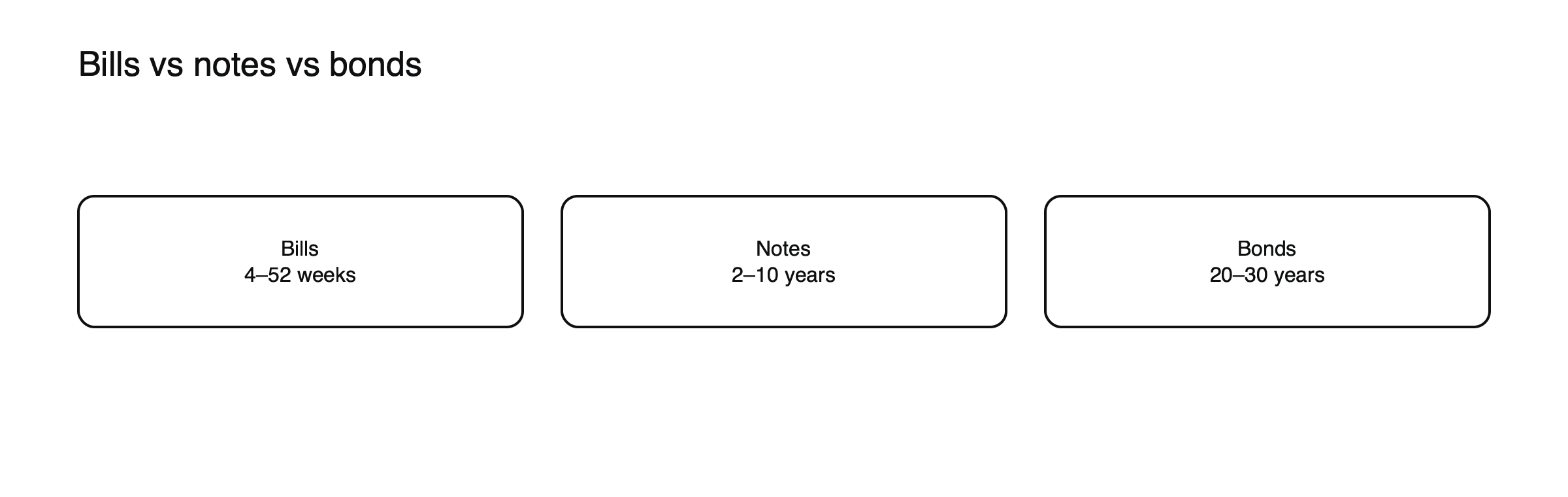
Figure: US Treasuries by maturity.
Bill pricing, worked through
A 26-week bill with a face value of $10,000 sells at auction for $9,800. (Example values.) The holder receives $10,000 at maturity, a gain of $200 over six months. That is about 2.04% for the half-year, or about 4.1% annualized. There are no coupons; the discount is the interest. Because bills mature so quickly, their prices barely move when rates change.
Why maturity matters
Longer maturities swing more when yields change. In 2022, 2-year notes lost about 4% while 10-year notes lost about 16%. See how bond duration predicts price moves.
Price sensitivity by maturity, illustrated
For 4% securities priced at par, a 1-point rise in yields would cut the price of a 2-year note by about 1.9%, a 5-year note by about 4.3%, a 10-year note by about 7.7% and a 30-year bond by about 15%. (Example values, annual coupons.) That gradient explains why the 2022 losses were so much larger for long maturities. See how bond duration predicts price moves.
Auctions
The US Treasury sells bills, notes and bonds through regular auctions on a published schedule, weekly for most bills and monthly or quarterly for longer securities. Markets watch auction results, such as how much demand there was relative to the amount offered and the yield achieved, as signals of investor appetite for US debt. Weak auctions for long bonds can push yields higher.
Other Treasury types
Inflation-protected securities (TIPS) adjust principal for inflation; floating-rate notes reset with bill yields. See how to calculate a real yield.
TIPS, illustrated
A Treasury inflation-protected security with a face value of $1,000 and a real coupon of 1.5% has its principal adjusted for inflation. If inflation is 3% in a year, the principal rises to about $1,030 and the coupon is paid on that higher amount. At maturity, the holder receives the inflation-adjusted principal, or the original face value if that is higher. (Example values.)
When risk-free does not mean riskless
“Treasuries are risk-free” refers to default risk; long bonds can lose heavily in price when yields rise.
See what the yield curve is and how bonds work.
Buying Treasuries
Individuals can buy Treasuries directly from the government through its online system, through brokers or via funds and ETFs that hold them. Bills and short notes are popular for parking cash; longer notes and bonds suit investors seeking income or protection against recessions. Funds offer convenience but never mature, so their prices keep moving with rates.
Treasuries as the benchmark
Treasury yields are the reference for borrowing costs across the economy, from mortgages to corporate bonds, and Treasuries are the main collateral in financial markets. Moves in the 10-year yield, which rose from about 1.5% to about 4.2% during 2022, ripple through every other market. See what moves the 10-year Treasury yield.
Futures and CFDs
Traders who want exposure to Treasury yields without buying securities often use futures on 2-, 5-, 10- and 30-year Treasuries, or CFDs based on them. Their prices move inversely to yields, and longer contracts move more for the same change in yield.
Taxes
Interest on Treasuries is subject to US federal income tax but exempt from state and local income taxes, which can make them more attractive than corporate bonds or bank deposits for some US investors.
A simple ladder, illustrated
An investor splits $50,000 equally into Treasuries maturing in one, two, three, four and five years. (Illustrative plan.) Each year, one rung matures and is reinvested in a new five-year note, so the ladder keeps its shape. The investor receives regular cash flows, avoids reinvesting everything at a single rate and, if held to maturity, faces no price risk on any rung. Ladders built from Treasuries are a common way to plan known future expenses.
Bills and money market funds
Treasury bills are the core holding of many money market funds, which offer daily access to cash at yields close to short-term policy rates. When the Federal Reserve raises rates, bill yields and money market yields rise within weeks; when it cuts, they fall just as quickly. Bills therefore offer little protection against falling rates, but almost no price risk.
The 2-year note and policy
The 2-year note yield closely tracks market expectations for Federal Reserve policy over the next two years. It moves sharply on surprises in inflation or employment data and on central bank communication, making it one of the most sensitive gauges of rate expectations.
The 30-year bond
The 30-year bond reflects long-run expectations for growth, inflation and government finances, plus a term premium for locking money up for decades. It is the most volatile Treasury security in price terms, attractive to investors seeking long-term income or protection against deflation, and dangerous for those who must sell after a rise in yields.
Supply and deficits
Large government deficits mean more Treasuries must be sold, and heavy issuance of long bonds can push long yields higher. Announcements about how much the Treasury plans to borrow, and at which maturities, are watched closely by bond markets.
Common misreadings
- Treating all Treasuries as equally safe in price terms.
- Assuming bill yields will stay high.
Treasuries in a crisis
In most market panics, investors buy Treasuries, pushing yields down and prices up, which is why long Treasuries have often cushioned portfolios in recessions. In the most acute days of March 2020, however, even Treasuries were sold as investors rushed for cash, and the Federal Reserve bought huge amounts to restore order. The episode showed that the safest market can also come under strain.
STRIPS
Treasury STRIPS are zero-coupon securities created by separating a note or bond’s coupon payments and principal into individual pieces. Each pays a single amount at a set date, making STRIPS useful for matching specific future needs, but their prices are highly sensitive to rates, especially for long maturities.
Treasuries or bank deposits?
Treasury bills often pay more than bank savings accounts, carry minimal default risk and, for US investors, avoid state and local income tax on interest. Deposits offer convenience and, up to insured limits, similar safety. Many investors hold some of each.
Bills or notes for cash, illustrated
An investor with money needed in two years can buy a 2-year note or roll 6-month bills four times. (Illustrative choice.) If rates fall over the period, the note fixes today’s yield for two years while bill rollovers earn less each time; if rates rise, rolling bills earns more. The note carries price risk if sold early, while bills barely move. The choice depends on the investor’s view of rates and need for flexibility.
Market liquidity
The Treasury market is the deepest bond market in the world, with trillions of dollars traded each day, which makes it easy to buy and sell large amounts at tight prices in normal conditions.
Tracking the curve with Treasuries
Because Treasuries exist at every maturity from weeks to 30 years, their yields define the US yield curve. Watching bills, the 2-year note, the 10-year note and the 30-year bond together shows how markets see near-term policy and long-term growth and inflation. Changes in the gaps between them often say more than the level of any yield.
Frequently asked questions
Which is safest?
Bills, because their short maturity makes their prices almost insensitive to rates. All Treasuries carry minimal default risk.
Why is the 10-year note so important?
It sits in the middle of the curve, is heavily traded and is used to price mortgages and many other loans.
This article is educational content and does not constitute financial, investment, legal or tax advice. Digital assets are volatile and you may lose the amount you invest.
Sources
- United States Treasury security (bills of 4, 6, 8, 13, 17, 26 and 52 weeks; notes of 2, 3, 5, 7 or 10 years; bonds of 20 or 30 years) — Wikipedia
- Treasury bonds vs notes vs bills (bills a year or less; notes 2–10 years; bonds 20 or 30 years; notes and bonds pay interest twice a year) — Bankrate
- Bonds: a H1 2023 report card (2022 returns from −4.1% for 2-year to −16.3% for 10-year Treasuries) — WisdomTree
- Why ordinary investors got hit so hard in 2022 (10-year yield from about 1.5% to about 4.2%) — Yahoo Finance Morning Brief, December 2022