
How Interest Rates Affect Stock Prices
Higher rates raise borrowing costs, make bonds more competitive and shrink the value of future profits, weighing on stocks. How it works, with 2022 as example.
Interest rates affect stock prices through three channels: companies’ borrowing costs, how attractive bonds and cash are compared with shares, and how much future profits are worth today. Rising rates usually weigh on stocks, especially those with distant profits. In 2022, as the Fed hiked fast, US equities fell about 18%.
Channel 1: borrowing costs
Higher rates make loans and bonds costlier for companies, reducing profits and investment, especially for heavily indebted firms.
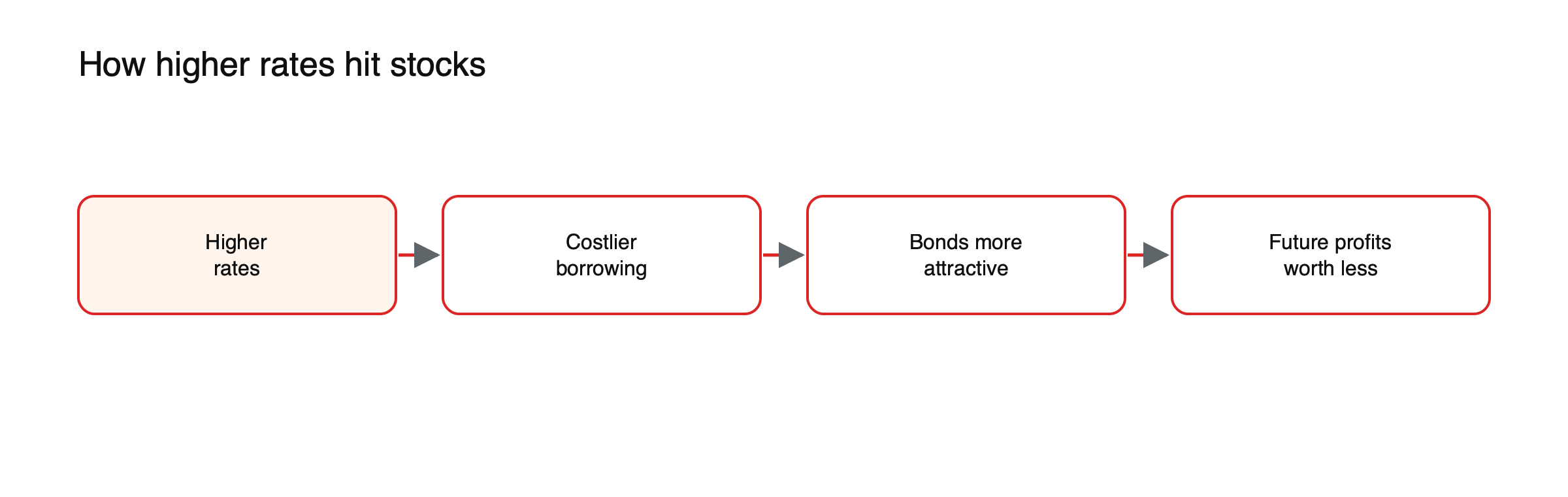
Figure: Three ways higher rates weigh on stocks.
Channel 2: competition from bonds and cash
When safe assets pay 4% or 5%, investors demand more from stocks to justify the extra risk, which lowers the prices they will pay.
Channel 3: the value of future profits
Investors value a company by discounting its future profits back to today. A higher discount rate shrinks today’s value, most for companies whose profits are expected years ahead. See why tech stocks are so sensitive to bond yields.
Discounting in numbers
A simple model shows how sensitive values are to rates. Suppose a company earns $5 a share, expected to grow 3% a year forever. If investors require an 8% return, the share is worth about 5 ÷ (8% − 3%) = $100. If higher interest rates push the required return to 9%, the value falls to about $83, a drop of about 17% with no change in the business. (Illustrative figures; real valuations are less precise, but the sensitivity is real.)
The equity risk premium
Investors expect shares to return more than safe bonds to compensate for their risk. That extra return, the equity risk premium, is often estimated by comparing the earnings yield on stocks with government bond yields. When bond yields rise sharply and share prices do not fall, the premium shrinks, making stocks less attractive relative to bonds, which is one reason higher yields tend to pressure valuations. See how to calculate and read a P/E ratio.
Why the direction is not automatic
- Rates rising with strong growth can coexist with rising stocks, as earnings grow.
- Rate cuts due to recession can come with falling stocks. See what happens to stocks when the Fed cuts rates.
- Surprises matter more than expected moves.
2022 in detail
In 2022, the Federal Reserve raised its policy rate at the fastest pace in decades to fight inflation, and bond yields rose sharply. US stocks fell about 18% over the year, and bonds fell about 16%, a rare year in which both lost money together. Growth and technology shares, whose value depends most on distant profits, were among the hardest hit, while energy companies, helped by soaring commodity prices, rose. The year showed all three channels working at once.
Rate cuts and stocks
Rate cuts are not automatically good for stocks. When central banks cut because inflation has fallen while growth holds up, shares often rise. When they cut because a recession is under way, falling earnings can outweigh lower rates, and shares can fall even as rates drop. Markets therefore watch why a central bank is cutting, not only that it is cutting.
Sector differences
Banks may benefit from higher rates through wider lending margins; utilities and real estate, often financed with debt, tend to suffer.
| Sector | Typical response to rising rates |
|---|---|
| Banks | Can benefit from wider lending margins, unless credit losses rise |
| Utilities and real estate | Often weaker: high debt and bond-like dividends |
| Technology and growth | Often weaker: value depends on distant profits |
| Energy and materials | Driven more by commodity prices than by rates |
| Consumer staples | Relatively defensive, but valuations can compress |
Smaller companies often feel rate rises more than large ones, because they rely more on bank loans and floating-rate debt and have less cash.
See how asset classes behave across the rate cycle and what moves stock prices.
Central bank meetings and stocks
Stocks often move sharply around central bank decisions and press conferences, as investors reassess the path of rates. A decision that signals more hikes than expected can push shares down within minutes; a signal of earlier cuts can lift them. Traders holding stock or index positions through these events face the same kind of gap and spread risk as around earnings. See how central bank decisions move currencies.
The yield curve
The difference between long-term and short-term bond yields, known as the yield curve, also carries information. When short-term yields rise above long-term ones, an inverted curve, markets have often been signaling an expected slowdown. Steepening curves can indicate improving growth expectations or concerns about inflation and government debt. Equity investors watch the curve as a guide to where the economy, and earnings, may be heading.
Inflation and real rates
What matters most for valuations is the real interest rate, the return on safe money after inflation. If inflation and interest rates rise together, real rates may barely change, and stocks can hold up as companies raise prices. If interest rates rise while inflation falls, real rates jump, and valuations usually suffer. Watching inflation-protected bond yields shows which is happening. See why real yields matter for gold, stocks and crypto.
Dividend shares and rates
Shares bought mainly for their dividends, such as utilities and some consumer companies, compete directly with bonds for income-seeking investors. When bond yields rise, these shares often fall until their dividend yields look attractive again. When yields fall, they tend to benefit. See how to calculate dividend yield.
Rates in different countries
Each market responds mainly to its own central bank and bond yields, but US rates influence markets worldwide, because they affect the dollar, global capital flows and the valuation benchmarks investors use. A rise in US yields can weigh on stocks in Europe and Asia even when local rates are steady.
Common misreadings
- Assuming rate cuts always lift stocks.
- Ignoring the difference between nominal and real rates.
- Treating all sectors as equally affected.
A rate-surprise day, illustrated
Suppose a central bank raises rates by half a percentage point when markets expected a quarter point, and signals more hikes ahead. (Illustrative scenario.) Two-year bond yields jump, the currency strengthens and stock indices fall 2% within an hour, led by property, utilities and technology shares, while bank shares hold up better. By the next morning, some of the move may reverse as investors digest the details, but the surprise has shifted expectations for the path of rates, and with them valuations.
The long-term view
Over decades, stocks have risen through periods of both rising and falling rates, because earnings growth eventually dominates. Rate changes matter most for the timing and size of moves within those decades, and for which sectors lead or lag.
Rates and the dollar
Higher US interest rates tend to strengthen the dollar, which reduces the dollar value of US companies’ foreign sales and profits. Multinationals with large overseas businesses can therefore face two headwinds when US rates rise: higher discount rates and weaker translated earnings. Companies that sell at home, such as domestic retailers or utilities, are less exposed to this currency effect, though not to the rate effect.
Frequently asked questions
Do higher rates always mean lower stock prices?
No. If rates rise because the economy is strong and earnings are growing, stocks can rise too. The effect depends on why rates are moving and how fast.
Which interest rate matters most for stocks?
Both central bank policy rates and longer-term bond yields matter. Long-term yields, especially inflation-adjusted ones, have the most direct effect on valuations.
This article is educational content and does not constitute financial, investment, legal or tax advice. Digital assets are volatile and you may lose the amount you invest.