
What Is a CFD and How Does CFD Trading Work?
A CFD is a contract to exchange the difference in an asset's price between opening and closing a trade. How CFDs work, what they cost and why most lose.
A CFD, or contract for difference, is an agreement with a provider to exchange the change in an asset’s price between opening and closing a trade. You never own the asset. CFDs let you go long or short, usually with leverage, which magnifies gains and losses; EU regulators found 74% to 89% of retail accounts lose money.
What a CFD actually is
A CFD is a derivative: its value comes from the price of something else, called the underlying. That underlying can be a company’s shares, a stock index such as the S&P 500, a currency pair such as EUR/USD, a commodity such as gold or oil, a cryptocurrency, an ETF or a government bond.
When you open a CFD, you are not buying that underlying on an exchange. You are entering a private contract with the CFD provider, which agrees to pay you, or charge you, the change in the underlying’s price over the time the trade is open. When you close, the difference is settled in cash in your account. No shares, ounces of gold or bitcoin change hands.
Three features follow from that structure and shape everything else about CFD trading:
- Direction is symmetrical. Selling a CFD you don’t own is as simple as buying one, so you can profit from falling prices.
- Leverage is built in. You only deposit a fraction of the position’s value as margin.
- The provider is your counterparty. Your contract is with the provider, not with an exchange or another investor.
How a CFD trade works
- Choose a market and a direction. Buy (go long) if you expect the price to rise; sell (go short) if you expect it to fall.
- Choose a size. Size is set in units of the underlying: shares, ounces, barrels, lots of currency or coins.
- Post margin. The provider holds a percentage of the position’s value as collateral.
- Watch the position. Your profit or loss changes with every price tick, and so does your account equity.
- Close the trade. The price difference, multiplied by your size and minus costs, is credited or debited in cash.
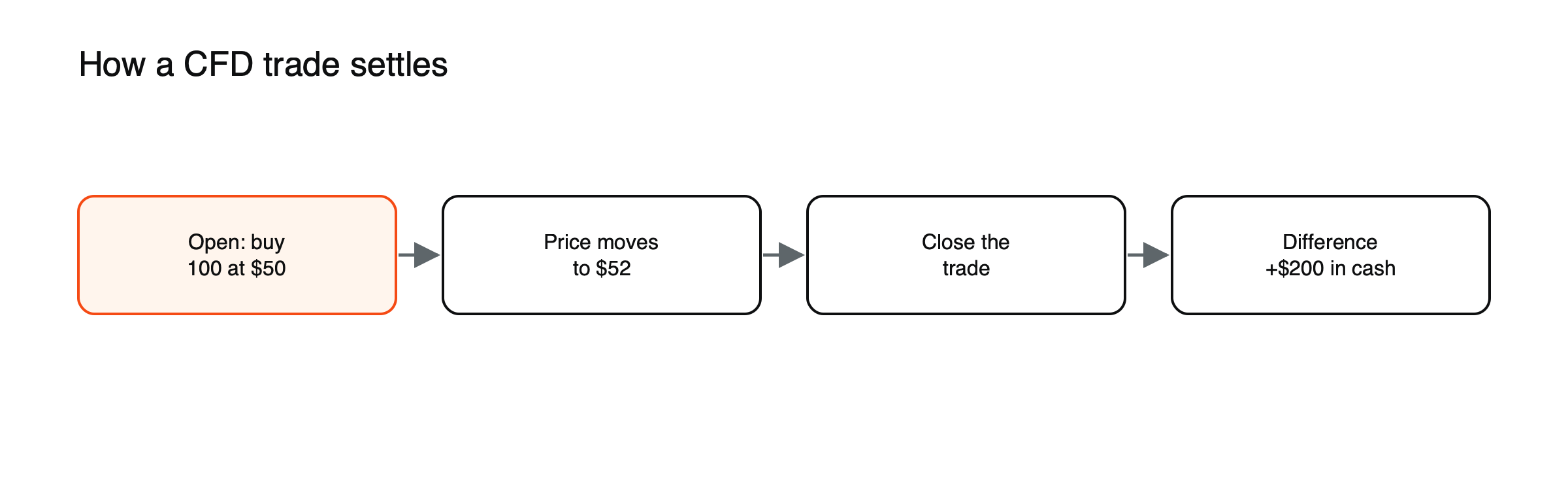
Figure: A CFD settles the price difference in cash; you never own the shares.
A worked example
Suppose a share trades at $50 and you buy a CFD on 100 shares. The position is worth $5,000. If the margin rate for share CFDs is 20%, the leverage limit for retail clients in the EU, you post $1,000 of margin.
- The price rises to $52: your gross profit is 100 × $2 = $200, a 20% return on the $1,000 of margin, from a 4% move in the share.
- The price falls to $48: your gross loss is $200, again 20% of your margin.
- The price falls to $40: the loss of $1,000 equals your entire margin, from a 20% fall in the share.
The same leverage that turns a 4% move into a 20% gain turns a 20% fall into a total loss of the money committed. This is the single most important thing to understand before trading CFDs. (Example values.)
The same trade, including costs
The example above ignores costs. Here is the winning trade again with typical cost items added (example values):
- Spread: the buy price is $50.02 and the sell price $49.98, so the 4-cent spread costs $4 on 100 shares.
- Commission: 0.1% on entry ($5,000) and exit ($5,200) = $10.20.
- Overnight financing: an annual rate of 7% on the $5,000 position is about $0.96 a night; ten nights cost $9.59.
- Net result: $200 − $4 − $10.20 − $9.59 ≈ $176.
Costs took about 12% of the gross profit in ten days. Held for three months, the same position would pay roughly $86 in financing alone, which is why CFDs suit shorter holding periods.
How to read a CFD quote
Every CFD has two prices. The bid is the price at which you can sell; the ask, or offer, is the price at which you can buy. A long position opens at the ask and is valued at the bid, so it starts slightly negative by the size of the spread. A short position does the opposite. Spreads are usually tightest when the underlying market is open and busy, and widen around news, at market opens and closes, and in quiet hours.
Going long and going short
Going long works like buying the underlying: you gain if the price rises. Going short is the mirror image: you sell first and buy back later, gaining if the price falls. With shares bought outright, short selling requires borrowing stock and is often restricted; with a CFD it is a standard order.
That convenience cuts both ways. A long position can lose at most the value of the position, while a short position has no theoretical ceiling on losses, because a price can keep rising. See how short selling works with CFDs.
Margin and leverage
Margin is the deposit you put up; leverage is the ratio between the position’s value and that deposit. A 5% margin rate means leverage of 20:1.
Under the rules ESMA introduced in 2018, EU retail clients face maximum leverage of:
| Underlying | Maximum leverage | Margin |
|---|---|---|
| Major currency pairs | 30:1 | 3.33% |
| Other currencies, gold, major indices | 20:1 | 5% |
| Other commodities, minor indices | 10:1 | 10% |
| Individual shares and other | 5:1 | 20% |
| Cryptocurrencies | 2:1 | 50% |
The same rules require providers to close positions when account equity falls to 50% of the margin required, and to make sure retail clients cannot lose more than the money in their account. See what leverage is in CFD trading and what happens in a margin call and a stop-out.
What CFDs cost
CFD costs are less visible than a commission on a share purchase, but they add up:
- The spread: the gap between the buy and sell price, paid every time you open a position.
- Commission: charged on some products, most often share CFDs.
- Overnight financing: a daily charge, or occasionally a credit, for positions held past the provider’s cut-off time. Because it is based on the full position value, not your margin, it can be the largest cost on trades held for weeks.
- Adjustments: dividend payments on share and index CFDs, and roll adjustments on CFDs based on futures.
- Currency conversion when an instrument is priced in a different currency from your account.
See what a CFD trade really costs and how overnight financing works.
How CFD prices are set
A provider builds its CFD price from the underlying market: the exchange price of a share, the interbank rate of a currency pair, or a futures contract for an index or commodity. Some CFDs track the cash price and charge daily financing; others track a futures contract and roll from one month to the next. See how CFD prices track the underlying market.
Types of CFDs
The same contract structure is applied to very different markets, each with its own drivers and costs:
- Share CFDs track individual companies; dividends and corporate actions lead to adjustments. See how stock CFDs work.
- Index CFDs track benchmarks such as the S&P 500, DAX or Nikkei 225. See how stock index CFDs work.
- Currency CFDs track pairs such as EUR/USD. See how the forex market works.
- Commodity CFDs track gold, oil and other raw materials, often through futures prices. See how commodity CFDs work.
- Crypto, ETF and bond CFDs extend the same structure to cryptocurrencies, exchange-traded funds and government bonds, with leverage limits that vary by asset class.
What traders use CFDs for
- Short-term speculation on price moves in either direction.
- Hedging: a short CFD can offset falls in shares an investor already owns, without selling them.
- Market access: one account can reach shares, indices, currencies and commodities across many countries.
- Capital efficiency: margin ties up less cash than buying the asset outright, though it also concentrates risk.
Where CFDs came from
CFDs were developed in London in the early 1990s, initially for institutional investors and hedge funds that wanted leveraged exposure to shares, including short positions. Retail providers began offering them in the late 1990s and early 2000s, and they spread to many markets. They are not permitted for retail trading in the United States.
The main risks
- Leverage: small price moves can wipe out your margin, as the example above shows.
- Gaps: prices can jump overnight or over a weekend, past any stop-loss order. See why prices gap over weekends.
- Costs over time: financing erodes positions that are held for long periods.
- Counterparty risk: your contract depends on the provider’s ability to pay.
- Behavioral risk: the ease of trading encourages overtrading and oversized positions.
Regulators have repeatedly found that most retail clients lose money. In Australia, the retail clients of 13 CFD issuers lost more than $774 million in five weeks during the March–April 2020 volatility.
Where CFDs matter, and where they don’t
CFDs are designed for trading price moves over days or weeks, and for short positions and hedges. They are a poor fit for long-term investing: you receive no voting rights, financing costs grow with time, and leverage makes it hard to sit through normal market swings. For holding an asset for years, owning it directly or through a fund is usually simpler and cheaper. See CFD trading vs owning the underlying asset.
Questions to ask before you trade
- Who is the provider, and who regulates it? The regulator determines which protections apply to your account.
- Is client money segregated? Segregation keeps client funds separate from the provider’s own money.
- Is there negative balance protection? It decides whether a gap can leave you owing money.
- What are the full costs? Check spreads, commissions, financing rates and any inactivity or withdrawal fees.
- How much can you afford to lose? Decide this before choosing a position size, not after.
CFDs, futures and spread bets: how they differ
CFDs and futures both give leveraged exposure, but futures are standardized contracts traded on exchanges with fixed sizes and expiry dates, while CFDs are provider contracts that usually have no expiry and can be sized in small units. Spread bets, offered in the UK and Ireland, are economically similar to CFDs but are structured as bets for tax purposes. See index futures vs index CFDs.
Frequently asked questions
Do you own the asset when you trade a CFD?
No. A CFD is a contract on the price of the asset, settled in cash. You have no ownership rights, such as voting at shareholder meetings, and you cannot transfer the asset. On share CFDs, dividends are passed through as cash adjustments rather than paid by the company.
Can you lose more than you deposit?
Under EU and Australian rules for retail clients, negative balance protection limits losses to the money in your account. Without such protection, or for professional clients, a fast market gap can create losses larger than the deposit. Check the rules that apply to your account. See what negative balance protection is.
Why do most retail CFD accounts lose money?
Leverage magnifies losses, costs are paid on every trade and on every night a position is held, and many traders use positions too large for their accounts. Regulators in the EU found that 74% to 89% of retail accounts lose money, which is why leverage limits and close-out rules were introduced.
Are CFDs legal everywhere?
No. CFDs are offered to retail clients in many countries under local rules on leverage and disclosure, but they are not permitted for retail trading in the United States, and some countries restrict specific types, such as crypto CFDs, which the UK has banned for retail clients.
Leverage, margin and cost figures in this article are example values for illustration. Actual terms depend on the provider, the instrument and the rules in your country.
This article is educational content and does not constitute financial, investment, legal or tax advice. Digital assets are volatile and you may lose the amount you invest.
Sources
- ESMA agrees to restrict CFDs (74%–89% of retail accounts lose money; leverage, close-out and negative balance protection) — ESMA, March 2018
- ESMA publishes decisions about CFDs (legal definition of a CFD as cash-settled long or short exposure) — WealthBriefing
- Contract for difference (not permitted for retail trading in the US) — Wikipedia
- Read this before trading CFDs (retail clients of 13 CFD issuers lost more than $774 million in five weeks in March–April 2020) — ASIC
- ESMA adopts CFD measures (retail leverage limits by asset class; 50% margin close-out; negative balance protection) — Finadium