
Why Most Cryptocurrencies Fail
More than half of all tokens tracked since 2021 have stopped trading. Here is why most cryptocurrencies fail and the signs that show up before they do.
The main reason why cryptocurrencies fail is that nobody needs them once early buyers stop arriving. Creating a token takes minutes, so new supply is almost unlimited while lasting demand is scarce. When interest moves on, liquidity disappears, insiders sell and trading stops. By the end of 2025, more than half of all tracked tokens had failed.
The size of the graveyard
CoinGecko tracks tokens on its GeckoTerminal platform and counts a project as failed once it has stopped trading entirely. By December 31, 2025, it classed 53.2% of the roughly 20.2 million projects listed since 2021 as failed.
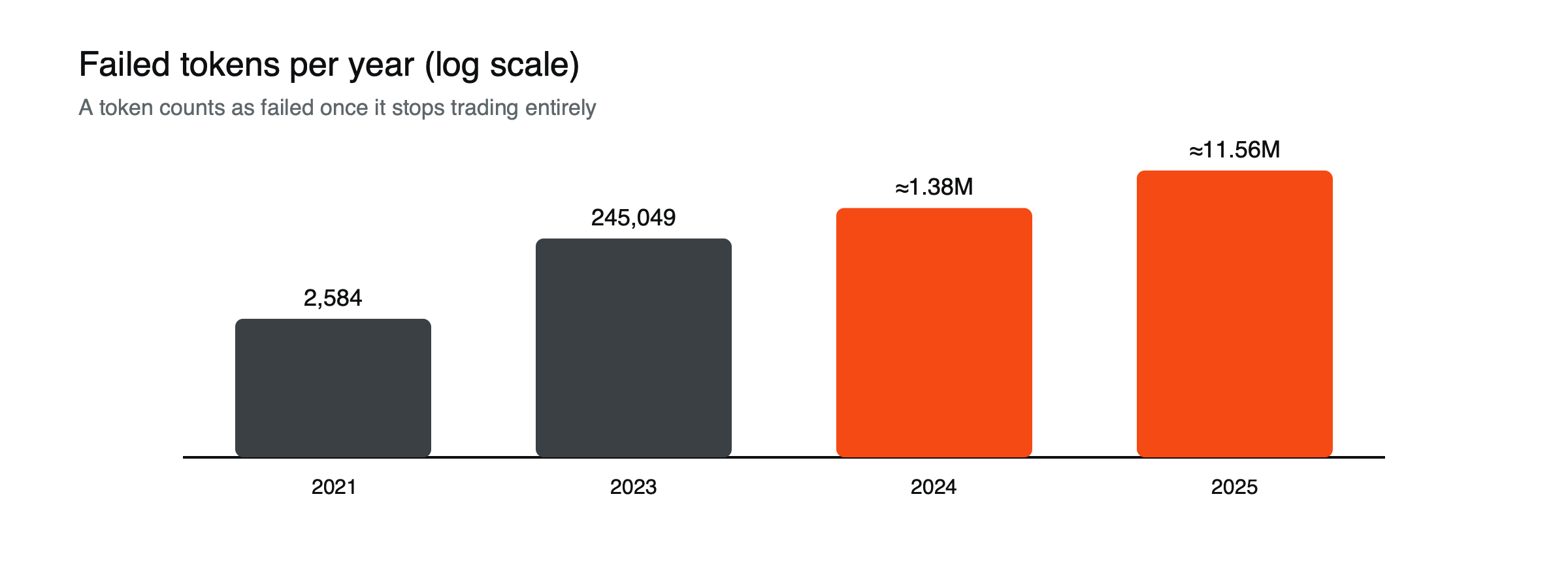
Figure: Token failures by year, log scale (2022 not reported in the sources). Data: CoinGecko via CryptoPotato and ForkLog, January 2026.
The pace of failures rose with the pace of launches:
| Year | Tokens recorded as failed |
|---|---|
| 2021 | 2,584 |
| 2023 | 245,049 |
| 2024 | about 1.38 million |
| 2025 | about 11.6 million |
The 2025 total alone made up 86.3% of all failures recorded from 2021 to 2025, and 7.7 million of them came in the fourth quarter, after the October sell-off. Behind the surge was a change in how tokens are made. GeckoTerminal listed 428,383 projects in 2021; launch platforms such as pump.fun then made it possible to create a coin with almost no cost or effort, and the total passed 20 million by the end of 2025.
How a token usually dies
Headline collapses get attention, but most failed tokens follow a quieter path:
- Launch. A token is created and seeded with a small pool of liquidity, often alongside a name or image tied to whatever is popular that week.
- Attention. Social media and early buyers push the price up. Volume is high and the chart looks strong.
- Distribution. The creators and earliest holders sell into that demand. The price stalls even while the story is still being promoted.
- Drift. New buyers stop arriving. Volume falls week by week and the price drifts lower.
- Liquidity leaves. Whoever supplied the liquidity withdraws it. Small sales now move the price sharply.
- The last trade. Listings disappear and trading stops. Holders often find out only when they try to sell.
That is why “it can’t go to zero” is a weak argument. In practice, a token goes to zero as soon as there is no one left to sell it to.
The underlying causes
No lasting demand
Most new tokens exist to be traded, not used. There is no network that needs the coin, so when the next meme or narrative appears, buyers leave and do not return. Compare that with what keeps established coins alive in what gives cryptocurrency its value.
Concentrated supply
When founders, early investors or a handful of wallets hold most of the supply, their selling sets the price. Scheduled releases of insider tokens can add more supply than the market can absorb. See how token unlocks affect price.
Security failures and deliberate exits
Smart-contract bugs and hacks can drain a project overnight. In a “rug pull,” the team itself removes the liquidity and disappears. See what a rug pull is.
Collapse of the design itself
Some failures are not small tokens at all. TerraUSD, a stablecoin that relied on an algorithm rather than reserves, lost its dollar peg in May 2022, and its sister token LUNA collapsed with it, erasing tens of billions of dollars of value within days. See what happened in the TerraUSD collapse.
Abandonment and regulation
Development stops, the team moves on, or exchanges delist a token after legal pressure. The coin still exists on a blockchain, but there is nowhere practical to sell it.
Warning signs to check before buying
- Thin liquidity: a small order book or liquidity pool relative to the token’s market value.
- Concentrated holdings: a few wallets holding most of the supply, visible on a blockchain explorer.
- Large unlocks ahead: vesting schedules that release insider tokens soon.
- No real use: no fees paid, no active users, nothing the token is needed for.
- Anonymous team with control: admin keys that can mint tokens or pull liquidity.
- Marketing over product: promises of returns, countdowns and pressure to buy now.
None of these proves a project will fail, and established coins can still fall sharply. Together, they describe the profile of most tokens that already have.
What failure means for the people holding the token
A failed token rarely disappears from a wallet. It stays there, visible and apparently worth something according to the last recorded trade, while no one is left to buy it. Holders typically find that exchanges have delisted it, the liquidity pool is empty and any sale would move the price to almost nothing.
Failures also distort the picture of how crypto performs. Lists and indices of the “top 100 coins” today include only the projects that survived. The thousands that dropped out along the way are missing, which makes the asset class look less risky in hindsight than it was for people buying at the time. This survivorship bias is worth remembering whenever a chart shows how much early buyers of a successful coin would have made.
What survivors tend to have in common
Coins that last usually share four traits. They run a network people pay to use, so demand does not depend on the price going up. Their liquidity is spread across many exchanges rather than one pool. Their supply schedule does not depend on insiders’ goodwill. And their security has been tested over years, through bull and bear markets. Even then, survival is not the same as a rising price: plenty of long-lived coins trade far below their peaks.
The practical lesson is about position size rather than prediction. Because most new tokens fail, any money put into them should be money you can afford to lose entirely, and it should be a small part of any crypto holding. For practical checks, see how to research a crypto asset and the warning signs of a crypto scam.
For the fundamentals behind all of this, read what cryptocurrency is.
This article is educational content and does not constitute financial, investment, legal or tax advice. Digital assets are volatile and you may lose the amount you invest.
Sources
- Over Half of All Crypto Tokens Are Now Dead: CoinGecko Report (53.2%; 11.6 million in 2025; 7.7 million in Q4 2025; 428,383 projects in 2021; 2,584 failures in 2021; ~1.38 million in 2024) — CryptoPotato via KuCoin, January 2026
- CoinGecko Reports Record Token ‘Mortality’ in 2025 (245,049 failures in 2023; Q4 peak after October crash) — ForkLog, January 2026
- How an algorithmic stablecoin wiped out $40 billion (TerraUSD and LUNA, May 2022) — Netcoins