
Why the Yen Rallies When Global Markets Sell Off
The yen often strengthens in sell-offs because of carry trade unwinds and Japan's huge foreign assets. How it works and what happened on August 5, 2024.

The yen’s safe-haven role comes from two forces. Investors borrow cheaply in yen to buy higher-yielding assets abroad and buy yen back to close those trades when markets fall. Japan also has the largest net foreign investment position, about $3.3 trillion. In July and August 2024, the yen rose 14% against the dollar in under a month.
The carry trade
For years Japan kept interest rates near zero. Investors borrowed yen cheaply and bought assets that paid more, such as US bonds and stocks. The trade profits while the yen stays weak. If the yen rises, the debt grows in other currencies, and investors rush to close positions, which pushes the yen up further.
The carry trade, illustrated
Suppose an investor borrows ¥150 million at near-zero interest when the dollar buys 150 yen, converts it into $1 million and buys US bonds yielding 5%. (Illustrative figures.) While the yen stays weak, the trade earns about 5% a year. If the yen strengthens 14%, to about 129 per dollar, repaying the ¥150 million loan now costs about $1.16 million, wiping out years of interest in weeks. To limit losses, investors buy yen to repay loans, which pushes the yen higher still.
Japan’s foreign assets
Decades of current account surpluses left Japanese investors with large holdings abroad. When risk rises, some of that money can be repatriated, adding to demand for yen.
August 5, 2024
The Bank of Japan raised rates to 0.25% and signaled less bond buying, while concerns about the US economy grew. The yen jumped, carry trades were unwound and the Nikkei 225 fell 12.4% on August 5, its worst day since 1987.
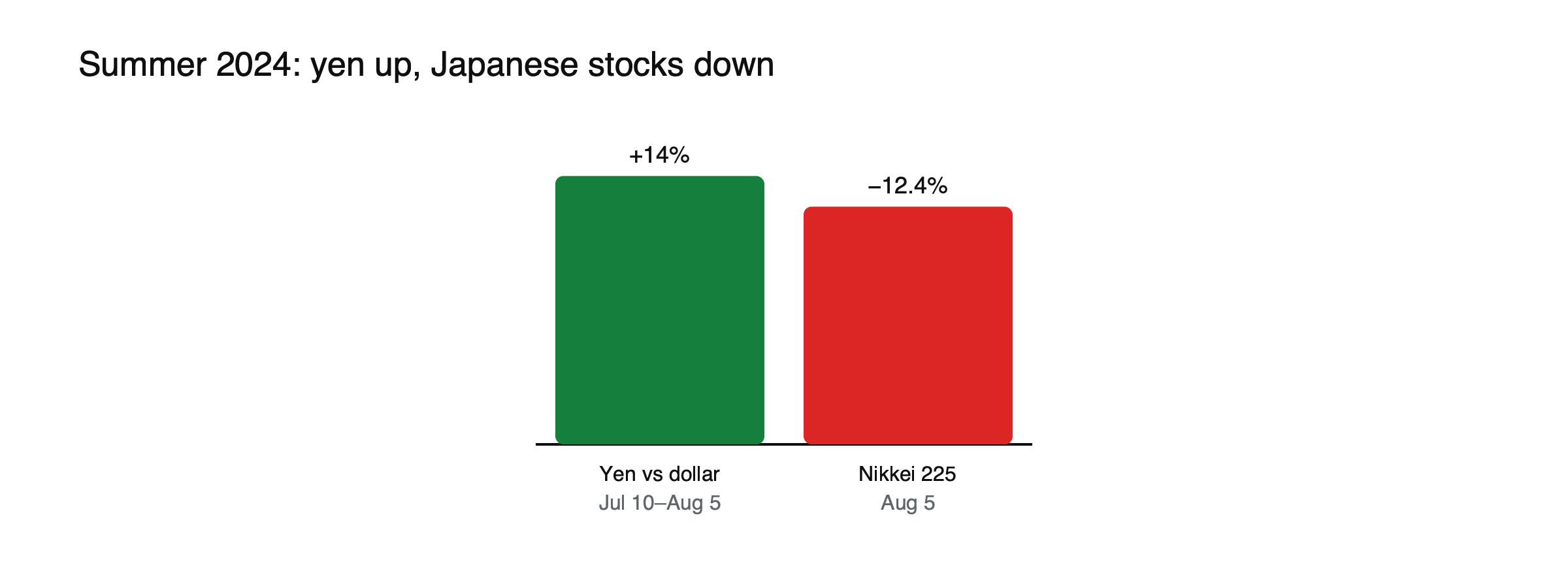
Figure: The yen’s surge and Japan’s stock crash in 2024. Sources: Schwab; Money by CJ.
The days around August 5
The yen rose about 14% against the dollar between July 10 and August 5, 2024. The Nikkei 225 fell about 12.4% on August 5, and the VIX briefly jumped to around 65. The next day, the Nikkei rebounded about 10.2%, its largest one-day gain on record, as the Bank of Japan signaled it would not raise rates while markets were unstable. The speed of both moves showed how crowded the carry trade had become.
How the shock spread
Losses spread to Europe and crypto before markets rebounded the next day. See why volatility in one market spills into others.
When the pattern fails
The yen is not a safe haven in every crisis. If a shock comes from Japan itself, or if Japanese rates rise for domestic reasons, the yen can move without global stress. Its role depends on the size of yen-funded positions at the time. For how currencies interact with other assets, read Bitcoin, gold and the dollar under market stress and why correlations go to one in a crisis.
Japanese investors abroad
Japan’s net foreign investment position, about $3.3 trillion, includes large holdings of foreign bonds and shares by pension funds, insurers and individuals. When markets fall or Japanese rates rise, some of that money comes home, adding to yen demand. The prospect of higher Japanese yields making domestic bonds more attractive is one reason investors watch Bank of Japan policy closely. See how Japan’s bond market affects global yields.
The yen and other havens
The yen often rises alongside the Swiss franc, US Treasuries and gold in risk-off episodes, but for different reasons. The franc benefits from Switzerland’s stability and surpluses; Treasuries from their depth and liquidity; gold from its role as a store of value. The yen’s moves are often the sharpest because of carry trade unwinds. See what makes a currency a safe haven.
Trading the pattern
Traders sometimes watch the yen as an early warning: a sudden yen rally can signal stress building in global risk positions before it shows up in share prices. But because the yen also moves on Japanese policy and US rates, a yen rally alone is not proof of a global sell-off. Checking whether other risk indicators are moving the same way helps avoid false alarms.
A checklist
- How large are yen-funded positions, judging by futures positioning?
- Is the Bank of Japan shifting toward higher rates?
- Are US yields falling, narrowing the rate gap?
- Are other safe havens rising too?
The yen’s long slide and interventions
The yen weakened for years as Japanese rates stayed near zero while US rates rose. Japan intervened to support it several times: about ¥6.35 trillion in October 2022, about ¥9.79 trillion in April and May 2024 and about ¥5.53 trillion in July 2024. In 2026, it intervened again, about ¥11.7 trillion in April and May and a record ¥15.4 trillion between July 30 and August 26, including the first joint US–Japan yen purchase since 1998. A weak yen and large carry positions set the stage for the sharp reversals that make it a safe haven in sell-offs.
The Bank of Japan’s shift
In 2024, the Bank of Japan ended negative interest rates and its policy of capping long-term yields, and it began raising rates. Each step toward higher Japanese rates narrows the gap with other countries and makes yen-funded carry trades less attractive, increasing the risk of sudden unwinds when global markets wobble. Bank of Japan meetings have become major events for global markets as a result.
When intervention and risk-off meet
If the yen is already rising because of a global sell-off, and Japan has recently intervened to support it, the move can be especially sharp: speculators who were short the yen rush to close positions at once. Traders holding yen-funded positions watch both global risk and Japanese official comments for warning signs.
Common misreadings
- Assuming yen strength always means a global crisis.
- Ignoring Japanese policy when explaining yen moves.
The yen and Japanese shares
A stronger yen tends to hurt Japanese exporters, because their foreign earnings are worth less in yen, which weighs on the Nikkei 225. When the yen jumps in a global sell-off, Japanese shares can fall more than other markets, as on August 5, 2024. When the yen weakens, Japanese exporters often rally. See what the Nikkei 225 is.
Carry trades in other currencies
Carry trades are not limited to the yen. Investors have also borrowed in the Swiss franc and, at times, the euro, when their interest rates were very low, to buy higher-yielding currencies and assets. When those trades unwind, the funding currencies rise and the target currencies, often in emerging markets, fall. The yen is the most prominent example because of the size of yen-funded positions and Japan’s long period of near-zero rates. See what a carry trade is.
Signs an unwind may be coming
Warning signs include a narrowing gap between Japanese and US interest rates, a hawkish shift from the Bank of Japan, very large speculative short positions in the yen shown in futures data and rising volatility in global markets. When several appear together, carry trades become vulnerable to a sudden rush for the exit.
The yen in 2026
In 2026, the yen weakened again, prompting record Japanese interventions and, in July, the first joint US–Japan yen purchase since 1998. Interventions can trigger sharp, fast yen rallies, adding another source of sudden moves to the carry trade story.
Trading around the yen
Traders with exposure to yen crosses often reduce size ahead of Bank of Japan meetings and US data releases, and watch Japanese officials’ comments for hints of intervention. Because yen moves can be sudden and large, stops are often skipped in fast markets, so sizing for gaps matters more than usual. Those holding positions in Japanese shares or global risk assets can use the yen as an early indicator of stress. Sudden yen strength, in particular, often deserves a closer look at other markets.
Frequently asked questions
Is the yen always a safe haven?
Usually in global risk-off moves, but not when the shock comes from Japan itself.
Why did the yen fall so much before 2024?
Because Japanese rates stayed near zero while US rates rose sharply, making the yen attractive to borrow and sell.
This article is educational content and does not constitute financial, investment, legal or tax advice. Digital assets are volatile and you may lose the amount you invest.
Sources
- Carry Trade Unwind: Is It Really Over? (yen +14% against the dollar July 10 to August 5, 2024; Japan’s $3.3 trillion net foreign investment position) — Schwab via Advisor Perspectives
- What is the ‘yen carry trade’? (BoJ raised rates to 0.25% and announced less bond buying; Nikkei −12.40%) — GKToday
- The Yen Carry Trade that Crashed the Markets in August 2024 (worst day since 1987) — Money by CJ
- Bank of Japan reassures markets (Nikkei +10.2% on August 6, 2024) — FinanzaOnline, August 7, 2024
- Yen carry trade unwind: 2024 episode (VIX briefly 65 on August 5) — Lambda Finance, 2026
- History of Japan’s intervention in currency markets (October 2022 ¥6.35 trillion; April–May 2024 ¥9.79 trillion; July 2024 ¥5.53 trillion; April–May 2026 ¥11.7 trillion) — Reuters via Investing.com, 2026
- Japan spent record $96 billion in yen interventions (¥15.4 trillion between July 30 and August 26, 2026; first joint US–Japan yen purchase since 1998) — Kuwait Times / AFP, August 2026