
Commodity Trading Mistakes Around Contract Rolls
Six commodity roll mistakes analyzed like engineering failures, rated for severity and detection: unknown roll dates, misread jumps, stops, contango, expiry.
Common contract roll mistakes: not knowing when a commodity CFD rolls, reading the roll jump as a real move, leaving stops at levels that no longer fit, forgetting how contango erodes long positions and holding near expiry as liquidity thins. Each can be analyzed like an engineering failure, by its effect, severity and prevention.
How the analysis works
Engineers use a method called failure mode and effects analysis to study how a system can fail. For each possible failure, they ask what happens, how serious it is, how easy it is to detect in time and what prevents it. Applied to commodity rolls, the method turns a list of mistakes into a set of specific checks. Severity is rated from 1 (minor) to 5 (can wipe out an account), and detection from 1 (obvious in advance) to 5 (usually noticed only after the damage). Ratings are judgments for a typical retail trader, not precise measurements.
Failure 1: the roll date is unknown
- What goes wrong: a trader holds a futures-based oil CFD without knowing it will switch contracts in three days.
- Effect: the position changes price on the chart, open orders may behave unexpectedly and, near expiry, liquidity can thin sharply.
- Severity: 3. Detection: 4, because nothing on the chart warns of the roll in advance.
- Prevention: check the provider’s roll calendar when opening any futures-based commodity CFD, and add roll dates to your trading calendar. See how to read a commodity contract specification.
Failure 2: the roll jump is read as a market move
- What goes wrong: the chart shows oil jumping $1.20 overnight; the trader takes it as a breakout and adds to the position, or panics and closes.
- Effect: a trading decision based on a move that did not happen in the market. The provider’s cash adjustment offsets the jump in equity, so there was nothing to react to.
- Severity: 2. Detection: 3, if the trader checks the roll calendar or the account statement.
- Prevention: before acting on any sudden jump in a commodity CFD, check whether it falls on a roll date. See how a futures roll adjusts a commodity CFD price.
Failure 3: stops and limits not adjusted
- What goes wrong: a long position has a stop $1.00 below the price. At the roll, the price jumps down by $1.50 because the next contract is cheaper, and the provider does not move open orders.
- Effect: the stop triggers on the roll alone, closing a position that the market never moved against.
- Severity: 3. Detection: 2, because the gap between contracts is known before the roll.
- Prevention: confirm whether your provider shifts open orders at the roll; if not, move stops and limits yourself by the price gap before the roll date.
Failure 4: contango costs ignored
- What goes wrong: a trader holds a long oil position for six months in a market where each next contract trades about 1% higher.
- Effect: even if the headline price ends where it started, roll costs take roughly 6% off the position’s value over six months, which on a 10:1 leveraged position is about 60% of the margin.
- Severity: 4. Detection: 4, because the cost builds slowly and is easy to mistake for bad luck.
- Prevention: check the shape of the futures curve before any longer hold, estimate the roll cost and compare it with the expected gain. See what contango and backwardation are.
Failure 5: holding into expiry
- What goes wrong: a trader holds a product that tracks the expiring futures contract into its final days.
- Effect: as most participants roll or close, liquidity in the expiring contract can collapse. In April 2020, the expiring May WTI contract settled at −$37.63 while the June contract settled at $20.43, and holders of products still tied to May suffered extreme losses.
- Severity: 5. Detection: 3, because expiry dates are published, but the danger is easy to underestimate.
- Prevention: know the expiry date of whatever contract your product follows, and be out or rolled well before the final days. See why oil prices went negative in April 2020.
Failure 6: comparing prices across contracts
- What goes wrong: a trader compares a futures-based CFD price with a news headline quoting a different contract month, or with a cash CFD, and concludes that the provider’s price is wrong.
- Effect: confusion, mistrust or trades placed against an imagined mispricing.
- Severity: 1. Detection: 2.
- Prevention: check which contract each price refers to before comparing.
The analysis in one table
| Failure | Severity | Detection | Priority |
|---|---|---|---|
| Holding into expiry | 5 | 3 | Highest |
| Contango costs ignored | 4 | 4 | High |
| Roll date unknown | 3 | 4 | High |
| Stops not adjusted | 3 | 2 | Medium |
| Roll jump misread | 2 | 3 | Medium |
| Cross-contract comparisons | 1 | 2 | Low |
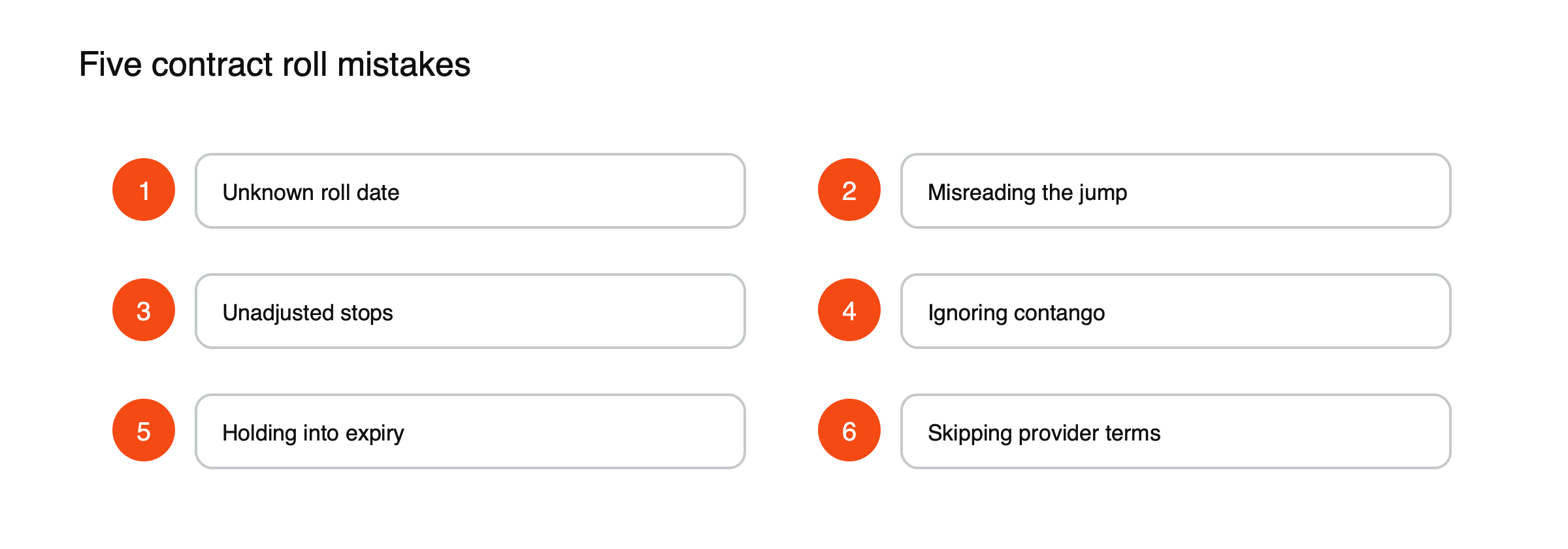
Figure: Five roll mistakes.
Failures that are both severe and hard to detect deserve the most attention, which is why expiry risk and slow contango costs come first.
A pre-roll routine
A week before each roll, check the date, the price gap between the expiring and next contracts and the direction of the curve. Decide whether to keep the position through the roll, close it or move to a cash CFD. Adjust stops and limits if the provider does not. After the roll, confirm that the cash adjustment matches the price gap and that open orders are where you expect them. The whole routine takes a few minutes and addresses every failure in the table. See how to read a futures curve and how commodity CFDs work.
Two scenarios in money terms
Stops not adjusted. A trader is long 100 barrels at $80.00 with a stop at $79.00, risking $100. At the roll, the next contract trades $1.50 lower, so the quoted price drops to $78.50 and the stop triggers, closing the position. The cash adjustment credits $150 for the roll, but the trader is now flat, having been stopped out by a contract change rather than a market move, and pays a spread to get back in. (Illustrative values.)
Contango ignored. A trader holds a long of 100 barrels for six months, with each next contract about 1% higher. With oil at $80, each roll costs about $0.80 a barrel as the new contract converges toward the old price, about $80 a month or $480 over six months on a position with about $800 of margin. The trader blames poor timing; the curve was the cause. (Illustrative values.)
Questions to ask your provider
- Does this CFD follow a futures contract or a cash price?
- When does it roll, and how many days before expiry?
- Are open stops and limits adjusted automatically at the roll?
- Is there a charge for rolling, and how is it applied?
- How will the adjustment appear on my statement?
When a cash CFD avoids the problem
Cash commodity CFDs do not switch contracts, so failures 1, 2, 3 and 5 largely disappear. The carry shows up instead as daily financing, which brings its own version of failure 4: costs that build slowly over long holds. For short holding periods, a cash CFD often simplifies matters; for longer ones, comparing financing with expected roll costs shows which is cheaper.
Where the failures bite hardest
Roll failures are most frequent in markets with monthly contracts, such as crude oil and natural gas, because there are twelve rolls a year to manage. They are most costly where the futures curve is steep, as in natural gas around the change from summer to winter contracts, or in oil during gluts. Gold, which rolls less often and usually has a gentle curve, is less exposed. Traders who move between commodities should not assume that habits formed in one market are safe in another. See what moves natural gas prices. Keeping a separate roll calendar for each commodity, rather than relying on one general rule, removes most of these surprises before they cost money. A few minutes of preparation per roll is cheaper than one stop-out.
This article is educational content and does not constitute financial, investment, legal or tax advice. Digital assets are volatile and you may lose the amount you invest.