
Risk Management Rules for Crypto CFD Trading
Cap risk per trade, size for volatility, limit total crypto exposure, keep free margin, avoid thin hours and set a daily loss limit: crypto CFD risk rules.
Good crypto CFD risk management means capping each trade’s loss, sizing for crypto’s swings, limiting total crypto exposure because coins move together, keeping free margin, avoiding thin hours for new positions and stopping after a daily loss limit. EU studies found 74% to 89% of retail CFD accounts lose money.
Before you start
Write your rules down and decide them before trading, not during a fast market.
Applying them, rule by rule
Cap risk per trade
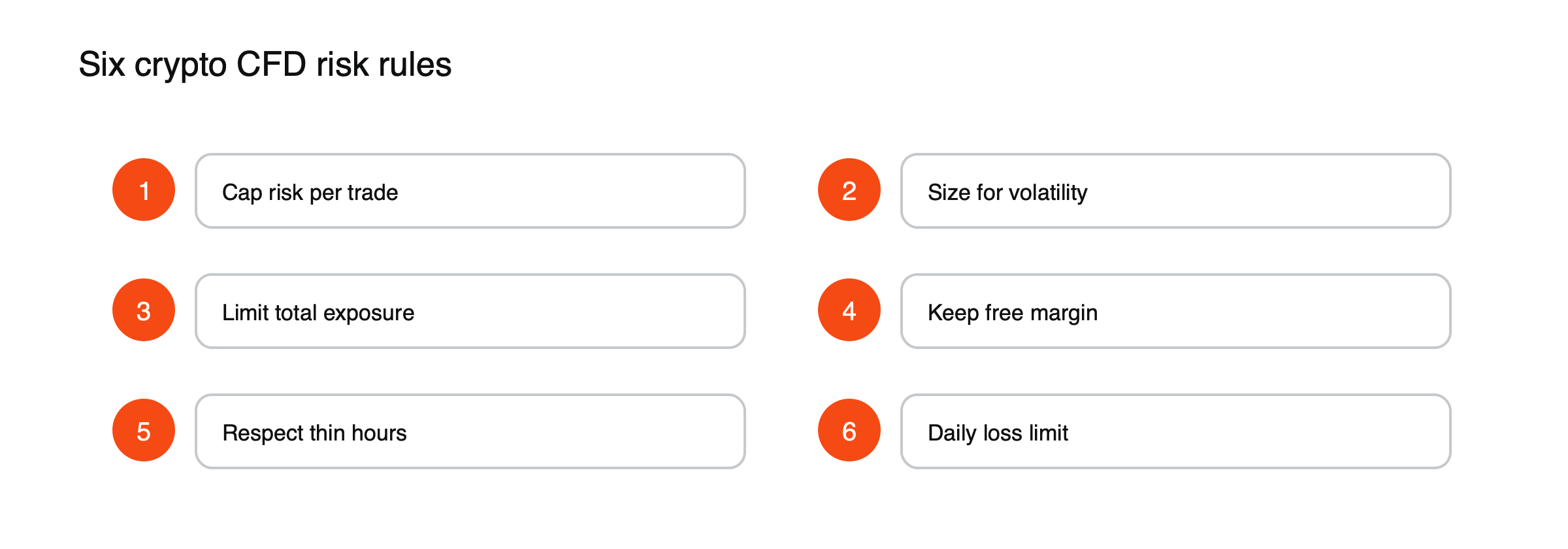
Figure: Six risk rules.
For example, 1% of the account or less. See how to size a crypto CFD position for high volatility.
Size for each coin’s volatility
Wider stops and smaller sizes for altcoins. See why altcoin CFDs move more than bitcoin CFDs.
Limit total crypto exposure
Bitcoin, ether and most altcoins often fall together; count them as one risk bucket.
Keep free margin
Stay well above close-out levels. See how volatility changes the margin on a crypto CFD.
Respect thin hours and events
Avoid opening positions in weekend lulls or right before big announcements.
Set a daily loss limit
Stop trading after a set loss to avoid revenge trades.
A rulebook, illustrated
Here is how a trader with a $10,000 account might write the rules down. (Example values.)
| Rule | Setting |
|---|---|
| Risk per trade | 1%, $100 |
| Stop basis | At least twice the coin’s average daily range |
| Gap allowance | Size as if stops could fill at twice their distance |
| Total crypto risk | 3%, $300, across all open positions |
| Effective leverage | Total positions no larger than the account |
| Free margin | Never below 50% of equity |
| New positions | None in the two hours before major announcements or late on weekends |
| Daily loss limit | Stop trading after losing 2%, $200, in a day |
| Weekly loss limit | Halve sizes after losing 5% in a week |
Every number can be adjusted to suit experience and temperament; what matters is that the rules exist before trading starts.
Why the rules work together
Risk per trade limits the damage from any one idea; the total exposure cap limits the damage when all crypto falls together; free margin and effective leverage keep close-outs distant; event and weekend rules reduce gap risk; loss limits stop a bad day from becoming a bad month. Each rule covers a gap the others leave.
Common mistakes
Changing rules mid-trade and adding to losing positions. See common mistakes with crypto CFDs and what a crypto CFD is.
A losing streak, illustrated
With 1% risk per trade, ten consecutive losses leave the $10,000 account at about $9,040, a drawdown of under 10%, from which recovery needs a gain of about 11%. With 5% risk per trade, the same streak leaves about $5,990, needing a 67% gain to recover. (Example values.) Losing streaks of five to ten trades happen to most traders at some point, which is why small risk per trade matters more than any single trade’s outcome.
Loss limits in practice
A daily or weekly loss limit is easiest to follow if it is written down and, where possible, automated with alerts. Many traders also set a monthly limit, after which they stop trading for the rest of the month and review what went wrong. The aim is not to avoid losses, which are part of trading, but to stop small losses from growing through emotional decisions.
Reviewing the rules
Rules should be reviewed regularly, for example monthly, using a trading journal: which rules were followed, which were broken and what that cost. Rules that are broken repeatedly may need to be simpler; rules that never bind may be too loose to matter. See how to keep a trading journal.
Rules for shorts and hedges
Short positions can reach close-out sooner than longs of the same size, because losses and margin grow together in a rally, so many traders use smaller sizes for shorts. Hedges follow different rules again, sized from the holding they protect, with margin planned for a strong rally. See how to hedge crypto holdings with CFDs.
Adjusting rules to account size
Small accounts face a practical problem: 1% of a $1,000 account is $10, which may be smaller than the minimum position size allows with a sensible stop. Rather than raising the risk percentage, small accounts can trade the largest, most liquid coins, where minimum sizes are small, or wait until the account is large enough to follow the rules. Larger accounts can add rules for diversification across coins and limits on single-position size.
Limits per coin
Beyond risk per trade, some traders cap the share of the account in any single coin, for example no more than 50% of equity in bitcoin positions and 20% in any altcoin. Such limits prevent one coin’s sudden collapse, a delisting or a project failure from causing outsized damage, even if every individual trade followed the per-trade risk rule.
Percentage or fixed amount?
Risking a fixed percentage of current equity means position sizes shrink after losses and grow after gains, which slows drawdowns and lets winners compound. Risking a fixed dollar amount is simpler but does not adapt. Most traders find the percentage approach more resilient in volatile markets such as crypto.
Rules for volatile periods
When volatility rises, the same risk per trade requires wider stops and smaller positions. Some traders also lower their total crypto risk cap during turbulent periods, for example from 3% to 2%, and stop opening new positions after very large daily moves until conditions settle.
Alerts and automation
Platform tools can enforce some rules automatically: stop orders on every position, alerts when the margin level falls, and in some cases limits on daily losses or position sizes. Automating rules removes the need for willpower at the moment it is hardest to find.
Common misreadings
- Treating rules as guidelines to break when confident.
- Setting rules after a loss rather than before trading.
A drawdown plan, illustrated
Rules work best when they also say what happens after losses. A trader might decide: after a 5% fall from the account’s peak, halve risk per trade to 0.5%; after a 10% fall, stop opening new positions for a week and review the journal; after a 15% fall, stop trading crypto CFDs for a month. (Example rules.) Writing these steps down in advance turns a painful drawdown into a planned process rather than a series of emotional reactions, and keeps a bad run from becoming a disaster.
Testing the rules
Before relying on a set of rules, it helps to apply them to past trades or to a demo account for a few weeks. If the rules would have prevented the worst losses without blocking most good trades, they are probably well judged; if they are constantly broken, they may need to be simpler.
Rules as commitments
Some traders print their rules or keep them visible on their trading screen. Others share them with a trusted person who can ask whether they were followed. Making rules visible and accountable makes them much harder to ignore in the heat of a fast market.
The cost of having no rules
Without clear written rules, decisions are made in the moment, often under stress and time pressure. Traders then tend to cut winners too early, hold losers too long and increase size after losses. Regulators’ studies of retail CFD accounts in the EU found that most lose money, and behaviors like these are a very common reason why.
Frequently asked questions
Is 1% risk per trade too cautious?
For crypto, many experienced traders use 1% or less because volatility and gaps make larger risks dangerous over a losing streak.
What matters most if I can follow only one rule?
Sizing every position from a fixed, small risk per trade, because it limits the damage from almost every other mistake.
This article is educational content and does not constitute financial, investment, legal or tax advice. Digital assets are volatile and you may lose the amount you invest.