
How the Forex Market Works
The forex market trades about $9.6 trillion a day, mostly over the counter between banks. How it is structured, who trades, when it is open, how to access it.
The forex market is where currencies are exchanged, and it is the largest financial market in the world: about $9.6 trillion a day in April 2025, according to the Bank for International Settlements. It has no central exchange. Banks, funds, companies and brokers trade with each other over the counter, around the clock from Sunday evening to Friday evening.
A currency trade, from start to finish
Suppose a German company must pay a US supplier $1 million. (Illustrative example.) Its bank quotes EUR/USD at 1.0998 to sell euros and 1.1000 to buy them; the company sells about €909,000 to buy the dollars. Behind the scenes, the bank may offset the trade by buying euros from another bank or on an electronic platform, and the two currencies change hands a couple of business days later, the usual settlement period for spot deals. No exchange is involved at any point: the deal is agreed directly between the parties, which is what “over the counter” means.
How the modern market came about
For much of the 20th century, major exchange rates were fixed or tightly managed. Under the Bretton Woods system set up after the Second World War, currencies were pegged to the US dollar, which was in turn linked to gold. That system broke down in the early 1970s, and the major currencies began to float, with their values set by supply and demand. Governments still intervened at times, most famously in the 1985 Plaza Accord to push the dollar down, and in 1999 eleven European countries replaced their currencies with the euro. Electronic trading platforms from the 1990s onward made prices faster and cheaper to access, eventually opening the market to retail traders through brokers. See the Plaza Accord and the launch of the euro.
Floating, fixed and in between
Not every currency floats freely today. Major currencies such as the dollar, euro, yen and sterling float, with central banks influencing them mainly through interest rates. Others are pegged to another currency or a basket, kept within a band, or managed day to day by their central bank. A pegged currency can look calm for years and then move sharply if the peg breaks. See fixed vs floating exchange rates.
Who trades
- Banks and dealers, which quote prices to each other and to clients.
- Asset managers and hedge funds, investing or hedging foreign holdings.
- Companies, paying suppliers or converting overseas revenue.
- Central banks, managing reserves and sometimes intervening.
- Retail traders, usually through brokers offering spot FX or CFDs.
How prices form without an exchange
With no central exchange, there is no single official price. Large banks quote buy and sell prices to clients and to each other, electronic trading platforms match orders among dealers and institutions, and brokers combine quotes from several sources to price their own clients. Because the biggest participants watch each other’s prices constantly, quotes for the major currency pairs stay very close across venues, usually within a fraction of a pip. For less traded currencies, quotes can differ more, and spreads are wider.
How big it is
Turnover rose 28% from 2022 to April 2025. The US dollar was on one side of 89% of all trades.
Where trading happens
Trading is concentrated in a few centers: the UK handled 38% of turnover, and the UK, US, Singapore and Hong Kong together about 75%.
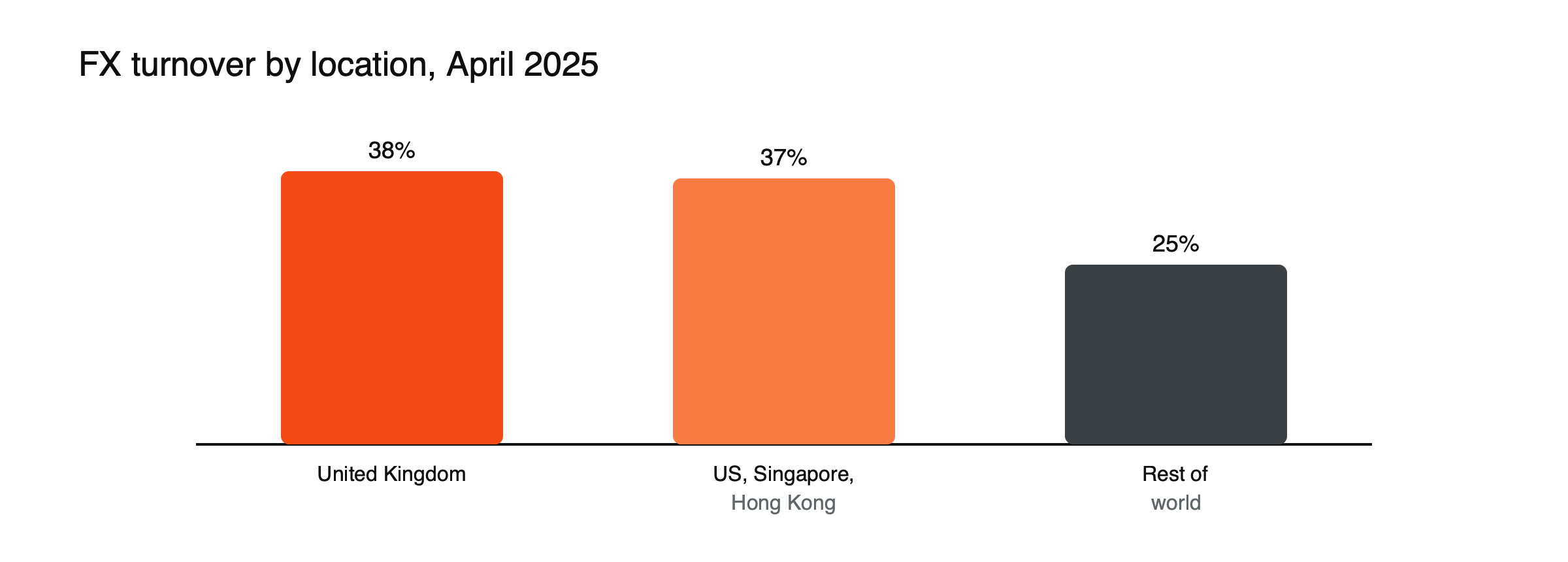
Figure: Where FX trading happens. Source: BIS Triennial Survey 2025.
Why the dollar is on almost every trade
The US dollar’s 89% share does not mean that most trades are about the United States. Many currency pairs are traded through the dollar because it is the most liquid currency: a bank exchanging South Korean won for Mexican pesos will often sell won for dollars and dollars for pesos, since both of those markets are deeper than a direct won-peso market. That role as a “vehicle currency,” along with the dollar’s place in trade, debt and central bank reserves, keeps it at the center of the market. The euro and the yen follow at a distance, and sterling’s share fell to about 10% in 2025.
What gets traded
Spot deals for near-immediate delivery, forwards for a later date, and swaps that combine the two. Swaps are the largest category; spot is about a third of turnover.
The three main instruments
| Instrument | What it is | Share of 2025 turnover |
|---|---|---|
| Spot | Exchange at today’s rate, settled within about two business days | About 31% |
| Outright forwards | Exchange at a rate fixed today for a later date | About 19% |
| FX swaps | A spot deal and a forward in opposite directions, used to manage funding | About 42% |
Most of the market’s volume serves funding and hedging needs, not speculation. Companies lock in future rates with forwards, and banks and funds use swaps to borrow one currency against another.
When it is open
From about 5 p.m. New York time on Sunday, when Sydney opens, to 5 p.m. on Friday. Activity rolls through the Asian, European and US sessions. See forex trading sessions.
When liquidity peaks
Activity is heaviest when two major centers overlap, especially when London and New York are both open in the European afternoon. Spreads on major pairs are usually tightest then. Liquidity is thinnest in the hour around the daily rollover in late New York trading and on Sunday evenings, when spreads widen and prices can move sharply on small orders.
What moves exchange rates
Currencies respond above all to interest rates and expectations about them: when a central bank raises rates, or is expected to, its currency tends to strengthen as returns on deposits and bonds rise. Inflation, growth data, trade flows, government finances and political events all feed into those expectations. In times of stress, investors move toward currencies seen as safe havens, such as the dollar, yen and Swiss franc. See what moves currency prices and central bank decisions and currencies.
Majors, minors and exotics
Currency pairs are often grouped by how widely they trade. Major pairs combine the US dollar with another leading currency, such as EUR/USD, USD/JPY or GBP/USD, and have the tightest spreads. Minor pairs, or crosses, combine two major currencies without the dollar, such as EUR/GBP. Exotic pairs combine a major currency with that of a smaller or emerging economy, such as USD/TRY, and tend to have wider spreads, larger moves and more political risk. See major, minor and exotic currency pairs.
How forex compares with other markets
Compared with stock markets, forex trades almost around the clock, has no central exchange and is driven mainly by interest rates and economic data rather than company earnings. Daily moves in major pairs are usually smaller than in individual shares, which is one reason leverage on currencies is higher. See forex vs stocks.
How retail traders access it
Through brokers quoting currency pairs, often as CFDs with leverage. Prices move in pips, and costs come from the spread and overnight rollover. See what a CFD is.
Keeping track of what matters
Most currency traders follow a short list of sources: an economic calendar for scheduled data and central bank meetings, central bank statements and minutes, and interest rate expectations implied by bond and futures markets. Watching these consistently, rather than reacting to every headline, explains most of the large moves in major pairs and helps avoid holding positions into events by accident. A weekly check of the calendar, done before positions are opened, is usually enough for most part-time traders. See how to use an economic calendar.
How a retail forex trade works
A retail trader does not join the interbank market directly. A broker quotes a buy and sell price, usually derived from its liquidity providers, and the trader opens a position, often as a CFD, in units called lots. One standard lot is 100,000 units of the base currency, so on EUR/USD a one-pip move is worth about $10 per lot. Under EU, UK and Australian retail rules, leverage on major currency pairs is capped at 30:1, so one lot of EUR/USD at 1.1000, worth about $110,000, needs about $3,667 of margin. See what a pip is and what lot size means in forex.
What forex trading costs
The main cost is the spread between the buy and sell price, which is narrowest on major pairs during busy hours and widest on exotic pairs and at quiet times. Some accounts add a commission in exchange for tighter spreads. Positions held past the daily cut-off pay or earn rollover, based on the interest rate difference between the two currencies plus the broker’s fee. See how much the forex spread costs.
How the market is regulated
Because the interbank market has no central exchange, there is no single regulator for it. Banks are supervised in their home countries, and the major dealers follow an industry code of conduct for wholesale currency trading. Retail brokers are licensed and supervised by national regulators, whose rules on leverage, client money and risk warnings differ. For retail traders, the broker’s regulator matters far more than the size of the overall market.
Risks particular to forex
- Leverage: small percentage moves become large gains or losses on margin.
- Central bank surprises: an unexpected policy change can move a currency several percent in minutes, as the Swiss franc showed in 2015. See the 2015 Swiss franc floor removal.
- Weekend and holiday gaps: prices can reopen far from Friday’s close.
- Thin markets at rollover: spreads can widen sharply around the daily cut-off.
- Exotic pairs: wider spreads, larger moves and occasional capital controls.
Frequently asked questions
Is forex trading open 24 hours a day?
It runs continuously from Sunday evening to Friday evening, New York time, as trading passes between financial centers. Individual brokers may pause briefly around the daily rollover.
Why is the forex market so large?
Because currency exchange underpins international trade, investment and funding. Most of the daily volume comes from banks, companies and funds managing currency needs and risks, not from speculation.
Do I need a lot of money to trade forex?
Brokers allow small positions, such as micro lots of 1,000 units. The real question is how much you can afford to lose, since leverage can turn small deposits into large exposures.
This article is educational content and does not constitute financial, investment, legal or tax advice. Digital assets are volatile and you may lose the amount you invest.
Sources
- Global FX trading hits $9.6 trillion per day in April 2025 (UK 38%; top four centers 75%) — BIS, September 2025
- Global forex trading hits US$9.6 trillion a day (dollar on one side of 89.2% of trades; spot 31%; swaps largest) — The Asset, September 2025
- Forex trading hours (opens Sunday 5 p.m. New York time, closes Friday 5 p.m.) — Benzinga
- BIS Triennial Survey of foreign exchange and OTC interest rate derivatives markets in April 2025: UK data ($4,745 billion a day; 37.8% of global turnover) — Bank of England, September 2025
- The BIS 2025 Triennial Central Bank Survey (spot 31%, outright forwards 19%, FX swaps 42%; sterling 10.2%) — BabyPips forum summary, 2025