
What Happened When Nixon Ended Dollar-Gold Convertibility in 1971?
On August 15, 1971, Nixon suspended converting dollars into gold at $35 an ounce, ending Bretton Woods and opening the era of floating currencies. What changed.
The Nixon shock came on August 15, 1971, when President Nixon suspended foreign governments’ right to convert dollars into gold at $35 an ounce. It effectively ended the Bretton Woods system of fixed exchange rates. Within a few years, major currencies floated, gold was market-priced and a decade of high inflation followed.
Background
Under Bretton Woods, currencies were pegged to the dollar, and the dollar to gold. By the late 1960s, US spending and inflation meant foreign holdings of dollars far exceeded US gold reserves, and countries began asking for gold.
How the system came under strain
The Bretton Woods system, agreed in 1944, made the dollar the anchor of the world’s currencies, with the US promising to exchange dollars held by foreign governments for gold at $35 an ounce. That worked while the United States held most of the world’s gold and ran trade surpluses. Through the 1960s, spending on the Vietnam War and domestic programs, rising inflation and growing imports sent more dollars abroad. Economists pointed out the built-in dilemma: the world needed more dollars to finance growing trade, but the more dollars circulated, the less credible the gold promise became.
Warning signs
In 1968, the London Gold Pool, a group of central banks that had sold gold to hold the market price near $35, collapsed under heavy buying, and a two-tier market emerged, with an official price for central banks and a free market price for everyone else. In 1971, pressure on the dollar intensified, and some countries asked to convert their dollar holdings into gold. By August, the United States faced the prospect of a run on its gold reserves.
1971
- August 15, 1971: the “gold window” closes; a temporary import surcharge is also announced.
- December 1971: the Smithsonian Agreement devalues the dollar by about 11% against other currencies.
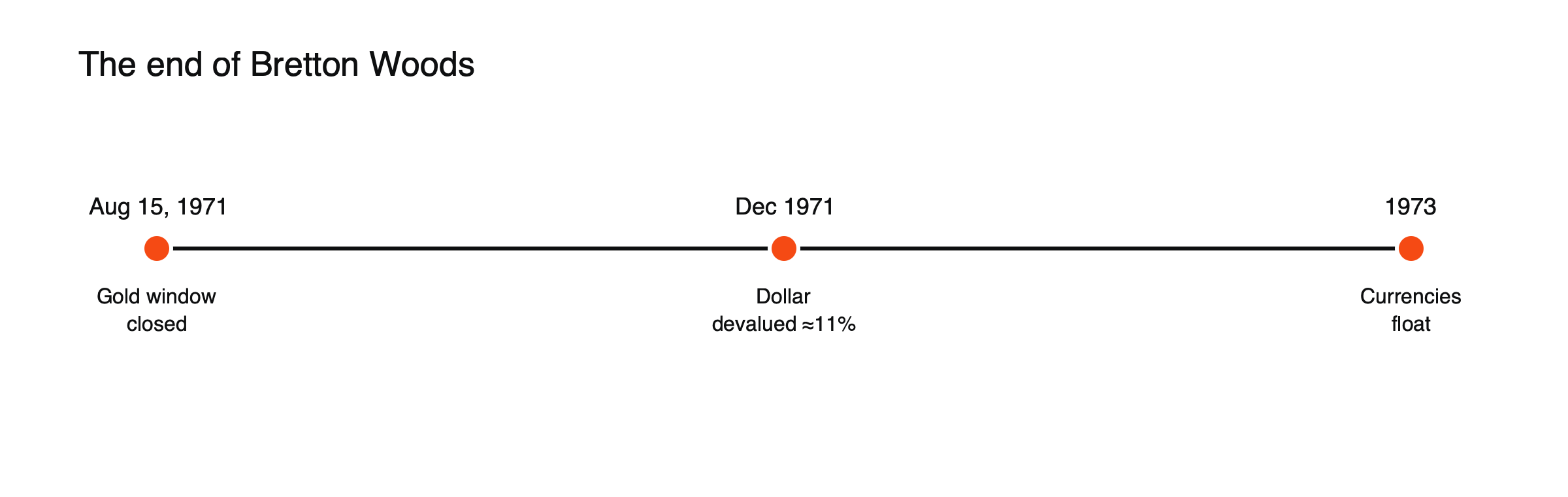
Figure: From Bretton Woods to floating rates.
The weekend at Camp David
President Nixon and his advisers met at Camp David over the weekend before the announcement. Alongside closing the gold window, the package included a 90-day freeze on wages and prices and a 10% surcharge on imports, intended to pressure trading partners into revaluing their currencies. Nixon announced the measures in a televised address on Sunday evening, August 15, so that markets would have time to absorb them before reopening. Treasury Secretary John Connally summed up the US attitude to foreign complaints by telling European officials that the dollar was “our currency, but your problem.”
The Smithsonian Agreement
In December 1971, the major economies agreed at the Smithsonian Institution in Washington to realign their currencies. The dollar was devalued by about 11% against other currencies on average, and the official gold price was raised from $35 to $38 an ounce, about 8.6% higher. The new pegs had wider bands, but they lasted little more than a year. In February 1973 the official gold price was raised again, to $42.22, and within weeks the major currencies were floating.
1973 and after
- 1973: major currencies move to floating exchange rates; the US Dollar Index starts at 100 in March 1973. See what the US Dollar Index is.
- 1970s: gold rises far above $35; inflation climbs.
Gold after the shock
Freed from its fixed price, gold rose through the 1970s as inflation climbed and confidence in paper currencies fell, reaching about $850 an ounce in January 1980, roughly 24 times its old official price. It then fell sharply as high interest rates brought inflation under control. The episode turned gold from a fixed monetary anchor into a market-priced asset driven by inflation expectations, interest rates and the dollar, the relationships traders still watch today. See why gold and the US dollar usually move in opposite directions.
Why it matters
It created the modern system of floating exchange rates, making currency trading as we know it possible, and turned gold into a market-priced asset.
Effects on commodities
A weaker dollar and rising inflation helped push commodity prices higher through the 1970s, including the 1973 oil shock and the 1979–1980 silver and gold spikes. See what caused the 1973 oil crisis.
Lessons
Fixed links break when the anchor cannot hold; monetary regime changes reshape every market. See fixed vs floating exchange rates and how commodity CFDs work.
The birth of modern currency markets
Floating exchange rates created the need, and the opportunity, for a large market in which currencies are traded continuously. Banks built trading desks, currency futures began trading in Chicago in 1972, and over the following decades the foreign exchange market grew into the largest financial market in the world, now turning over trillions of dollars a day. Every forex and currency CFD trade today rests on the system that emerged after 1971. See how the forex market works.
Inflation and the 1970s
Without the discipline of gold convertibility, and with policy focused on growth and employment, US inflation rose through the decade, reaching double digits after the oil shocks. It was finally brought down in the early 1980s, when the Federal Reserve raised interest rates to very high levels. The experience shaped the modern emphasis on central bank independence and inflation targets.
A timeline
- 1944: Bretton Woods agreement; dollar convertible into gold at $35 for governments.
- 1968: London Gold Pool collapses; two-tier gold market begins.
- August 15, 1971: gold window closed; wage and price freeze; import surcharge.
- December 1971: Smithsonian Agreement; gold raised to $38.
- February 1973: gold raised to $42.22; floating follows within weeks.
- January 1980: gold reaches about $850.
How markets reacted
Foreign exchange markets in Europe and Japan were thrown into confusion. Several countries kept their exchange markets closed for days while governments decided how to respond, and when they reopened, many currencies were allowed to rise against the dollar. US stocks rallied the following day, as investors welcomed the wage and price freeze and the prospect of a weaker dollar helping exporters. Over the following years, the end of fixed rates made currency moves a permanent feature of international business.
Why it was called a shock
The decision was taken by a small group of officials without consulting other countries, and it was announced suddenly. For trading partners who had built their economic policies around a fixed dollar, it overturned the rules overnight. In Japan, it became known as one of the Nixon shocks, alongside the surprise announcement of a presidential visit to China the same summer.
Lessons for traders
The episode shows that monetary arrangements that look permanent can end abruptly when they become impossible to sustain, a lesson repeated in later peg breaks such as sterling’s exit from the European exchange rate mechanism in 1992. When an anchor is under strain, the warning signs, falling reserves, rising pressure on the market price and official denials, are often visible beforehand. See what happened on Black Wednesday.
Common misreadings
- Believing the dollar was devalued against gold in a single step.
- Assuming floating rates began on August 15, 1971.
The dollar’s role afterward
Many predicted that ending gold convertibility would end the dollar’s central role in the world economy. Instead, the dollar remained the main reserve currency and the currency used for most international trade, commodity pricing and borrowing. The depth of US financial markets, the size of the US economy and the lack of a ready alternative kept it at the center of the system, now resting on confidence in US institutions rather than on gold. Debates about whether gold or other currencies might eventually challenge that role continue, and they help explain why central banks have been buying gold in recent years. See how central bank gold buying affects the price. The arrangement has lasted far longer than many expected in 1971, and it still shapes markets today.
Frequently asked questions
Did the Nixon shock cause the inflation of the 1970s?
It removed a constraint, but inflation also reflected spending, policy choices and the oil shocks. Most economists see it as one of several causes.
Is the dollar still linked to gold?
No. Since the 1970s, the dollar and other major currencies have floated, and gold is priced freely in markets.
This article is educational content and does not constitute financial, investment, legal or tax advice. Digital assets are volatile and you may lose the amount you invest.
Sources
- The 45th anniversary of Silver Thursday (Nixon shock August 15, 1971; end of gold redemption at $35 under Bretton Woods) — Cheap Thoughts
- 1980 Hunt Brothers silver (Nixon closed Bretton Woods ties to gold on August 15, 1971; about 11% dollar devaluation agreed in December 1971) — SD Bullion
- U.S. Dollar Index (started March 1973 at 100 after Bretton Woods) — Wikipedia