
WTI vs Brent: Why Are There Two Oil Prices?
WTI is US crude delivered at Cushing, Oklahoma; Brent is seaborne North Sea crude priced for global markets. How they differ and why their spread moves.
WTI vs Brent are the two main oil benchmarks. WTI is US crude delivered by pipeline to Cushing, Oklahoma; Brent is North Sea crude shipped by sea and used to price much of the world’s oil. Their locations and logistics differ, so their prices differ, and the spread moves with US storage, shipping and global supply.
Side by side
| WTI | Brent | |
|---|---|---|
| Origin | US inland fields | North Sea (with other crudes in the basket) |
| Delivery | Physical, at Cushing, Oklahoma | Waterborne; cash-settled futures |
| Main exchange | NYMEX (CME) | ICE Futures Europe |
| Prices | Mainly US crude | Much of global crude |
| Storage sensitivity | High, landlocked | Lower, seaborne |
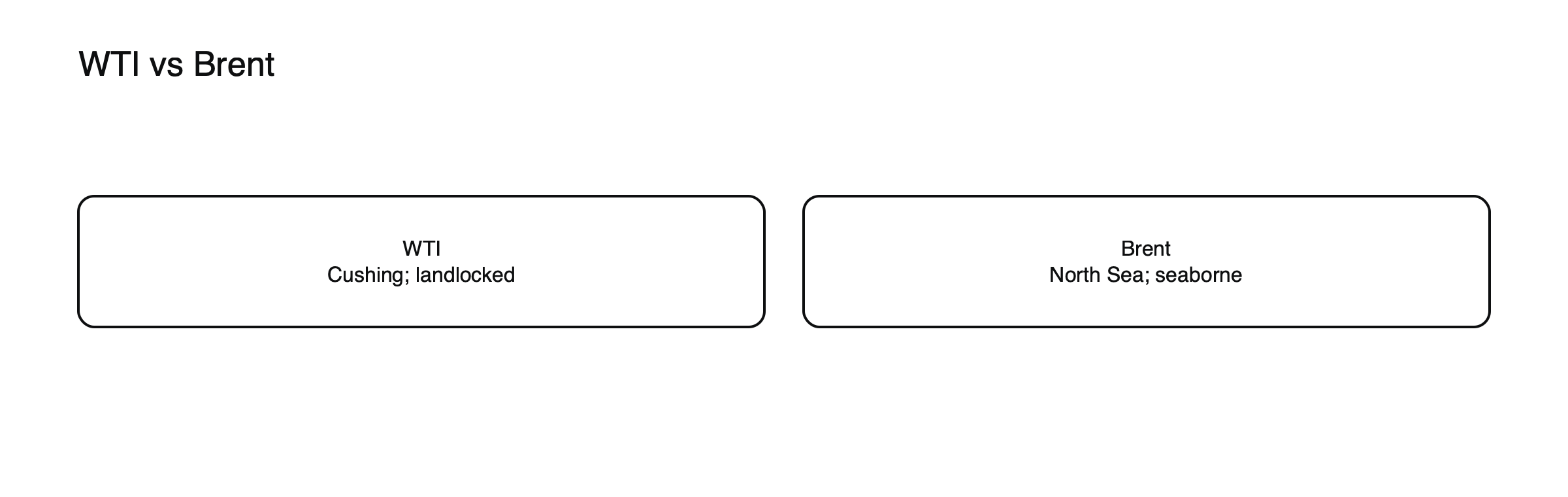
Figure: Two benchmarks, two locations.
Why the spread moves
- US storage: a glut at Cushing pushes WTI below Brent; low Cushing stocks, below 20 million barrels in mid-2026, can tighten it.
- Shipping and export capacity for US crude.
- Global disruptions: Middle East or Europe-focused shocks often lift Brent more.
The spread in numbers
Suppose WTI trades at $70 and Brent at $74, a spread of $4. (Illustrative prices.) If US crude can be piped to the coast and shipped abroad for less than $4 a barrel, exporters buy WTI and sell into markets priced off Brent, which tends to pull the spread back toward the cost of transport. If export capacity is full or shipping costs jump, the spread can widen further. The spread therefore reflects logistics as much as the quality of the oil itself.
A brief history of the spread
For years, WTI usually traded slightly above Brent, reflecting its lighter, sweeter quality. When US shale production surged in the early 2010s and pipelines could not move the new oil from the inland hub to the coast fast enough, WTI fell below Brent, at times by an unusually wide margin. The lifting of the long-standing US ban on most crude exports at the end of 2015, and new pipelines, allowed US oil to reach world markets more easily, and the spread settled into a narrower, more stable range.
The 2020 example
In April 2020, the expiring May WTI contract settled at −$37.63 as Cushing storage ran out, while Brent, which is not tied to that delivery point, stayed above $25.
A third benchmark: Dubai
In addition to WTI and Brent, a benchmark based on Middle Eastern crude, often referred to as Dubai or Oman, is used to price much of the oil sold to Asia. Disruptions in the Gulf tend to affect it most directly. The three benchmarks together give a fuller picture of where supply is tight and where it is plentiful.
The benchmarks in 2026
When shipping through the Strait of Hormuz was effectively closed in 2026, the shock hit Gulf supply directly, and seaborne benchmarks such as Brent responded strongly, rising toward $120 before falling back as traffic resumed. WTI rose too, since the US is part of a global market, but its link to inland storage and US production meant its moves did not always match Brent’s. Episodes like this are when the spread between benchmarks can change most.
Which one to watch
Brent reflects global supply and geopolitics; WTI reflects US conditions more closely. Oil CFDs may track either, so check which benchmark and which futures month your CFD follows.
See what moves crude oil prices, how to read the weekly EIA oil inventory report and how commodity CFDs work.
Which benchmark does your CFD follow?
Providers usually offer separate CFDs for WTI and Brent, each based either on a futures contract or on a cash price derived from futures. Their prices, roll dates and trading hours can differ. Before trading, check which benchmark and which contract month the instrument tracks, and whether news you are following, such as US inventory data or Middle East supply, matters more for one than the other. See how to read a commodity contract specification.
Trading the spread
Some traders take positions on the spread itself, for example buying Brent and selling WTI when they expect US supply to build up or global disruptions to lift seaborne crude. Such trades depend on logistics and inventories rather than on the overall direction of oil, but they carry their own risks, including different roll dates for the two contracts and sudden shifts in shipping costs.
Light, sweet, heavy and sour
Crude oils differ by density and sulfur content. Light crude is less dense and yields more high-value products such as gasoline; heavy crude needs more processing. Sweet crude has little sulfur, while sour crude has more and costs more to refine. Both WTI and Brent are light, sweet crudes, which is one reason they trade close to each other. Heavier, more sulfurous crudes usually sell at a discount to them, and that discount changes with refinery demand.
Why Cushing matters
Cushing, Oklahoma, is a hub of pipelines and storage tanks where WTI futures contracts are physically delivered. Because the contract settles by delivery there, the amount of oil in storage at Cushing and the room left in its tanks directly affect WTI’s price, especially near expiry. When tanks fill, as in April 2020, the expiring contract can fall sharply; when stocks run low, it can rise relative to other crudes. Weekly inventory reports show Cushing stocks separately for this reason. See how to read the weekly EIA oil inventory report.
How Brent is assessed
Brent today refers to a basket of North Sea crudes rather than a single field, because output from the original Brent field has declined. Including several crudes keeps the benchmark liquid enough to be reliable. Brent futures are settled in cash rather than by physical delivery at a single site, which makes them less exposed to local storage problems than WTI.
Common misreadings
- Treating WTI and Brent as interchangeable.
- Assuming the spread is always the same size.
- Comparing a WTI CFD price with a Brent headline and expecting them to match.
The two CFDs side by side
| WTI CFD | Brent CFD | |
|---|---|---|
| Most sensitive to | US inventories, Cushing storage | Global supply, Middle East and European news |
| Typical roll | Monthly | Monthly |
| Price level | Usually a few dollars below Brent | Usually a few dollars above WTI |
(General tendencies; check each provider’s specification.) Many traders follow both, using the spread as a simple gauge of whether US or global factors are driving oil at a given moment.
Frequently asked questions
Why is Brent used more widely than WTI?
Because it is a seaborne crude that can be delivered almost anywhere, it is used as a reference for pricing much of the oil traded internationally, while WTI is tied more closely to conditions in the United States.
Can WTI trade above Brent?
Yes. Historically it often did, and it can again if conditions in the US market tighten relative to global supply.
This article is educational content and does not constitute financial, investment, legal or tax advice. Digital assets are volatile and you may lose the amount you invest.
Sources
- What’s new: release schedules (Weekly Petroleum Status Report after 10:30 a.m.; Weekly Natural Gas Storage Report Thursday 10:30 a.m.; Cushing below 20 million barrels in mid-2026) — US EIA
- Lack of storage space drives Nymex WTI to record low (Brent settled at $25.57, not constrained by physical delivery at Cushing) — Journal of Petroleum Technology, April 2020
- OPEC+ (three primary benchmarks: WTI, Brent and Dubai) — Journals of India
- OPEC+ decides on additional output increase as transit through the Strait of Hormuz resumes (Brent about $72 on July 3, down from about $120 after the conflict began; +188,000 b/d from August) — FN News, July 2026
- OPEC+ to boost oil production 206,000 b/d as Iran conflict threatens supply (Hormuz carries about 20% of global crude and product flows; Saudi and UAE spare capacity about 2.5 million b/d per the IEA) — World Oil / Bloomberg, March 2026