
How OTCN Calculates Margin and Overnight Financing
Margin = position value × margin rate; daily financing = position value × annual rate ÷ 365. How both are calculated on an OTCN position, with examples.
OTCN margin and financing follow two industry-standard formulas: margin = position value × margin rate, and daily financing = position value × annual rate ÷ 365, charged each night a position stays open. The rates depend on the instrument, account type and rules in your country, and appear in each instrument’s specification.
[PRODUCT FACTS SHEET — Open decision 3: every OTCN-specific step, screen name, fee, limit and time in this article is a placeholder marked PFS and must be confirmed before publishing.]
The formulas
- Position value = size × price (× contract size where relevant)
- Margin = position value × margin rate
- Daily financing = position value × annual rate ÷ 365
Worked example: margin
- Position value $10,000; margin rate 5% (20:1) → margin $500
- One standard lot of EUR/USD, 100,000 euros, at 1.1000 → position value $110,000; at 30:1 → margin about $3,667
- 0.1 bitcoin at $60,000 → position value $6,000; at 2:1 → margin $3,000
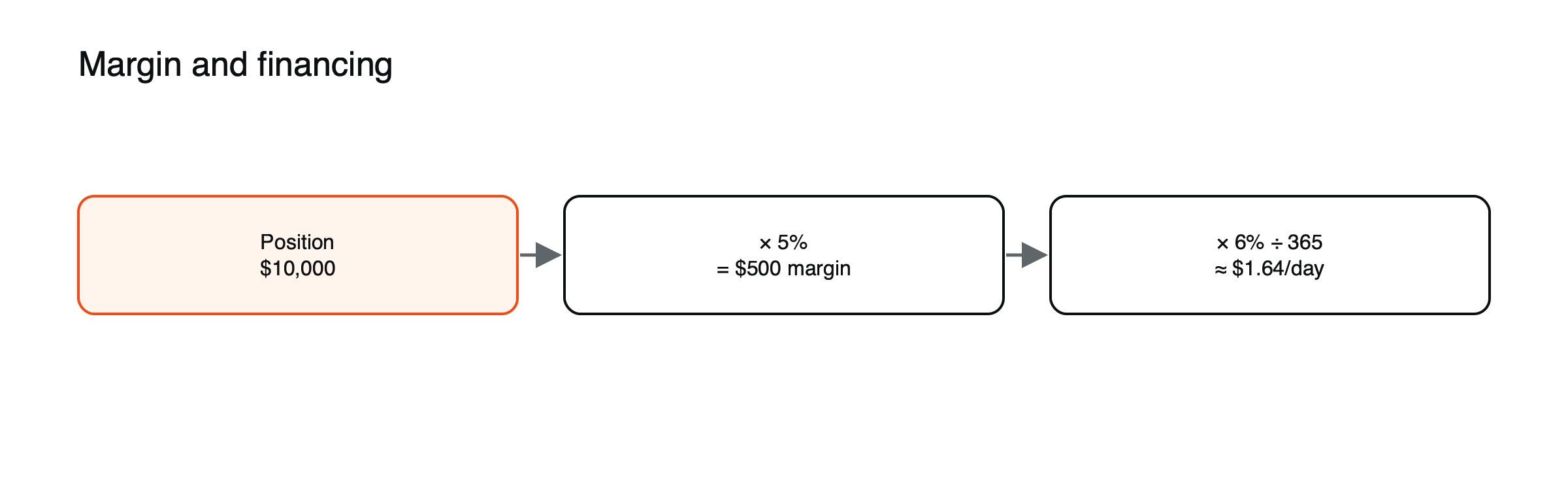
Figure: Margin and financing (placeholder rates).
Worked example: financing
- Position value $10,000; annual rate 6.8% → daily ≈ $1.86; 30 nights ≈ $56
Short positions may pay a lower rate or receive a small credit, depending on interest rates in the currencies involved. (Placeholder rates for illustration. [PFS: OTCN margin rates by instrument and account type; financing benchmark and markup; triple-swap day; Islamic or swap-free terms if any.])
Retail leverage limits
| Asset class | Maximum retail leverage (EU rules) |
|---|---|
| Major currency pairs | 30:1 |
| Other currency pairs, gold, major indices | 20:1 |
| Other commodities, other indices | 10:1 |
| Individual shares | 5:1 |
| Cryptocurrencies | 2:1 |
[PFS: leverage that applies to OTCN clients in each jurisdiction.] See what leverage is in CFD trading.
Margin level and free margin
Free margin is equity minus the margin in use; margin level is equity divided by margin used, as a percentage. With equity of $4,000 and $500 of margin used, free margin is $3,500 and the margin level is 800%. See what free margin and margin level are.
Margin calls and stop-outs
If equity falls toward the required margin, you may receive a margin call and positions can be closed at the stop-out level. Under EU retail rules, positions are closed when equity falls to half of the margin required. [PFS: OTCN margin call and stop-out levels.] See what happens in a margin call and a stop-out and what negative balance protection is.
Margin across instruments, illustrated
| Position | Position value | Leverage | Margin |
|---|---|---|---|
| 1 lot EUR/USD at 1.1000 | $110,000 | 30:1 | about $3,667 |
| US index CFD, $2 per point at 5,000 | $10,000 | 20:1 | $500 |
| 10 ounces of gold at $3,000 | $30,000 | 20:1 | $1,500 |
| 100 shares at $50 | $5,000 | 5:1 | $1,000 |
| 0.1 bitcoin at $60,000 | $6,000 | 2:1 | $3,000 |
(Illustrative prices and EU retail leverage limits.) The same account balance supports very different position sizes depending on the asset class.
How margin changes as prices move
Because margin is a percentage of position value, it changes as prices move. If the index position above rises 2% in value to $10,200, the margin required rises to about $510; if it falls, the margin falls too. Losses also reduce equity, so a falling market cuts free margin from two directions at once for a long position: the loss itself and the margin still tied up.
Hedged positions
Some providers reduce the margin required when a client holds opposite positions in the same instrument; others charge margin on both. [PFS: OTCN treatment of hedged positions.]
Financing on currency pairs, illustrated
On currency pairs, overnight financing reflects the interest rate difference between the two currencies plus the provider’s markup. If you buy a currency with higher interest rates against one with lower rates, the financing may be a small credit; selling the same pair usually costs more. Rates change when central banks move, so the same position can switch from earning to paying. See how overnight financing is calculated.
Weekend financing
Positions held over the weekend are financed for the extra days, often by charging three nights on one weekday. On the $10,000 index position at 6.8% a year, that day costs about $5.59 instead of $1.86. [PFS: OTCN weekend charging day by asset class.]
Financing by instrument type
Cash index and share CFDs usually use a benchmark interest rate plus a markup. Currency pairs use swap rates based on the two currencies’ interest rates. Futures-based commodity and index CFDs usually have no daily financing, because the cost is in the futures price and rollover adjustments. Crypto CFDs often carry a fixed annual rate set by the provider. [PFS: OTCN financing method for each asset class.]
Margin requirements can change
Providers can raise margin requirements before major events, during extreme volatility or for large positions, which reduces the leverage available and can require more funds at short notice. [PFS: OTCN policy on changing margin requirements and how clients are notified.]
Before you open a position
- What is the position value, and how much margin does it need?
- How much free margin will remain afterwards?
- How far could the price move before a margin call or stop-out?
- What will financing cost for the planned holding period, including weekends?
Margin and position sizing
The margin a position needs says how much of your balance it ties up, not how much you could lose. A sensible size starts from the amount you are willing to lose if your stop is hit, and only then checks that enough margin and free margin remain. Sizing from the maximum leverage available is one of the most common ways traders run into stop-outs. See how to size a CFD position using risk per trade.
A stop-out, illustrated
Suppose an account holds $2,000 and opens positions needing $1,000 of margin. Under a 50% close-out rule, positions are closed when equity falls to $500. That takes a loss of $1,500, three-quarters of the account, before the stop-out acts. (Illustrative figures.) Holding positions that need only a small share of the account as margin leaves far more room for normal price swings.
Financing and holding period
| Nights held | Financing on $10,000 at 6.8% a year |
|---|---|
| 1 | About $1.86 |
| 7 | About $13.04 |
| 30 | About $55.89 |
| 90 | About $167.67 |
(Illustrative rate.) Financing grows in line with the holding period, which is why it matters most for positions kept for weeks or months.
Professional clients
Clients classified as professional may be offered higher leverage and may not benefit from the same retail protections, such as negative balance protection. [PFS: whether OTCN offers professional client status and the criteria.]
Margin on share CFDs
Share CFDs require higher margin than indices or currencies, 20% under EU retail rules, because individual shares are more volatile and can gap on company news. Some providers set even higher margins for smaller or more volatile companies. [PFS: OTCN share CFD margin tiers.]
Margin on crypto CFDs
Crypto CFDs carry the highest margin of any asset class for retail clients, 50% under EU rules, because prices can move 10% or more in a day. A 25% fall in bitcoin would use up half the margin on a fully leveraged position and could trigger a close-out. Keeping spare funds in the account matters even more than for other instruments. See how margin and volatility interact on crypto CFDs.
Where financing appears
Financing charges and credits are usually listed for each position and each day in the account history and statements, separately from realized profit and loss. Reviewing them regularly shows how much holding costs are taking from results, especially on positions kept open for long periods. [PFS: where OTCN shows daily financing in the platform and statements.] See how to read your OTCN account statement.
Several positions at once
Margin for each open position is added together, so several positions can tie up much of an account even if each looks small on its own. Correlated positions, such as two US indices, can also lose money together, reducing equity while their combined margin stays in use. Checking total margin and exposure across all positions, not one at a time, gives the true picture of how close an account is to a margin call.
Where to find the numbers
Each instrument’s specification on the platform. See how to read a commodity contract specification and OTCN fees explained.
Frequently asked questions
Is margin a fee?
No. Margin is the part of your balance set aside to keep a position open. It is released when the position closes, adjusted for any profit or loss.
Why does financing apply to the full position value?
Because the provider effectively funds the whole position, not just the margin you put up.
Can financing be positive?
Yes, on some short positions and on some currency pairs, depending on interest rates.
[RISK WARNING — Open decision 2: approved CFD and leverage risk warning to be inserted here before publishing.]
Leverage, margin and cost figures in this article are example values for illustration. Actual terms depend on the provider, the instrument and the rules in your country.
This article is educational content and does not constitute financial, investment, legal or tax advice. Digital assets are volatile and you may lose the amount you invest.