
What Happened When the Swiss Franc Floor Was Removed in 2015?
In January 2015 the SNB scrapped its 1.20 EUR/CHF floor. The franc jumped about 30% in minutes, stops failed and brokers collapsed. The timeline and lessons.
The Swiss franc floor removal on January 15, 2015, was one of the most violent moves in modern currency markets. Without warning, the SNB dropped the 1.20 EUR/CHF floor it had defended for over three years. The franc rose more than 30% at one point, liquidity vanished, stops filled far away and several brokers failed.
Why the floor existed
In 2011, investors fleeing the euro area debt crisis poured money into Swiss francs, a traditional safe haven. The franc’s surge threatened Swiss exporters and pushed the economy toward deflation. On September 6, 2011, the SNB declared that it would not tolerate a EUR/CHF rate below 1.20 and would buy foreign currency in unlimited amounts to defend it.
The policy worked for years. EUR/CHF traded just above 1.20, and many traders came to treat the floor as close to a guarantee. To hold it, though, the SNB kept buying euros and other currencies, and its balance sheet swelled to about 85% of Swiss GDP.
Timeline
- September 6, 2011: the SNB sets a 1.20 minimum for EUR/CHF.
- 2011–2014: the floor holds; buying euros near 1.20 looks like a trade with little downside.
- Early January 2015: the euro weakens steadily, with the European Central Bank widely expected to start large-scale bond buying; defending the floor requires ever larger interventions.
- January 12, 2015: SNB Vice-Chairman Jean-Pierre Danthine reaffirms the bank’s commitment to the floor.
- January 15, 2015, about 10:30 a.m. Swiss time: the SNB announces it is discontinuing the floor and cutting the interest rate on sight deposits above an exemption threshold from −0.25% to −0.75%.
- Seconds later: EUR/CHF falls through 1.20; some quotes are 1,000 pips away within seconds.
- The next 45 minutes: almost no executable prices; spreads widen to thousands of pips.
- End of the day: the franc is still about 15% stronger against the euro than before the announcement.
- January 16–19: Alpari UK files for insolvency; Global Brokers NZ closes; FXCM reports client losses of more than $225 million beyond their deposits and receives a $300 million rescue loan from Leucadia.
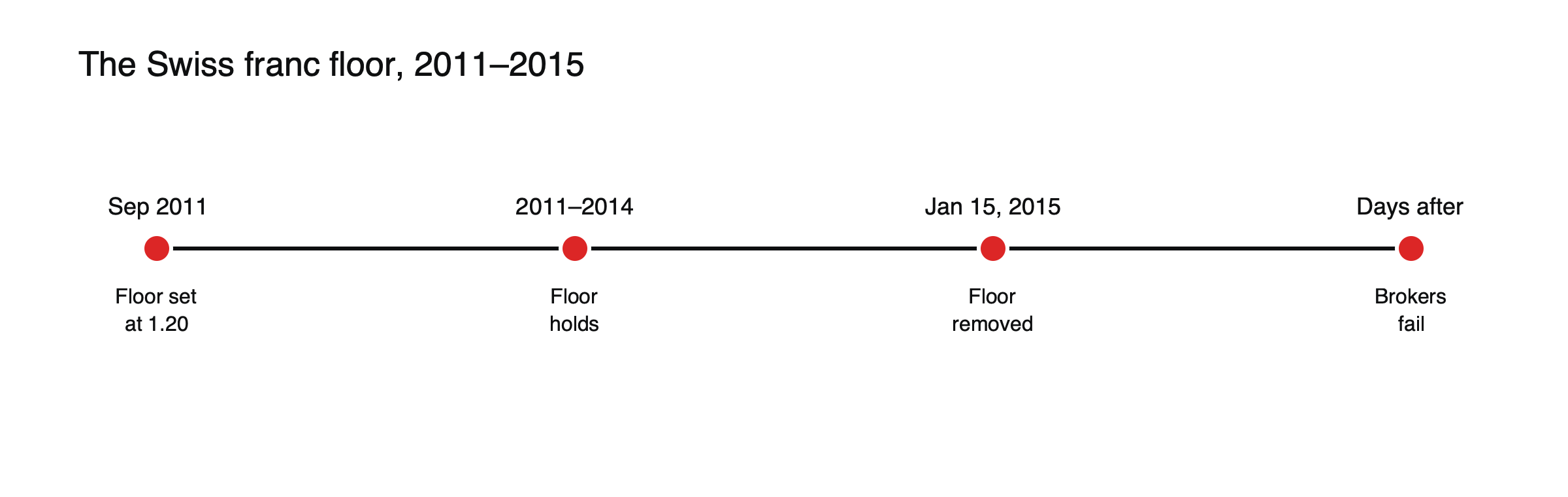
Figure: From floor to failure.
What traders saw on their screens
For most retail traders, the first sign was not the news headline but prices that stopped making sense. EUR/CHF quotes jumped from just above 1.20 to levels hundreds and then about 1,000 pips lower within seconds. Many platforms showed no tradable prices at all, and orders sat unfilled. When prices returned, stop-losses and margin close-outs executed at whatever level the market offered, often far below where traders had placed them. Some brokers later reported that client accounts had gone deeply negative before any order could be filled.
Why the SNB acted
The SNB said the floor could only have been enforced through “permanent currency interventions of rapidly increasing magnitude” as the euro weakened. With the ECB about to start quantitative easing, the bank judged that the cost of defending 1.20 was no longer justified. The surprise was deliberate in one sense: announcing an exit in advance would have invited a flood of speculative buying of francs.
Why it was so damaging
Crowded positions. Years of stability led many traders to buy EUR/CHF near the floor, often with leverage, on the assumption that the SNB would always defend it.
Leverage. Many retail accounts used leverage far above the 30:1 cap that now applies to major currency pairs in the EU. At 50:1, a 15% move against a position wipes out the margin seven and a half times over.
No liquidity. Banks and market makers stopped quoting prices. A stop-loss is an instruction to close at the next available price, and for many minutes there was none. Stops set a few pips below 1.20 filled hundreds or thousands of pips lower.
No negative balance protection. Many brokers allowed accounts to go below zero, and then asked clients to repay the deficit. Brokers that could not recover those deficits, or whose own hedges failed, became insolvent.
Who was hit
Retail traders long EUR/CHF lost far more than their deposits. Brokers that passed client orders to banks and hedged imperfectly faced losses they could not absorb. Swiss exporters saw their goods become more expensive abroad overnight, and borrowers outside Switzerland with loans in francs faced higher repayments.
There were also winners: holders of Swiss francs, and the small number of traders positioned for the floor to break.
Why some brokers failed and others survived
Brokers that took the other side of client trades, or that hedged with banks only after clients traded, faced two problems at once. Their clients’ losses exceeded their deposits, creating receivables that were hard to collect, and the banks that provided their own hedges executed at the new, much lower prices. Firms with thin capital could not absorb the gap. Others survived because their exposure to EUR/CHF was small, they had cut leverage on the pair in advance, or they decided not to pursue clients’ negative balances.
Could it happen again?
Many currencies are still pegged or tightly managed. In the same weeks of 2015, Denmark cut rates four times and spent about $15 billion defending the krone’s peg to the euro, and that peg held. A peg can last for decades, but when a central bank decides that defending it costs more than abandoning it, the adjustment usually comes as a jump, not a gradual move.
How it compares with other broken pegs
The Swiss case was unusual because the currency jumped up, not down. In most famous peg breaks, a central bank runs out of reserves defending a weak currency:
| Event | Date | What broke | Immediate move |
|---|---|---|---|
| Black Wednesday | September 16, 1992 | UK exit from the ERM after rates went from 10% to 12% and 15% | Pound fell sharply against the mark |
| Thai baht float | July 2, 1997 | Thailand abandoned its dollar peg after using most of its reserves | Baht lost about half its value over the following months |
| Swiss franc floor | January 15, 2015 | SNB stopped capping the franc | Franc rose more than 30% at one point |
In 1992 and 1997, speculators could see reserves draining and bet against the peg. In 2015, the SNB could in principle print unlimited francs, so the floor looked unbreakable, and that confidence made the surprise worse. See what happened on Black Wednesday and what caused the 1997 Asian financial crisis.
What changed
Negative balance protection became a selling point for retail brokers and, from 2018, a requirement for retail CFD clients in the EU. Leverage on currencies was capped at 30:1 for major pairs. Some brokers stopped offering currencies with pegs or floors, or raised margin on them sharply. Risk teams began treating pegged currencies as a source of sudden jump risk rather than as stable assets. See what negative balance protection is.
Lessons for traders
- Pegs and floors hide risk until they break. A price that barely moves can still carry very large jump risk.
- Stops do not guarantee prices. In a gap, a stop fills at the next available price. See how stop-loss orders work.
- Leverage turns gaps into account-ending losses. Position size, not direction, decides whether a shock is survivable.
- Central banks can change course without warning. Official reassurance days earlier did not prevent the move.
- Check your broker’s protections. Negative balance protection and segregation of client money matter most in exactly these events.
See fixed vs floating exchange rates, what a safe-haven currency is and how the forex market works.
This article is educational content and does not constitute financial, investment, legal or tax advice. Digital assets are volatile and you may lose the amount you invest.
Sources
- FXCM publishes data on the SNB event (removal of the 1.2000 floor; EUR/CHF 1,000 pips away in seconds; circuit breakers; negative balances) — Finance Magnates
- Swiss National Bank crisis (franc up almost 30%; about 45 minutes with virtually no liquidity; FXCM $300 million loan) — investingLive
- Swiss franc’s surge causes two brokerage firms to become insolvent (Alpari; Global Brokers NZ) — Fox News / AP, January 2015
- What is Black Wednesday? (rates from 10% to 12% then 15%) — FXCM
- The Asian economic crisis and the IMF (July 2, 1997; baht lost half its value) — Advisor Perspectives
- Swiss franc floor failure (floor policy; consequences) — EarnForex
- Swiss National Bank discontinues minimum exchange rate and lowers interest rate to −0.75% (SNB statement, January 15, 2015) — Mondo Visione
- SNB monetary policy after the discontinuation of the minimum exchange rate (reasons for ending the floor) — Swiss National Bank, April 2015
- Swiss franc: a look back at the end of the EUR/CHF floor (introduced September 6, 2011; removed about 10:30 a.m.; Danthine reaffirmed it on January 12) — B-Sharpe
- The Swiss National Bank’s recent currency actions (franc up more than 30%, settling about 15% higher; SNB balance sheet about 85% of GDP; Denmark cut rates four times and spent $15 billion defending its peg; Alpari insolvency January 19; FXCM shortfall over $225 million) — Congressional Research Service, February 2015